Kubatana.net ~ an online community of Zimbabwean activists

Recycling Angels

del.icio.us TRACK TOP
Thursday, December 12th, 2013 by Bev Reeler

At the Environment Africa Recycling centre by Avondale Stream
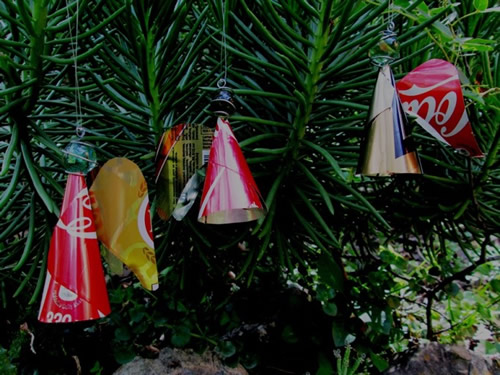
a group of men make a whimsical array of things
out of aluminium cans
everything from sheets of brightly coloured flatted cans for roofing,
to lampshades, baobabs, geckos, giraffes, spiders and Christmas trees

Zimbabweans are never short of a plan

This year Robert has been making a range of imaginative Christmas tree decorations

There is something touchingly beautiful
about his recycled angels
the curse of our consumerism
reappearing as the messengers, warriors, guardians
a re-visitation of the wise ones
kitted out in the latest colours

Robert asked me to invite you to drop by
if any of you in Harare are on a hunt for Christmas tree decorations…

Robert angel

recycled angels 2

Show us some respect, City of Harare

del.icio.us TRACK TOP
Wednesday, December 4th, 2013 by Amanda Atwood

This morning, I attended a seminar at which Zimbabwe’s Deputy Minister of Finance, Dr Samuel Undenge, said that information in the public interest should be available to the public, across every area of government.

This statement in itself is refreshing, given Zimbabwe’s tendency to make even public information inaccessible to people (take the recent examples of polling stations and local government election results). And his comments came at a discussion on ZimAsset, which explicitly lists ICT and e-Governance (including getting the Registrar General’s office online by this month!) as one of its goals.

This afternoon, my experience showed just how far Zimbabwe has to go to honour this pledge, if indeed government is sincere in offering it.

The City of Harare 2014 Budget is currently under review, and the proposed tariffs for 2014 are available for public inspection. The idea is that, since it’s residents who will have to pay the fees, residents should be able to inspect the fees before they are finalized, and also should be able to register any complaints about them. Residents have one month to do this, and this year the complaints submission phase ends at close of business on 11 December 2013. (If you’re a super keen outraged resident type, find more details about how to do this on the tariff document.)

So this afternoon, I went to my district office and asked to see the income and expenditure budget. “You want to see it here?” The receptionist asked me. Yes, I told her, and she handed me a 37 page document. She could not photocopy it for me, and I was not allowed to take it away to make a copy of it and return it. So instead, I took a picture of each page, and pasted these into a PDF document.

This is a ridiculously inefficient way to do things. The City of Harare 2014 Budget is available on their website. Why not make the tariff schedule available there too? And, what about a completely radical suggestion – Make the documents spreadsheet friendly and easily computer readable, so that people can actually analyse the data more easily, not just consume it. The way it stands, you can’t even readily tell if the tariffs they are referring to are monthly, quarterly, annual, or what.

Even more worryingly, the tariff schedule is a tiny fraction of what someone would need to know to assess concerns with the city budget. It lists what will be charged for city services – but not how many people might consume them, or how often. And it tells you nothing about expenditure. Even the budget speech, which is publicly available, is vague on detail particularly when it comes to expenditure.

When I phoned the city council to try and get more information, it was not readily available. I was referred to the health department, if I wanted more detail on the health licensing fees, and I was told to go to Cleveland House in person to ask any questions about advertising charges (the woman at Town House told me their phones don’t work). If I wanted more detail on the actual budget estimates for income and expenditure, I could come to the Chamber Secretary’s office, again in person, in the hopes that maybe they could help me.

In Section 288, the Urban Councils Act requires a city’s Finance Committee to “draw up and present for the approval of the council estimates in such detail as the council may require of the income and expenditure on revenue and capital accounts of the council for the next succeeding financial year.”

The same section also states that “Copies of the estimates approved in terms of subsection (1) shall be available for purchase by any person at such charge as may be fixed by the council: Provided that the charge fixed by the council shall not exceed such amount, if any, as may be prescribed.”

I find it hard to believe that the 2014 Budget Speech, which is available on the City of Harare website, represents the “council estimates in such detail as the council may require.” The document is readable, but it’s not detailed. Someone applying for a bank loan or developing a business plan would provide more detail on where their income would be coming from and how it would be spent.

So why does the City of Harare not treat its residents (read its revenue base) with the same respect?

Getting to Zero through art on World AIDS day

del.icio.us TRACK TOP
Monday, December 2nd, 2013 by Lenard Kamwendo

AIDS awareness in schools

Under the theme “Getting To Zero: Zero new infections. Zero deaths. Zero Discrimination” schools in Zimbabwe kicked off the World AIDS Day School Arts Festival commemorations in Harare last Friday at Allan Wilson High School.

Various schools drawn from several provinces across the nation converged in Harare to raise and strengthen HIV and AIDS awareness through debate, drama, poetry, song and dance. Art is a powerful tool to fight stigma associated with HIV and AIDS especially among children and youths. This year’s commemorations hosted by Let Them Trust saw schools battling it out for top honors in drama and poetry. Students urged society to fight AIDS through seeking early treatment, practicing safe sex, getting tested and abandoning cultural norms like spousal inheritance.

According to the National Aids Council, around 1,242,768 as people are living with HIV of which 941,0241 are AIDS orphans.

AIDS has left many children in Zimbabwe vulnerable. The effect of AIDS has resulted in many children dropping out school to become parents at a tender age. Left with no coping strategies most of these children end up on the streets begging and exposed to sexual abuse, especially young girls. The economic situation in the country has seen an increase in spousal separation as people cross borders to neighbouring countries in search for jobs. As highlighted in one of the plays, the battle to reduce the HIV prevalence rate takes the collective effort of the whole community.

Recently it was reported in the press that the HIV prevalence rate in Zimbabwe is on the up and this has been attributed to the economic challenges we are facing. In addition, the delay by men to visit health institutions, and inconsistent treatment uptake has also been one of the major setbacks in the fight against AIDS in Zimbabwe.

“100 HUNDRED” Exhibition Launch

del.icio.us TRACK TOP
Tuesday, November 26th, 2013 by Bev Clark

100

You are cordially invited to

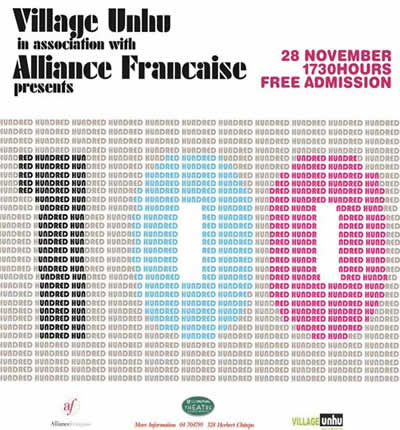
“100 HUNDRED”

Exhibition Launch

at Alliance Française

Thursday, 28 November at 5.30pm

Old Mutual Theatre at Alliance Française, 328 Herbert Chitepo Ave, Harare

Village Unhu & Alliance francaise are again pleased to present another exhibition titled ’100 hundred’ of paintings, graphics and multi media sculptures.

’100 Hundred’ simply meaning ten times ten, for the exhibition simply meaning a hundred works for a hundred each.

We are glad to feature works by, to only mention a few, Gareth Nyandoro, Wallen Mapondera, Shannon Murphy, Thandazani Dhlakama, James Jali, Moffat Takadiwa, Mattheus Nyaungwa, Misheck Masamvu and many others.

Desperately seeking Harare Water solutions

del.icio.us TRACK TOP
Tuesday, November 26th, 2013 by Amanda Atwood

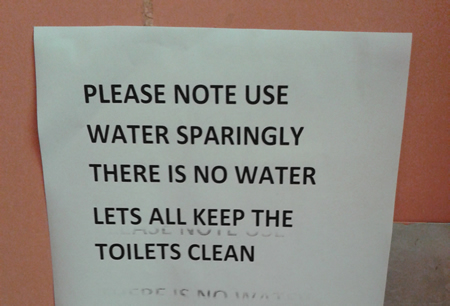
no_water_toilets_131126

In the office block where we work, there are about 30 offices, each with maybe 4 employees. So that’s about 120 workers, plus their various visitors, clients and passers through at the café and hair salon downstairs.

For the past ten days, there has not been municipal water. The borehole which the owners sunk for the building last year is dry. For a few days, the pump to the water tanks was broken. The building manager ordered a water delivery which lasted for about three days. Meanwhile, he’s struggling to get another delivery, and the water companies he phones tells him there is a backlog. No one has municipal water, and everyone is trying to order some.

Where does the bulk water we order come from? Some comes from legitimate sources, but some is pumped out of residential boreholes and city water recharge sources, further compromising the city’s water supply.

Like the recent Human Rights Watch video and report say – Never mind the quality of Harare’s water, even the supply is in crisis. Signs like this one at the toilet in our office block are the order of the day. We know there isn’t any water. We know to use it sparingly. But what we don’t know is when that’s going to change, and how.

Consultative meeting on Marlborough Wetland

del.icio.us TRACK TOP
Saturday, November 23rd, 2013 by Amanda Atwood

Notice from the Environmental Management Agency (EMA)

Dear All

The Environmental Management Agency (EMA) invited Marlborough Residents and all Stakeholders to a consultative meeting on Local Environmental Planning (LEAP) for the restoration and conservation of Marlborough Vlei.

Marlborough Vlei is a Protected Wetland which provies many wetland and water provisioning services and functions to the people of Harare. The meeting seeks to raise awareness on the importance and value of wetlands. Together residents and local authorities, as well as all stakeholders, have an opportunity to decide the best way forward for the restoration and conservation of Marlborough Vlei.

Place: Marlborough Vlei, Newstead Road, Marlborough
Time: 8am – 1pm
Date: Saturday 23 November 2013

For further information please contact
EMA: 0773 609289 or 0773 404779
Marlborough District Office: 0774325882
Email: ema@ema.co.zw