Kubatana.net ~ an online community of Zimbabwean activists

Archive for the 'transitional justice' Category

Similarities between Kenya and Zimbabwe are just too many to be ignored

del.icio.us TRACK TOP
Tuesday, February 12th, 2013 by Lenard Kamwendo

Lessons and challenges from the coalition government of Zimbabwe and Kenya brought together civil society representatives from the two nations under the weeklong Utetezi exchange visit in Zimbabwe. Kenya’s civil society members are in Zimbabwe to share experiences particularly in areas of national healing and reconciliation, governments of national unity and the constitution making process. The similarities between the two nations are just too many to ignore as the social, political and economic challenges experienced by both nations depict a similar picture. The two nations were once colonised by Britain and they both inherited badly written constitutions, which failed to address marginalization and injustices perpetrated during the pre and post-colonial era. The failed promises of independence saw further marginalisation of people and alienation of fertile land as the political elite amended and manipulated the constitution for personal gain.

Political power is now being used as a gateway to riches as the majority continue to wallow in poverty.

One can easily describe these coalition governments currently running both nations as initiatives brought about not out of good faith, but out of frustration. Zimbabwe, just like Kenya shares the same history of rejected constitutions. In  2000 Zimbabwe passed a “NO” vote over a constitution, which they regarded as not people driven and the same happened in Kenya in 2005 when President Mwai Kibaki tried to fast track a constitution, which had no input from the people. The same debatable issue around executive powers of the president, land, devolution of power, accountability, the re-structuring of the political system, the rule of law characterise the constitution making history of the two nations.

The exchange visit also focused on the role of civil society in shaping political discourse. The recent crack down of dissenting voices in Zimbabwe, particularly the politicisation of the work of civil society indicates the growing concern over the urgent need for reforms. Zimbabwe’s civil society was urged not to lie dormant but take its rightful place in society.

The journey to national healing and reconciliation resulted in the formation of the Organ on National Healing in Zimbabwe and the adoption of the Human Rights Commission, which recently came under fire for lack of independence and capacity. One speaker said that “change is not an activity but a process”, the current transitional period, which Zimbabwe is currently going through, could be compared to the situation where Kenya was ten to fifteen years ago. A constitution can remain a piece of paper unless it is put to use to solve the social, political and economic problems facing the nation. And if the nation is to progress political leaders need to drop self-aspirations and question the status quo.

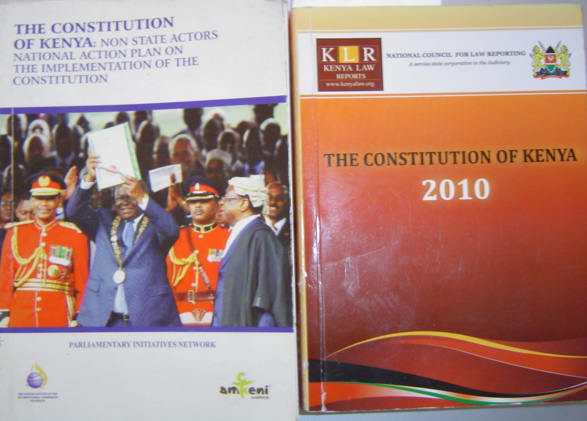
Kenya constitution

Pocket sized printed versions of the Constitution are distributed in Kenya.


Growing Roots

del.icio.us TRACK TOP
Tuesday, December 4th, 2012 by Bev Reeler

The Tree of Life had its last partners meeting of 2012
Representatives came from each of our 15 different community partners
from neighboring Chisawasha and Chitungweza, and as far as Buhera, Murehwa and Motoko
over 60 old friends meeting from across the country after a years of dedicated work
gay colours and gay voices echo through the trees

Over this last year, three of these rural communities are now established as locally approved and licensed organizations
five more are in the process of setting theirs up
the others are still doing facilitator training and getting organized for next year

the roots are in the ground

rural workshops have taken place in communities in widening circles
run on a minimal budget (transport and food and cell phone air time)
and are being welcomed by the local authorities across political divide.
they have included teachers and headmen and war veterans and rape victims
and perpetrators and pastors and counselors  and grandmothers and children
we have trained 50 new facilitators
there have been football matches between communities
and monthly circles
and facilitators sharing responsibility for running healing circles between communities

The work of connecting to all the structures, to individuals in different communities and maintaining the circles has been unending

This year the Tree of Life facilitators – the core team and a number of our community facilitators
conducted a research study lead by CVT (the Centre for Victims of Torture)
with 144 participants in rural communities  (some a 14 km walk from the bus stop)
we compared our workshop with an alternative (Psychology Education) intervention and a group with no intervention
double blind/pre and post interviews/ 2months and 5 months follow ups etc.etc.
The results are amazing

They show beyond any doubt
that Zimbabweans (even as the conflict continues) have the ability to heal themselves
that survivor-to-victim facilitation in community circles carries incredible power
that communities have the ability to transform
that connections can be made across the country and the political divide

The power of this realization is immense . . .

from those early seeds sewn in those first circles over 8 years ago
we find ourselves standing in a growing forest

Over these years – as we have struggled with funding
small groups of people across the planet have sent us life-saving pocket money
we call it ‘Love Money’ and keep it in the Circle Fund
it has been these acts of trust and generosity from these small groups that has kept these rural people going

It is now Christmas

We received a donation from our friends at WHEAT in Canada which arrived just before our closing circle
and with it we were able to answer a call we have had from a number of our rural partners
– a bike to reach one another in the communities!
So we handed out ‘the-price-of-a-bike’ Christmas tokens (about $70) to each of our Tree of Life partners
for them to choose how it can best be spent in their area
and acknowledged them all for the contribution they have given to the healing and holding of their communities

It has been a good, hard, real year
thank you all

Women and the constitution making process

del.icio.us TRACK TOP
Monday, May 21st, 2012 by Elizabeth Nyamuda

It is sad to be reminded that negotiations for the Zimbabwe Independence Constitution held in 1979 at the Lancaster House in London were made without the inclusion of women. According to one woman activist the only female present had gone solely for the upkeep of the men, like to make sure they were fed on time. Various movements and efforts by government and civil society have brought about a change in the order of this. One body that has greatly worked for the inclusion of women participation in constitution making matters is the Women’s Coalition of Zimbabwe. They have worked to ensure women’s rights are met and have took a step further to advocate for women’s inclusion in governance.

The WCoZ according to their website is described as, “A network of women rights activists and women’s organizations with national structures. The WCoZ is a forum where women meet to engage in collective activism on issues affecting women and girls in Zimbabwe. Its central role is to provide a focal point for activism on women and girl’s rights”. Among the commendable work they have done is to fight for the increase in participation of women in the constitution making processes in Zimbabwe.

The Inclusive Government, which agreed to pen a new constitution before electing a new president, saw the formation of COPAC, which is co-chaired by three representatives from the three parties that are signatories to the Government of National Unity. Speaking at a FFT session at the US Embassy Public Affairs Section Netsai Mushonga, a representative of WCoZ, gave an analysis of the organisation’s work in pushing for the inclusion of women in both the constitution making process and in the constitution itself. One of COPAC’s steps in the constitution making process was that of getting information of what Zimbabweans need included in the constitution. They created outreach teams but men outnumbered women in these teams. This led to a petition being made by the women’s movement for the engagement of more women in the outreach teams and the figures rose from 10% to 25%. They went on further to advocate for women engagement in the Thematic Committees and managed to get 37% representation of women.

Moving to the constitution itself, the WCoZ clearly spells out its demands for women in the constitution and they list five minimum demands on their site which include: the quota system for women’s political participation; socio-economic rights; non-discrimination (all forms of disability); customary law subject to the Bill of Rights; and access to and control of resources. Netsai Mushonga indicated that the current draft constitution by COPAC had met at least 80% of their needs. She said the forum had vowed to continue advocating for the remaining 20% to ensure full achievement of women’s rights in the constitution. Their decision to vote for or against the constitution will only be made when they have the constitution in their hands. She likened the constitution-making process to a train that moves from New Delhi to Bombay in India, which is overloaded with people entering through the windows, but still makes it to its final destination. Likewise, the constitution making process might not be the best ride in town but one day it will reach its final destination.

Get involved – Report violence

del.icio.us TRACK TOP
Monday, February 20th, 2012 by Amanda Atwood

The Zimbabwe Justice Project calls for people across the country to take action to stop the violence and to stand up for their rights. The first step is to report all the people who have committed acts of violence and to ensure that they are held accountable. Victims of violence are asked to fill in “Stop the Violence” forms, which can be downloaded here

Can an African make it in Hollywood or on Broadway?

del.icio.us TRACK TOP
Wednesday, November 2nd, 2011 by Varaidzo Tagwireyi

American-born, Zimbabwean actress Danai Gurira, who is conquering Hollywood and Broadway, gave a talk recently about her trajectory in the industry, her artistic principles and work ethic, how she envisions her work will shape the artistic landscape for future generations, her thoughts on the future of the Arts Industry in Zimbabwe.

Danai explained how she got into acting and writing by saying that the arts found her. While in high school she realised that when she performed, something special happened between her and an audience and she felt she would lose all sense of time and place. Encouraged by her parents to pursue what she was good at, she continued her studies in the arts, after having initially studied psychology and liberal arts. Danai started to create pieces in response to the fact that she was not finding portrayals of Africans that she wanted to play. Actors tend to be at the bottom of the food chain in the American industry, but with good training during her 2nd degree, she learnt how to create her own work and not just sit and wait by the phone. This is how her world-famous play In the Continuum was born. She was encouraged to discover that she could create things in America, about Zimbabweans, and the people in both places (and in-between) would get it. It was also quite clear that Gurira appreciates and revels in the fact that her debut performance on the world stage, was of her own work, in her own voice.

While so many of us associate the film industry with glitz, glamour and money, one quickly realises that Gurira is all about the craft and creating the best artistic products she can. From early on she has been driven by her desire to create things that are connected to what is important to her, what she is trying to give the world and what she visualises about her future artistic interests. This focused attitude has led her to be quite picky about what she gives her energy to by finding out what the spirit of the work is and if it is really giving life and a different dimension and complexity to a story.

When Gurira comes home, she holds workshops in order to transfer all that she has learnt from her time in the US. She strives to help young Zimbabwean actors know the level of work-ethic, ferocity, and energy required to succeed in the competitive industry and make people feel they have no choice but to hire you. One also has to develop a thick skin as only 2-5% of your auditions may lead to work.

Though Danai felt that it would be quite tricky to say how our country should develop the industry, which is currently not so strong, she believes that we should try to nurture standards of excellence that are specific to who we are, as a nation. Though it is tempting to follow the footsteps of African countries like Nigeria, which has a thriving film industry, she feels it would be unwise to use another country’s template. There is a need for Zimbabwean artists to continuously challenge themselves, to remain sharp in artistry, and always in pursuit of excellence. Gurira insists that excellence in the quality of work we produce, will ensure that we begin to produce work that is on a globally recognisable level, not because it caters to western ideologies or structures, but because no one can deny or ignore it’s superior quality, as artistic excellence is not bound by language and culture.

In order to achieve this Gurira says Zimbabwean artists have to be innovative and pioneering in contributing to the work that will build the industry, all the while, having in the back of their minds, a clear vision about the future artistic landscape of Zimbabwe. It is about thinking far ahead and beyond ourselves, and creating something that is so excellently executed, that it will stand the test of time, so that if someone picked it up decades from now, it will still be a brilliant piece of Zimbabwean literature, (Harvest of Thorns). When asked what she wanted her legacy to be, Danai Gurira said, “I want people to pick up my work in 100 years and be able to do it – [so that] men and women have opportunities to really shine, in African roles.”

Transitional Justice in Zimbabwe

del.icio.us TRACK TOP
Thursday, October 13th, 2011 by Varaidzo Tagwireyi

The USA Embassy played host to a very lively discussion on Transitional Justice in Zimbabwe, based upon a national survey report compiled by the Zimbabwe Human Rights NGO Forum. Shastry Njeru, Manager of the Transitional Justice Section in this organization, presented the findings of the report. This presentation was facilitated by Leon Hartwell, a South African academic, passionate about African politics.

Transitional justice refers to legal or non-legal processes in which past violations are systematically addressed. It is a deliberate process of addressing the wrongs of the past.  Though used synonymously with ‘national healing’, the term refers to a more definitive process, focusing more on righting past wrongs than on just forgiveness and getting over the past.

Njeru reiterated the need for the process to begin, expressing hope that the Organ on National Healing, Reconciliation and Integration, would come up with policy framework for management of a National Healing Process soon. Njeru believes Zimbabwe needs transitional justice because it has gone through several violent processes, namely,

Colonization
Liberation struggle
Post-independence disturbances & atrocities (Matabeleland & Midlands)
Other processes after the Unity Accord
Land reform
Murambatsvina
2008 elections

He feels that the ideal transitional justice model for Zimbabwe will draw from both western and traditional models, striking a context-driven balance, in order to achieve results that are legitimate to the citizens of this country

Njeru outlined countrywide outreach efforts of the Human Rights NGO Forum, from 2009 to date, including the Taking Transitional Justice to the People project, focused on seeking opinions of Zimbabweans and clearly showed that most Zimbabweans want restorative as opposed to retributive (revenge) resolutions. The Transitional Justice, National Survey continued on from this, and with the use of scientific research and selection tools 3189 randomly selected people were interviewed on what they thought was important for transitional justice.

Their findings

49% – effective healing can be achieved through compensation.
13% – perpetrators need to openly ask forgiveness.

Who’s responsible for compensation?
24% – individual perpetrators
(The majority of which have nothing themselves)
55% – Government
(Which essentially means the people of Zimbabwe, through taxes)

Who leads process?
60% – churches & government.
(But, which church(s)?

Organ on National Healing, Reconciliation and Integration the second, least-trusted to lead process.
(Due to lack of awareness?)

Which periods addressed?

41% – from 2000 onward.
18% – from just after Independence onward.
14% – from the Liberation Struggle onward.
1821
Below 45% – indifferent to questions.
(Due to fear and lack of awareness).

Recommendations for the way forward

Encourage awareness and further discourse through outreach programmes.
Use more victim-centered approaches in further programmes.
Organ on National Healing, Reconciliation and Integration needs to spread awareness and encourage discussions.

He concluded by saying that Zimbabweans would have to do the work by demanding more on the part of government, civil society and communities, to engage in the issue, and that if past issues are not addressed now, it will become more costly in the future.

Leon Hartwell’s comments

“A lot of people assume… that democratic elections in Zimbabwe will solve your problems… I don’t think that will happen. Looking at the past, if we don’t [properly] deal with transitional justice, violence will happen again.”

Hartwell believes that despite the nature and results of upcoming elections, unless something concrete happens, transitional justice will become meaningless and that Zimbabwe can no longer drag out the issue.

He naturally, drew parallels to South Africa’s TRC process, asking if it might be one way Zimbabwe can approach transitional justice. Although he stated that the TRC helped to bridge the transition process in SA, with over 21,000 people breaking the silence on apartheid, he admitted to its eventual failure. He said, even though it “did not get the complete truth…it [the process] gave a more complete picture of the truth”. South Africa still has a long way to go, and Hartwell said that the country has much to learn from Zimbabwe, and that his country is having discussions now, that Zimbabwe had in the 90s.  He concluded by that the process will meet with resistance and it is important for civil society to keep the debate alive, in spite of it.