Kubatana.net ~ an online community of Zimbabwean activists

No water, no electricity for Chitungwiza

del.icio.us TRACK TOP
Monday, September 5th, 2011 by Lenard Kamwendo

People queuing for water, and carts carrying firewood, are now an everyday sight in the town of Chitungwiza. Chitungwiza gets the bulk of its water supply from the City of Harare but with the recent erratic water supply experienced by the capital city, a negative and severe impact can now be felt by the residents of Chitungwiza. Clean water, which is a basic necessity for everyone, is now a luxury for some residents. People have had to resort to digging shallow wells after going for weeks, if not months, without running water.  Residents now fear that the cholera pandemic, which caused havoc in 2008, is set to come back if the city fathers of Chitungwiza take their time getting their act together to resolve their differences with the City of Harare. To ease the burden a bit, UNICEF in conjunction with some NGOs, managed to drill a few boreholes in the town but since the demand for water has risen sharply, only a few can access clean water from the water-points.

To make matters worse, the pathetic electricity supply from Zimbabwe Electricity Supply Authority has created a scenario, which leaves one wondering if Chitungwiza is a town or rural area. Residents now resort to using firewood. Others, who can afford it, use gas or paraffin. Customer satisfaction from ZESA is now a thing of the past as residents only get electricity supply during the night or for less than 8 hours per day. No explanation or apologies for the inconvenience caused is given and the only thank you residents get is disconnection for non-payment and tariff hikes. During the Zim dollar era Chitungwiza Town Council and ZESA used to hide behind the forex shortage to cover up for their service delivery shortcomings. However now that forex is in abundance, clear signs of incompetence and poor administration are evident.

What you see sure ain’t always what you get!

del.icio.us TRACK TOP
Monday, August 29th, 2011 by Marko Phiri

So, the Libyan ambassador Taher Elmagrahi got himself into trouble for hoisting the “rebel flag” in Harare.

You just have to ask yourself when he actually had the flag in his possession for him to raise it as soon as word got out Gaddafi literally had one foot in the grave. Could be Libya’s point man in Harare always was a sympathiser and was waiting for that aha! moment. And of course all that claim about “following the people’s will” is just but a ruse veiled as diplomatic-speak, meaning he could have defected long ago had he the gall to dare Mugabe, a known long-time ally of the Libyan strongman! After all, we have just been told our own Sylvester Nguni made generous donations to his employer’s political opponents, meaning he could well just be waiting for his own aha moment and then he like Pilate will wash his hands of his allegiance to the regime and claim he is “following the will of the people of Zimbabwe” when the moment arrives. But then why not?

Who then can you trust in this wily game of politics? It’s great though when folks show their true colours, or in the case of Nguni, when their true colours are exposed in a court of law of all places! From the terraces, we damn sure are loving it.

Sex for education

del.icio.us TRACK TOP
Thursday, August 25th, 2011 by Upenyu Makoni-Muchemwa

We held a discussion group this morning with a vibrant and energetic group of students from several tertiary institutions across the country including the University of Zimbabwe, Harare Polytechnic, Africa University and Harare Institute of Technology. In some respects things haven’t changed much since I was a student; they worry about the same things I did then. But while getting a degree and wondering if it will be good enough to guarantee a (high-paying) job is an obvious and universal concern, I think our tertiary institutions are letting their students down by not addressing the social issues that affect them.

Sexual harassment of women students by men in general seems to be one of the biggest problems. In the period when the UZs halls of residence were closed, numerous students had to find alternative accommodation close to the university. One student reported cases of women students staying with gardeners in Mount Pleasant. In addition to paying rent, the women students would also have to give them sexual favours.

Women students are also exploited by their lecturers, and what concerns me most is that the students themselves were unable to even imagine a possible solution for addressing this. The newer institutions like Africa University seem to have the correct structures in place for reporting and investigation, while the older ones like Harare Polytechnic and the University of Zimbabwe simply discourage it by not having or not informing students of the channels in place for bringing up this issue with administrative or faculty staff. Alarmingly, all our women participants reported a lack of faith in any attempt to seek redress by reporting to school authorities. In one story a student reported harassment to a departmental head, who was a woman, but nothing was done to help the distressed student or investigate her claims.

When asked to estimate how many women students got their degrees because they had sexual relationships with lecturers, the average was 80%. The general consensus was that while this relationship was not desired at all by the student, it was in the student’s best interests to endure and make the best of it. One woman student who attends the University of Zimbabwe said: ‘We know that as girls we just have to accept some of these things. If she reports him [for harassment] he will fail her and stop her from getting her degree by talking to all his friends in the faculty.’

Zimbabwe boasts thirty-one government funded universities and colleges whose purpose is to be bastions of knowledge and enlightenment. Instead they have become a playground for the sexual exploitation of women, where every man with so much as a modicum of power seeks to manipulate his way in to gaining sexual favours. Equally culpable are lecturers, department heads and faculty staff; men and women who are aware of this situation but for whatever reason choose to do nothing. It is not enough to protect your own daughter, every woman is someone’s daughter, and every woman has the right to gain an education without harassment. Shame on you!

I’m losing my mind

del.icio.us TRACK TOP
Thursday, August 25th, 2011 by Varaidzo Tagwireyi

Everyday I have a fight. Everyday I exchange words with some man. Not my own man, just some random guy I won’t remember seeing soon after I’ve finished biting his head off. It’s not my fault though they make me do it. They enrage me! In fact they enrage the entire city.

I’m talking of course about combi drivers and/or hwindis. These men have us up in arms over a few small pieces of silver. Fighting our way to and from home, EVERYDAY! They almost always act surprised when you ask them for your change. Before you get into a combi, they treat you so well; asking you if you want to go where they are going, and even helping you carry any luggage you might have. But once you’re in, they reveal their true selves, demanding payment for the trip, with change of course, even before you’ve safely taken a “seat”.

All combi users dread/loath the days when they have no coins or tickets for the journey ahead, because we all know that we will most likely  have to put up a fight for change. Often passengers are given their change, combined with someone else’s (dollar for 2 or kuchatiswa) and left to somehow split this money on their own.

We are faced with such tremendous inconveniences for what should be a purely mundane activity – taking the bus. As passengers, we have had to sometimes become excessively aggressive, even towards each other, in order to walk out of combis with change that rightfully belongs to us. In many instances, these daily battles are fruitless, leaving us frustrated.

I have now taken to praying for peaceful and uneventful trips, because I know that with my terribly short temper, I will NEVER hesitate to lock horns with any hwindi. My anger in these situations usually overrides logic, reason, fear and especially my better judgement. I don’t suffer fools easily, and why should anyone, for that matter.

I thought that the purpose of a hwindi is to collect money from passengers and then sort out the change. Now, if we have to sort out our own change, what then is the point of having a hwindi who takes up valuable space in the combis, adding to our discomfort? I hear that combi drivers in South Africa go it alone. There is no such thing as a hwindi there. Lucky them!

Something needs to be done about this change issue! Below is my personal (and I’m sure, shared) plea to hwindis, combi drivers and owners alike, all over Harare:

Dear combi-people

I’m sure that by now you are aware of the change problem in your industry. What are you doing in order to alleviate some of the stress this is causing us, your ‘valued’ customers, and even yourselves? Aren’t you tired of fighting with us all day, everyday, about the same thing? It’s now time for you all to put your hands together and come up with a convenient and lasting solution to this madness.

I would like to commend the owners and operators for Westgate, Ashdown Park, Mabelreign etc. for managing to organize an official, nearly trouble-free ticketing system for their routes. Why don’t the rest of you follow their example? In fact, why is there not an official, cashable (possibly pre-paid), acceptable ticket for the whole of Harare? Surely that is possible?

Yours truly,
Enraged Passenger

Ideas sharing platform launched in Zimbabwe

del.icio.us TRACK TOP
Monday, August 22nd, 2011 by Lenard Kamwendo

The first edition of Tedx was launched in Harare under the name Tedx Harare. This independently organised event was packed with interesting speakers, music performances and Tedtalk videos. The idea of TED started 25 years ago in USA to create spaces for idea sharing and discussions. And finally it has now reached Zimbabwe.

The speakers included some of Zimbabwe’s researchers, entrepreneurs and artists and they all lived up to expectations with inspirational and stimulating performances and presentations. The presentations created an environment where everything was just free from any political and religious agenda. Zimbabwe is awash with so much talent that it begs the question how and where we are getting it wrong as a country. Among the most inspirational presentations was the one done by researcher and academic Oswald Jumira. Oswald explored and shared ideas on how we can make technology work for the next generation and us. He talked on how technology creates challenges, which can be turned into opportunities and make our country move forward and compete in the global village. In the presentation he emphasized the need for government, companies and individuals to invest in technology since it strengthens the future of the next generation.

In one of the Tedtalk videos, Chimamanda Adichie explores the Danger of a Single Story. This Tedtalk got me thinking especially on the way news is reported in Zimbabwe by different newspapers and organisations in mainstream media. A good example of the danger of a single story is how election campaigning in Zimbabwe has caused a lot of stereotyping among citizens. One lesson to learn from this presentation is not to make early judgements on a particular situation or story and not to work on assumptions. This was a wonderful way of educating people about the single story perspective.

Live music performances during the breaks from Tina Watyoka added more life to the event. The other presenters who left the audiences with questions and inspirational answers included Max Soutter and Sarah Norman.

The next edition Tedx Harare is expected to be bigger with more speakers coming to share their ideas and innovative skills with the people of Zimbabwe.

Recycling in Zimbabwe

del.icio.us TRACK TOP
Thursday, August 4th, 2011 by Elizabeth Nyamuda

It is so easy for one to throw litter on the streets without caring about who then picks it up. Some of this litter finds its way into the city’s water sources, which in turn means that the City Council has to fork out millions to purify the water. Failure to do so then means residents will receive a short supply of this precious resource. The possibility of it being contaminated and dirty cannot be ruled out.

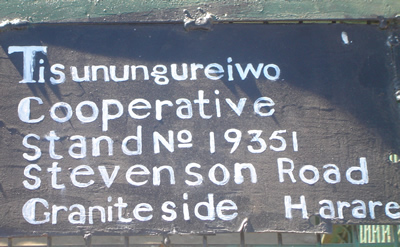
Tisunungureiwo Cooperative is a community-based organisation that recycles waste material. The cooperative collects the rubbish from unemployed people who move around the city of Harare.

It is the Cooperative’s dream to build solid infrastructure at their complex and also be able to do the recycling themselves. For example, melting plastic bottles or grinding metal objects. They also wish to have a supply of electricity and water, both of which they currently don’t have. Some members of the group have received training in waste management but they also wish to further their knowledge and the skills of all their members.

These photographs show the work of Tisunungureiwo Cooperative. This is a way they earn their living by being responsible citizens.