Kubatana.net ~ an online community of Zimbabwean activists

When the bus dies

del.icio.us TRACK TOP
Monday, August 1st, 2011 by Bev Clark

With yet another horrific Zimbabwean traffic accident, Chris Kabwato’s most recent piece carries extra weight. Make yourself a cup of coffee and read his fine writing:

AS ONE drives on our country’s highways (highway here being a polite term for those dangerous pot-holed paths that connect our cities) there is one thing that one gets used to: the sight of a broken down bus. As one who literally grew up plying the Mutare-Harare route on a Tenda or Kukura Kurerwa bus, I know the pain and despair when the bus gives up the ghost. But it seems to be happening just too often nowadays.

In 1992, because of my mad love for soccer, I used to take the first bus out on a Sunday morning and do the 265km journey to Harare to watch Reinhard Fabisch’s Warriors slaughteringTruck/bus other national teams. At one time the bus of choice for us was called “Scud Mabasa” and it was driven by an equally crazy man who wore a permanent huge grin which pretty much resembled the front grill of his blue and white machine. Serious.

Immediately after the game it was a mad rush to Msasa to try to catch the last Tenda bus. If you missed that then it was the gonyeti ­– long-distance trucks. Believe me these were a nightmare in themselves – the drivers were always garrulous, slow and overly keen on stopping and piling more passengers into that small cabin. One time I jumped onto a gonyeti driven by a man who had a severe tummy problem. I will spare you the details but you can imagine how many times we had to stop and the driver would rush into the nearby bush…

Now where am I going with this road tale? Each week we are buffeted by events that bring contradictory emotions in us – the economy is re-bounding we are told and at the same time some people behave like Nazi blackshirts and storm parliament. The result can be that feeling of uncertainty that comes whenever you jump on any of our “chicken” buses.

To get a perspective on uncertainties our country throws at us, let’s go on a journey on the Pungwe Star bus from Mabiya to Chigodora. You board the bus – not because that is the one you really want – but the touts at the terminus do not give you a choice. They seize your bag and the next thing your Monarch suitcase is on the roof being bundled with other luggage. For that involuntary service the “hwindi” will demand a tip or else… Ask yourself if this is too different from being frog-marched to an election booth and being told where to place your “X”.

Once on the bus you will discover that the bus is like a mini-country – there are all sorts of people there – women, men, children…But like in the real world you will be forced to cohabit with strange characters – the young boy who opens his “skaf-tin” to take out two boiled eggs and salt wrapped in khaki paper. The woman who buys mealie cobs, misses the window as she tries to throws the sheaves and messes up your Michael Jackson red and black leather jacket. The drunkard who piles in sorghum beer, washes it down with some lagers and forgets there is no loo on the bus (he will later shout himself hoarse for “Recess, driver!”)

The bus conductor is a greasy character that all passengers are in awe of (very much a mini-Joseph Chinotimba or Jabulani Sibanda). He has not given anyone their change – he has written what’s due to you on your ticket and he will sort out the change when he feels like. Should you complain rather loudly he threatens to stop the bus and chuck you out – right there in the middle of the msasa bush.

There will be roadblocks – countless stops by officers asking for the same things over and over again. For the bus crew roadblocks are like toll-gates…

The inevitable tyre puncture happens (could this be the equivalent of inflation?) It is discovered that the spare tyre has no pressure and also it is a “snake” (it is worn out). Worse still, the hydraulic jack is missing. The wait begins. The povo does not have a clue if a spare bus will be sent. No one knows if the driver has called for help after all he had said his cellphone had no airtime… Just like a country there is no plan B.

All that people can say on their phones to anxious relatives is the dramatic – “Bhazi rafa” (literally, the bus has died). When the bus dies no one gets a refund. It’s like contributing to a public housing fund and the next thing you know some clever folk have swindled you of your money and built themselves mansions.

But it could be worse – an accident could happen. At one time we seemed to be on a mission to kill our farmers – think Dande Bus Disaster 1982 (61 farmers killed), Chivake Bus Disaster 1989 (78 farmers perished) and we had to add schoolchildren too with 80 killed in the 1991 Nyanga Bus Disaster (the overall total was 87).

Can we safely declare 2008 to be our worst year in living memory –the year of when the locust ate the economy and politics contrived to deny the will of the people? Was this our Nyanga Bus Disaster?

Or maybe we avoided a total disaster but we have the unique arrangement of three drivers who constantly argue about who should be at the wheel and where the bus should be going? The third driver is content to be just called a driver.

In any case the Zimbabwe bus is heading towards an uncertain destination. Maybe one day the passengers shall take matters into their own hands and demand to be delivered home – safe and kenge? For now the bus croaks on…
Poetry and Rock

del.icio.us TRACK TOP
Thursday, July 28th, 2011 by Bev Clark

Poetry & Rock

Date & Time: Saturday, July 30 from 5:00pm – 8:00pm
Location: Mannenberg, Harare

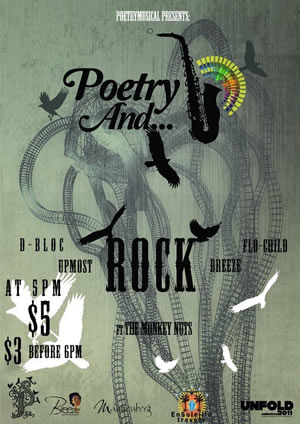
Poetry And…Rock a continuation of the Poetry And Events. Poetry And…Rock will feature Poets and will be accompanied with live music. This is an event that wants to establish commercial poetry. We want to blast poetry into your minds with some rock and roll and the cast is the same but some surprises are in store with the presentation. A battle between POETS and some HARD ROCK MUSIC. Featuring a hot, up and coming band, THE MONKEY NUTS! The war has been waged, now let’s get ready for some rock and roll.

See you there!

Marriage and its implications on inheritance

del.icio.us TRACK TOP
Thursday, July 28th, 2011 by Bev Clark

WLSA has been in existence for the past 24 years. We have handled and continue handling many cases on inheritance. We have also noted an increase in inheritance disputes due to the increase in deaths brought about by HIV/Aids. The case below is one of the thousands of cases that we have dealt with. It illustrates the complexities in our lives especially in relation to marriages.

B (male) paid lobola for A in 1960 under an unregistered customary law union. The union was blessed with five children, three girls and two boys. B acquired a stand in the High density area of Glen View in Harare in 1981. A was a hard working woman and spent time in the rural areas, farming and selling the produce. She also went to neighbouring countries to purchase goods for re-sale. Most of the money generated by A was used to purchase building materials and develop the residential stand in Glen View until it became a complete nine roomed house. A’s desire was to wed in church with B but the latter adamantly refused. In 2001, B met a woman C and started an affair with her. In 2002 B paid lobola for C. She constantly nagged B for a wedding until B gave in. In the same year, B advised A that she should stay permanently in the rural home in Wedza. In 2003, B and C unknown to A “married” at the Magistrate Court in terms of Chapter 5:11 marriage. A only learnt with shock the existence of the marriage on the 1st of June 2007 when B passed away.

Legally, an unregistered customary law union or a registered customary law marriage cannot exist side by side with a monogamous Chapter 5:11 marriage. From research conducted by WLSA, the situation enunciated above is not uncommon. As a result of intense advocacy, the Administration of Estates Amendment Act that started operating on the 1st of November 1997 provides that if a man is married in a registered customary law marriage or an unregistered customary law union but goes on to marry another wife in a Chapter 5:11 without dissolving the marriage or union, both the Chapter 5:11 marriage and the customary marriage or unregistered customary law union will be recognised as and treated as customary law marriages for purposes of inheritance only. A will be considered as the first wife and C the second wife. A and C will be entitled to inherit the house that they each stayed in at the time of B’s death, the household goods and contents and for the remainder they share with the children. A as the senior wife will get more from this remainder.

While WLSA applauds this law, research and other evidence has revealed that women in the situation of A who may have contributed to the acquisition and building of the house will often lose out since wives in the situation of C above who may not have contributed anything will inherit the house by virtue of the fact that they were living in the urban home at the time of B’s death.

On the other hand, if A and B had a registered chapter 5:11 marriage that allows a man to have only one wife at any given time and B goes on to marry C in an unregistered customary law union or registered customary law marriage without dissolving his marriage with A, if B dies, C will not be entitled to inherit anything from B’s estate.

Find out more about this and share your views. Email WLSA on sly [at] wlsazim [dot] co [dot] zw, gettie [at] wlsazim [dot] co [dot] zw or dorcas [at] wlsazim [dot] co [dot] zw

You can also use Skype as follows: slyvia.chirawu, getrude.matsika and dorcas.makaza

You can visit our website on www.wlsazim.co.zw

Making The Law Work For Women, Challenging The Legal System To Work For Women

The taste of traditional

del.icio.us TRACK TOP
Friday, July 15th, 2011 by Elizabeth Nyamuda

Visiting this year’s Processed Products Fair at the Harare show grounds rekindled some experiences I had in my late grandmother’s hut (kitchen). A small hut located in Chivi, warm and filled with love. The last time I was there was when I was still in primary school just before she passed on. The meals were not my favourite at that time. I always wanted to have some rice rather than any of those dried vegetables.

Back then I used to think that eating traditional foods like ‘sadza nemfushwa’ (sadza with dried vegetables) was a sign of poverty and that the food coffers were running dry. Only now do I understand the nutritional richness of these foods I once despised. Traditional meals contain the nutrients that we need whether one is living with the HIV virus or not. Many families in Zimbabwe are operating on shoestring budgets, opting to process their own traditional foods and eating these in the home, helping to cushion strained financial budgets.

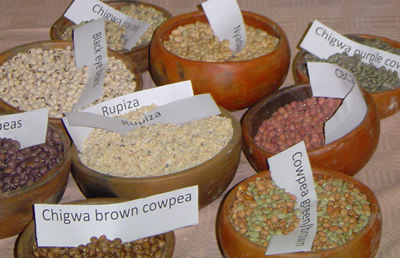
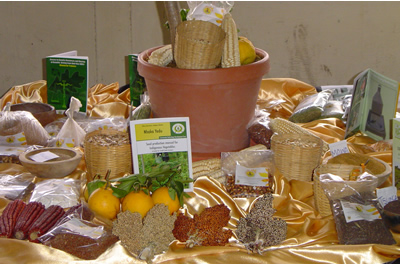
The Processed Products Fair organised by a network of nine NGOs comes in handy in this day and age where most of the people of our generation do not know how to cook delicious traditional recipes. At the fair you can see the raw agricultural products, the processed product together with the recipe and, you’re allowed to taste! And if the food tickles your taste buds you can buy the raw products on sale and try cooking for the rest of the family at home.

Born-free

del.icio.us TRACK TOP
Thursday, June 30th, 2011 by Upenyu Makoni-Muchemwa

A few days ago I was stopped at a police roadblock on my way home. While the officer was writing my ticket, he commented,

‘Ah sisi munogona kunosa.’ (not a nice way of saying you speak Shona with an accent)

Then he proceeded to try and get my phone number.

I have never been black enough. When I was very young my family conducted a roora ceremony for my aunt and we all moved kumusha for a week. Not having any other girls my age to play with, and having been shooed away from the cooking fire whenever the older women wanted to talk about men too many times to keep trying, I spent much of my time indoors reading. One day my older cousin recited Roses are red, violets are blue, you brother and me are black, but what are you?’

It was over twenty years ago, and I was half way through primary school at the time, but it was cruel.

I’ve never really liked that cousin since then.

When I first returned from the Diaspora, relatives would ask my mother if I still spoke Shona and observed our traditions. The implication being that I was no longer one of them.

‘Handiye apfugama achimuoberayi zakanaka?’ (Isn’t she the one who knelt and greeted you properly?) My mother would reply.

Later, I dated a man whose mother objected to our relationship because I was too privileged to be a ‘good African woman’. Her assumption was that because I had grown up kuma ‘dale-dale’, had attended private school, and lived outside Zimbabwe briefly, I was too ‘sala’ to qualify as such. Once in a heated conversation she asked him

‘Kamusalad kako kanombogona kubika sadza here?’ (Does your salad girlfriend even know how to cook sadza?)

I am not alone, there a few born-frees out there who grew up much the same way I did. Criticisms of the born-free generation are not all equal. For those who grew up in the middle class, and are perceived to have been granted access to privilege and lost their culture and language in the process, it holds a particular disdain. There are times when we are faced with the difficult choice of either embracing our otherness, or apologizing for the way we were raised.

I don’t believe in apologizing for the way my parents raised me. Especially to anyone who’s view of tradition, culture and history is narrowly defined in terms of where in Harare I grew up, how I speak Shona, and whether I cook or eat sadza. There is more to us than that, and it’s a shame that those who are loudest in defining our cultural identity believe that those things constitute the totality of who we are.  I think that is a very simple minded reduction of a complex culture, and a language that is steeped in a rich history. What I, and others like me, are judged for is not our acculturation, but rather that person’s lack of access to privilege.

What’s happened to business zoning laws?

del.icio.us TRACK TOP
Thursday, June 30th, 2011 by Bev Clark

Just wondering about Harare’s very weird business zoning laws. Remember back in the day when you had to be in a designated business area if you wanted to operate a business? No more. Imagine the poor suckers who own a house next to Paula’s Place, the re visioned Caiscais Restaurant. Paula’s is situated next to residential properties on Samora Machel Avenue in Eastlea. Don’t know about you but I wouldn’t relish living next door to a restaurant that’s going to have countless cars coming and going, the noise of happy go lucky patrons and the smell and sizzle of countless peri peri chickens on the grill. Isn’t it time that the City of Harare showed some sense when it comes to issuing (if they actually do) permits to businesses operating in residential areas? It’s an indictment on how many people don’t want to go into our city centre anymore. That’s where many of our restaurants used to be.