Kubatana.net ~ an online community of Zimbabwean activists

Harare North, South, East and West

del.icio.us TRACK TOP
Wednesday, May 6th, 2009 by Bev Clark

Recently Kubatana offered Brian Chikwava’s new book, Harare North, as a prize for the best bit of writing on the Diaspora. Here’s something from Martha in Bulawayo . . .

For me the Diaspora is any place outside Zimbabwe. This is in contrast with the main belief that the Diaspora is over the seas. I grew up in Tsholotsho and most men over the age of eighteen are in Egoli, as Joburg in South Africa, is commonly known. For me they are in the Diaspora. For the past thirty years or so this has been an increasing trend and it has led to an appalling lack of ambition. Boys dream of going to Egoli and girls dream of getting married to Injiva (a man working in South Africa). To me the Diaspora means a  total disregard for education, a break down of the family system (men working in South Africa only visit their families once or twice a year) and lack of achievement – although it might be argued that being able to  feed one’s family is achievement. But I believe if a person who could have been a doctor, an engineer et cetera ends up being a mere gardener in South Africa, there is a lack of achievement. The Diaspora has set an unreal sense of achievement so much that the youth, and in some cases adults, have totally lost focus. To me the Diaspora means a disturbance of a people’s value system and belief in themselves.

Mugabe on Genocide

del.icio.us TRACK TOP
Monday, May 4th, 2009 by Bev Clark

Huge congratulations go to the team that staged the Harare Festival of the Arts (HIFA) 2009. There’s been such a buzz in downtown Harare over the last few days lifting many people’s spirits. The opening show was evocative. Much of the feedback I’ve heard is that it was a bit on the depressing side and that the producer should have balanced the dark with more light. The HIFA producers once again didn’t shrink from telling it like it is and at one point the thousands gathered in the Harare Gardens watched a giant screen scroll the names of Zimbabweans who have died in political violence during the last year. The state-controlled Herald newspaper published a photograph of the fireworks that lit up the night sky but avoided any mention of the political content of the production.

Political statement was found just about everywhere. Ben Voss the star of Beauty and the B.E.E. had the jam packed Reps Theatre rolling in the aisles with a cutting satire on South African politicians. He also set his sights on Robert Mugabe who he situated in a horse race with the likes of Zuma and Zille. Mugabe was riding Genocide and Zuma was on Corruption. He ended his time on stage with a very pointed eulogy to Mugabe. The basic message was just get out of here already. It was curious to sense the discomfort in the audience as Ben moved from generally criticising South African politicians to specifically gunning for Mugabe. Have we ever experienced such direct public criticism of Mugabe, where we Zimbabweans have been encouraged to laugh at the small dictator? Bare our teeth at him in public? It showed me how far we all have to go to shrug off the effects of decades of oppression. I reckoned that Ben might be deported before his next show. I lost the bet. And I’m pleased I did.

Meanwhile an old blind woman begging on Julius Nyerere Street outside the main HIFA entrance clanked her two US coins in her small metal bowl. Most people walked around her. On Seventh Street, home to one of Mugabe’s mansion like houses, a tramp trawling the sidewalk picked up an old Coke can, gave it a shake, tilted his head back and sipped what was left.

My enjoyment of both Victoria, a Canadian production on aging, and a double bill dance show was lessened by the weirdness of some of the Zimbabwean audience. They laughed in all the wrong places. Whilst the interpretation of performance is a very personal experience there’s just too much conservatism in some folk here. The stunning Spanish dancer was ridiculed from start to finish by the people sitting behind me simply because he started his performance in a dress.

Oh wow – so radical!

Allegations, a play that looked at the troubles of a white farmer and a displaced Zimbabwean farm worker, gave us pause for thought about how similar we all are and how Mugabe has trashed our dignity no matter our colour. It was an outstanding production and deserves to be seen in all corners of Zimbabwe. I’m really hoping that it won’t go from Harare to Berlin in one swift plane ride as happens so often in this country.

Way to go HIFA for your courage and energy.

Zuma is unconvincing

del.icio.us TRACK TOP
Tuesday, April 28th, 2009 by Fungai Machirori

Will the new South African president, Zuma, break into spontaneous dance whenever he delivers a speech to the international community?

So far ( as far as I know), he has managed to keep his rousing rendition of the now out-of-context Umkhonto we Sizwe war cry ‘Mshini Wami’ confined to national fora such as political rallies and other platforms he has been provided to defend his innocence against the many charges levelled against him in the recent past.

The reason I ask is simple. Beyond his amazing agility and moves to rival Michael Jackson in the prime of his musical career, Zuma doesn’t seem to offer much else.

Now, to be sure, I have serious problems in looking beyond the misgivings of a man who claims that taking a shower after unprotected sex with an HIV-positive person can prevent transmission of the virus. That statement will forever stick in my mind whenever Zuma’s name is mentioned to me.

But after all his run-ins, and let-offs by the rule of law, I thought it only decent of me to give him an ear at the last ANC rally held last weekend in Johannesburg.

I will admit that I haven’t listened to many of his speeches, but called the Siyanqoba (We shall conquer) rally, and the last that the ANC held prior to elections that Wednesday,  I expected Zuma to give the  most rousing speech of his political career.

But oh, so drawl and monotonous was he that I dozed off a few times, as I watched. Was that un-emotive expressionless list of promises to make South Africa a better nation really what the people wanted to hear?

And when he promised to fight corruption, I couldn’t help the smirk that instantly appeared on my face. More transparent tendering processes and less misappropriation of public resources?!

That sounded like a page out of a Grimm’s fairytale.

While functional, apart from clever little statements like stating that South Africans ought to “put sport back into our national psyche” in the build-up to the 2010 World Cup, I found his speech drab and quite banal. Nothing in it would give anyone a shiver down their spine, which is what good speeches tend to do.

While he will never be an Obama in terms of his oratory, Zuma needs to start sounding a bit more convincing that he is a changed man and not some reluctant school kid forced to stand up and read his short story to the rest of the class.

His political persona already doesn’t look so good – what with a trail of corruption cases behind him – and other near-miss charges he has managed to worm his way out of.

Speech has power to convince. You only need look at the immortal place that Martin Luther King Jnr holds in history because of his ‘I have a dream’ speech.

And though more sinister, no one can deny the power of Adolf Hitler’s oration in convincing the German masses of the ‘goodness’ of Nazism.

For me, there’s nothing to savour about Msholozi’s political character yet – until, of course, he breaks into that ubiquitous theme song and jumps across the podium belting out “Mshini Wami, Mshini Wami.”

Have you ever noticed how the South African media focuses so intently on this aspect of Zuma in its coverage of him? With dance moves that crisp, he could put many a young man less than half his age to shame. Yes, that forms part of his ‘everyman’ appeal. But that should not become the hallmark of his persona.

Zuma has to appeal to a larger audience than just South Africans who have recently become disgruntled with the ANC and thus see him as the agent of necessary reform.

He has to appeal to regional and global audiences, to represent South Africa, and Africa as a respectable statesman in the mould of his predecessors who include Nelson Mandela.

And sadly for him, he will have to do all of that without the dancing.

For me, my greatest hope for Zuma’s reign is that he can combat the HIV epidemic that is currently wreaking havoc in South Africa and sending shock waves throughout southern Africa. For one who himself peddled gross misinformation about ways to prevent HIV transmission, this would represent the greatest victory in overcoming the very ignorance that continues to kill so many.

I sincerely hope that come May 9, at the presidential inauguration of Zuma, I will become more convinced by this man who holds the hopes and destiny of not only his nation, but the whole region.

Look this way

del.icio.us TRACK TOP
Friday, April 3rd, 2009 by Amanda Atwood

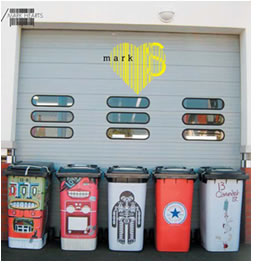
marklives_rubbishbins_090403cAs Bev pointed out a month or so ago, we’ve started getting these fantastic little occasional newsletters from MarkLives. They point out highlights in art, design and technology in South Africa. The MarkLives blog site isn’t exactly an example of compelling design, but the posts themselves invariably draw your attention to hidden treasures you’d never otherwise know about.

Even better, on the right hand sidebar of the blog site is a link to Mark magazine. Far more than your average pdf file, this is an interactive fully featured magazine experience. What’s more, the magazine content itself is stimulating, diverse, and interesting. The downside is it runs on a flash player type interface, and I shudder to think how much bandwidth it must chew. But where else will you find a reference to Vivienne Westwood’s ManifestoActive resistance to propaganda (“We shall begin with a search for art, show that art gives culture and that culture is the antidote to propaganda.”) in the same place as an advertorial promoting recent University of Cape Town research on “The Feasibility of Mobile Technology as an Information Medium” (about how much more education needs to be done in South Africa to help mobile phone users there take better advantage of the communications potential the phones have) and this photo of the rubbish bins decorated by five Cape Town ad agencies in an urban design project.

To subscribe yourself for the MarkLives newsletters, email join-marklives [at] emessagex [dot] net.

Time for Zimbabwe’s UDF

del.icio.us TRACK TOP
Tuesday, January 6th, 2009 by Amanda Atwood

I’ve been reading Padraig O’Malley’s Shades of Difference. It uses the life of Mac Maharaj, who according to Nelson Mandela, “ran the ANC’s underground in South Africa,” as a lens through which to discuss the anti-apartheid struggle. O’Malley introduces each chapter to set the historic or political context of that section of the narrative, and then Maharaj recounts a few years of his own autobiography. It’s clear, well written, and I’ve been so grateful for the insights that a story of that struggle can lend to Zimbabwe during ours.

I’m currently in the early 1980’s. Mac has served his 12 year sentence on Robben Island, after his conviction in the Little Rivonia Trial. And he’s escaped South Africa to rejoin the struggle outside the country. Meanwhile, the ANC’s progress has been slow. Frustrated by the pace of reform, and forced ever-deeper underground by the apartheid regime’s policies, the ANC is increasingly attracted to the strategy of armed struggle – despite its failures. In his introduction to Chapter 10, O’Malley credits the United Democratic Front (UDF)’s civil disobedience campaign with greater effectiveness than the armed struggle organised by Umkhonto weSizwe (MK) (Spear of the Nation). This despite the fact that it was 11 years from the formation of UDF to South Africa’s first democratic election.

Here are some excerpts:

The opposition to the tricameral parliament led to the creation in 1983 of the anti-apartheid United Democratic Front (UDF), a broad, non-racial grouping of about 650 affiliates with a total membership of more than 2.5 million who collectively put the emphasis on mass mobilisation and protest politics.

Meanwhile, the ANC had become addicted to the idea of armed struggle. The more it failed, the more the ANC pinned its hopes on guerrilla warfare and armed insurrection. The ANC’s armed struggle failed by almost every yardstick.

The post-1963 generation grew comfortable in exile. With no secure base from which to launch attacks on South Africa or to infiltrate operatives, getting MK cadres into the country was a disheartening process. There was no existing political underground in South Africa with which the exiled ANC could easily communicate. One estimate put the number of formal structures inside the country at fifty, the number of members at two hundred – hardly the makings of an adequate network.

As we start a new year – and thinking about Bev’s blog yesterday about the MDC’s need to rethink its strategy – I’ve been reflecting on O’Malley’s comments on the ANC in the 1980s – and what lessons we can learn for our situation today. If we replace the ANC with the MDC, South Africa with Zimbabwe and armed struggle with elections and negotiations, the paragraphs above sound eerily similar to what we are experiencing today.

The more elections and negotiations fail, the more the MDC wants to try them. The MDC’s structures are weak, and constantly under assault from the ruling party. Not exactly a recipe for success.

But discussing things with some colleagues yesterday, we realised – the objective of the MDC isn’t to oust the regime. The objective of the MDC, as a political party, is to win elections, get elected to power democratically, and to govern the country with the majority it has won. So, then, why are we surprised that they focus on elections and negotiations. I may think that’s a naively narrow strategy – since when is that small dicktator gonna share power equally just because we’ve politely requested that he play nice? – but it’s the strategy they’ve chosen. It’s even more naïve of me to expect otherwise from them.

Rather, thinking of Maharaj and O’Malley again, it’s time to take Natasha’s advice. Instead of looking for the MDC to restrategise, let’s look at how civil society can restrategise. The MDC wants to lead Zimbabwe’s democratic transition. But it’s not willing to lead the campaign to make the country ungovernable, so that the regime has no choice but to transition. If South Africa is anything to go by, it’s time for Zimbabwe’s UDF.

Driving the conversation

del.icio.us TRACK TOP
Tuesday, October 28th, 2008 by Amanda Atwood

The Kubatana team was in Johannesburg recently for MobileActive08. As we moved around the city, we spoke with taxi drivers about the ANC split, Xenophobia, Zimbabwe, and other issues.

Here are a few snippets of our conversations:

Troublemakers, they kind of respect the taxi drivers. For other people, they have no respect. But for taxi drivers, they kind of leave us alone. They know we can make our own violence.

—–

People must tell the truth. It will heal other people. Actually, that will teach people to learn, and forgive. Otherwise, when it’s not done, I will see a Shona person, and think you’re a part of Mugabe. You killed our people. You know, things like that. But if there is TRC [a Truth and Reconciliation process], then I think people will be able to see, okay, fine. This is what happened. Let’s forget about it.

—–

You’ll never get a settlement in Zimbabwe. You know why? Because they’re making too much money. They’ve got 25-tonne trucks travelling up and down from Zimbabwe to Jo’burg and Jo’burg to Zimbabwe everyday. With all the food in it you want to eat. All the appliances you want to buy. Those people are my customers like you sit there. I ride them to the trucks. I fetch them from the trucks. It’s completely shocking.

—–

There is no such thing as a Rainbow Nation. You must know where you come from and know where you’re going. If you’re a Zulu you’re a Zulu. If you’re a Xhosa you’re a Xhosa. Now (interim president Kgalema) Motlanthe is more of a rainbow person. He can socialize with anyone. Which is not right. We need someone who is either a Xhosa, or a Zulu.

—–

You know that woman that they say Zuma raped? It’s untrue. She was involved with Zuma for a very long time. Zuma was actually planning to marry her as one of his wives. So, they blame the Intelligence Minister. That might be true, that he tried to convince that lady, to pay her money so that she can threaten Zuma. That’s what she did! Those questions were asked in court – and she couldn’t manage to answer them. There were police outside, she had a phone, and there was a house phone. And you wake up in the morning, take a bath, make food, fry eggs, you eat, make phone calls. You know? The door’s unlocked. And you come up later and say you’ve been raped. Why didn’t she go out and report at the same time, when police were outside Zuma’s house. Besides that, she should have called. Or wake up in the morning and go and make a statement at the police station.