Kubatana.net ~ an online community of Zimbabwean activists

A Platform for Female Photographers

del.icio.us TRACK TOP
Monday, May 20th, 2013 by Emily Morris

Em one

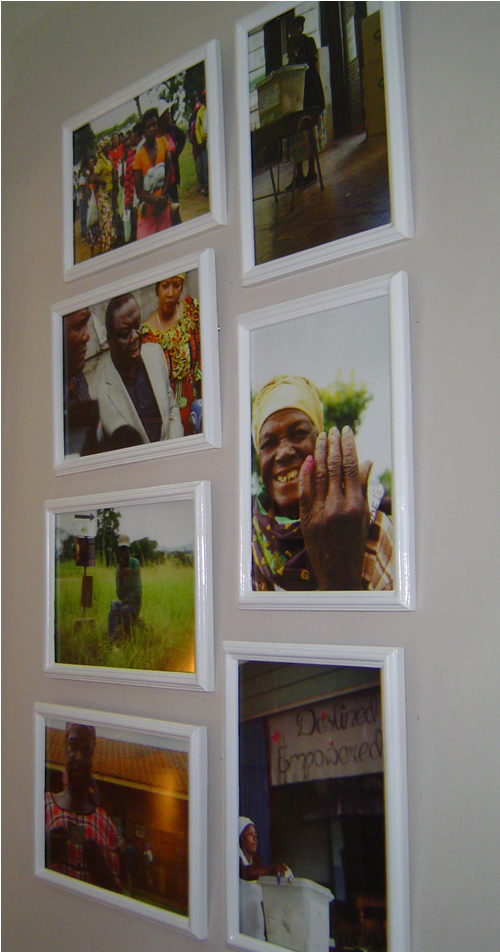
Last Friday I went to have a look at the Zimbabwe Association of Female Photographers (ZAPF) exhibition. It is an amazing illustration of talent, as well as being a great cause for female empowerment. It expresses women’s abilities and has given a chance for female photojournalists in Zimbabwe to demonstrate their talents in an exceptional display.

The exhibit has a wide variety of photography, from landscape to portrait and nature. The exhibit is well displayed and each piece carefully explained. I would highly recommend anyone with an interest in art to have a look.

Many of the pieces carry strong messages, from political to social. A particularly captivating piece was the exhibit “Pimp My Kombi” by Nancy Mteki. This exhibit explores “the notion of public transport as a social environment, marked by gendered power relations in which the woman remains objectified”, as described in the caption.

Another particularly prominent piece was “The Referendum Grid”, a collaboration of the work of Angela Jimu, Davina Jogi, Cynthia Matonhodze and Annie Mpalume. This politically striking series shows various images taken during the referendum, displaying a variety of emotions and attitudes. The different images contrast each other making it holistic and captivating.

I would advise anyone with an interest in art, or with a bit of time to spare to go and have a look at the exhibition at 15 Princess Drive, Newlands. It is open until the 24th May from 1pm to 2pm during the week and 10am to 1pm on Saturdays and is a couple of hours well spent!

Hey, show me the water!

del.icio.us TRACK TOP
Monday, May 20th, 2013 by Marko Phiri

Virtually every corner of Zimbabwe has huge challenges concerning access to clean water, and despite all talk about the country committing itself to meeting its MDG targets with 2015 fast approaching, it is quite a statement to hear a woman ask the Harare mayor, “can you tell us if the water in our taps is safe to drink!”

The UN says you cannot separate water from all the Millennium Development Goals, it thus has to be asked that in a country where water has become such a very emotional issue because of its regular absence in our taps, what then does this say about the country meeting all the eight MDGs?

But then, this question is rhetorical as it is on record that we are off the mark on many of these fronts.

I was given a jolt, recalling that water treatment chemicals have been hard to come by for big cities such as Bulawayo, and for someone to pose that question, “can you tell us if the water in our taps is safe to drink?” says a lot about the downward spiral of service provision in this country in the past decade.

The occasion was a Quill Speak at the Ambassador Hotel and it was themed “The water supply crisis in Harare – what is the solution?”

The Harare mayor, 59 months on the job he said, attempted to provide insights into the mother city’s water headaches, but like many public officials in this country never seemed to have anything new to say other than what has become a well-worn motif: we don’t have the money.

Someone asked where then the mayor expects to get the money, and it was then that for me he provided a useful insight about what has gone wrong in this once romanticized “great African hope” back in the euphoria of 1980.

Council could raise funds for its service provision obligations such as the ever-snowballing water sector migraines by issuing municipal bonds, but this last happened in the 1990s before the dollar crashed in 1997, the mayor explained.

It is explained elsewhere “municipal bonds are securities that are issued for the purpose of financing the infrastructure needs of the issuing municipality.”

But in a country where everything has been blamed on the voodoo economics of Zanu PF, municipal bonds also became a victim; simply meaning that local authorities could not sustain themselves, raise their own revenue outside payment of bills by residents.

Yet resident associations have criticized these municipalities of trying to run their cities with money collected from bills, which is an impossible proposition.

It explains why virtually every council in this country is broke, with residents being forced to live with the reality of disease outbreak right on their door steps.

We only have the 2008 cholera outbreak as a painful example, which Sikhanyiso Ndlovu claimed back then and without any hint of tongue-in-cheek was part of a biological-chemical warfare unleashed by Zimbabwe’s enemies, when everyone else knew its genesis.

Another lady asked the Mayor why she should bother paying her bills when she hardly gets any water, a question that has been asked everywhere but has not elicited any convincing response from the local authorities.

It is a telling indictment that amidst all these questions, Zimbabweans find themselves being part of the 783 million people UN Water says do not have access to safe drinking water, and these are people living not in the rural outback, but in the city of Harare!

No free rides here, thank you

del.icio.us TRACK TOP
Wednesday, May 15th, 2013 by Marko Phiri

I saw a group of police officers fill a kombi at the Copacabana rank and I found it rather curious that these cops made more numbers than civilian passengers; surely they would bankrupt the kombi owner.

I wondered why the tout would allow all of them into the vehicle, remembering of course that where I am from, police officers don’t pay for a kombi ride!

But turned out they were all paying customers.

Another eye opener about how things are done differently here perhaps, yet I chuckled recalling that for kombi drivers in Bulawayo, the whole idea of giving a cop a free ride right in the front seat is so that the driver is waved through by traffic cops checking for everything from vehicle fitness certificate to driver’s license.

The travelling cop becomes the driver’s Moses, parting the road for safe passage.

What then here where the cops are paying full fares, by the ways of logic, there is obviously no protection to speak of and I am trying to picture a scene where traffic cops stop a kombi full of fellow cops who are paying passengers. Perhaps the same would apply? Wave the kombi through, I mean?

Yet the whole idea of cops and free rides has been met with some daring by certain Bulawayo touts, and I recall a tout looking a young cop in the eye and asking him if he if he had money for the ride.

The dumbfounded cop stared blankly and hesitated before the kombi sped off without him!

In any case, if you think of it, the parallels extend to all sectors of the country’s troubled present: many politicians have been fingered in demanding protection fees from sectors as diverse as farming and mining where extortion has been the order of the day: pay up and I will make sure your farm is not expropriated!

And the small fry, the poorly paid cop, can only have a free ride ostensibly to protect the driver from having his vehicle impounded, at least only as long as the cop is in the kombi!

Yet seeing the cops in Harare pay their fares like everyone else did brings a sense that perhaps this relationship between kombi drivers and cops is based on reports of cops smashing kombi window screens so why reward them with free rides!

Harare’s mean streets

del.icio.us TRACK TOP
Monday, May 13th, 2013 by Marko Phiri

There is always something of a culture shock each time you move to a new city, whether it’s a bustling metropolis or a small city the kind where everyone knows everyone.

And for me returning to Harare after having lived here a decade ago is something that I am treating with a little trepidation.

After all, so much has changed in the past decade, from the growing population to the deluge of ex-Japanese vehicles clogging the streets.

Nothing has changed in the form of government and governance, but this is an obvious story that has been rehashed for so long it has become tedious because apparently the more you curse the oligarchs, the more they dig in, so why give yourself an ulcer.

I travelled in a kombi from Westlea to the city centre and felt choked by the traffic gridlock and watched as the kombi driver assumed a Formula One persona and I could only ask a friend how the motorists escaped the wrath of road rage.

Yet it seemed to me everyone here has accepted this – albeit grudgingly – as a part of their daily grind as they attempt to navigate these mean streets during the morning rush to get to work.

It’s something terrible nativising yourself to a life of misery, yet you still have to live with it, after all, there is nothing you can do about it.

I saw a single lane street turned into a four lane autobahn as motorists and kombis competed for space, and the question to ask came naturally for me, perhaps as someone just coming in from another city where the ubiquity of traffic cops cannot be escaped: “Are there no cops along the way?”

And all the way from Westlea to the CBD no green arms waving, signaling the motorists to stop and perhaps try and create order out this chaos. Or in fact fleece a few greenbacks from already enraged motorists.

Yet it is perhaps something to be expected in a big city where a vehicle census would produce numbers that show a rapid growth of cars per capita but very little or nothing in the form of developing the road network to accommodate all these carbon expelling beasts.

I want to imagine that it is not just transport that will keep me in awe in my first week here, because anything else would be a no-no, and as a virtual outsider trying to learn the ways of this host city, it is inevitable to make comparisons with my native Bulawayo and in the process make prejudiced judgments about the big city and its people.

Public discussion: The Arts & Disability

del.icio.us TRACK TOP
Wednesday, May 8th, 2013 by Bev Clark

When: Thursday 9 May 2013
Time: 5.30 – 7pm
Where: Book Cafe, 139 Samora Machel Ave/6th Street, Harare

On Thursday 9 May the popular arts hub, THE BOOK CAFE once again offers a platform and opens its doors for a free public discussion on THE ARTS & DISABILITY.

An initiative of the budding organisation ‘SIGNS OF HOPE’ the discussion brings together Zimbabwean musicians, singers and actors to examine the question “How do artists view and engage with the disabled through their art?”

Gone are the days when people with disabilities were secluded in private corners and excluded from social, educational and political activities. In Zimbabwe, like anywhere in the world, huge strides have been made as the nation produces excellent lawyers, teachers, activists, artists and sportspeople with disabilities who are excelling in their fields and making a difference in society. Compared with the western world however, we are still far behind, in terms of facilities and general perception of people with disabilities, and their inclusion and participation in nation building. Everyone has a role to play in society, and the discussion aims to raise awareness among the public in general and artists and arts practitioners in particular, about how the arts can contribute to attitude change in society, the gender perspective, and where the links might be.

Speakers include the acclaimed songwriter and guitarist Victor Kunonga who is active in this arena, working on projects with the St Giles Rehabilitation Centre; afrojazz singer/songwriter Dudu Manhenga, and Daniel Maphosa of Savannah Trust, working in theatre development. Masimba Kuchera will speak from the perspective of people with disabilities, and the discussion will be moderated by Thomas Deve.

The discussion is free and all people are welcome. Artists are specially invited to participate and gain a deeper awareness of the issues concerned.

Workers Day commemorations in Zimbabwe about political mileage

del.icio.us TRACK TOP
Thursday, May 2nd, 2013 by Lenard Kamwendo

The Workers’ Day theme at Gwanzura stadium was “Workers under siege, organize unite and fight on” – indeed workers in Zimbabwe are under siege from politicians who have hijacked the event to further their interests. If workers have nothing to lose but their chains like what Karl Max said in his literature, maybe its high time Workers Day in Zimbabwe is left to workers and free from politics. Sloganeering and empty promises from civic society activists who are trying to transform into political parties were the only major highlights of the day for those who braved yesterday’s chilly morning weather. Instead of addressing bread and butter issues for the workers most labor organizations have aligned themselves to various political parties and workers have been left wondering if the occasion had been turned into a political gathering. To lead a labor organization is now a one-way ticket to political stardom and this has lead to massive splits in the labor movement in the country as noted by the contestations for donor funds yet the marginalized worker continues to rely on empty promises of decent wages and better working conditions. The government has also taken advantage of these disorganized labor movements by refusing to come to the negotiating table hiding under the disguise of demanding legitimate workers representatives from labor unions. The same politicians who were propelled into power through a labor backed party now seem to be enjoying the sweet benefits of power and have turned out to be the oppressors. One aspiring politician reminded workers who assembled at Raylton Sports Club yesterday to never trust politicians and later used the same platform to announce intentions of launching a political party!