Kubatana.net ~ an online community of Zimbabwean activists

Reconciliation in Zimbabwe not being taken seriously

del.icio.us TRACK TOP
Wednesday, June 16th, 2010 by Dydimus Zengenene

When the unity government was formed in Zimbabwe, an organ of national healing and reconciliation was also established. Its main mission was to bring back order in the violence-maimed societies, rebuild unions in disjointed communities, reintroduce peace where violence was the order of the day, and bring back that oneness that we enjoyed swimming in before the political chaos.

This implies that people have been looking at this organ expecting action beyond mere talking. By this time we are expecting to have seen the members of the organ moving around in communities, preaching the gospel of peace, coexistence and love. We have for long been expecting the organ to spearhead radio and television programmes that reinforce the importance of peace and love. We have for long been waiting to see some initiative that make people share their feelings, forgive whoever they think is guilty and bring back the spirit of coexistence.

On the 7th of April 2009, the chairman of the organ spoke about reconciliation to stakeholders including churches. That gave people hope that peace had finally come to hand. Unfortunately very little has been done beyond that so far. If this organ had done its work well, a good ground for a peaceful Constitution making process would have been set.

It seems a Non Governmental Organization, Heal Zimbabwe, has seen the gap and is now initiating action. Its programmes that are reportedly taking shape in Muzarabani are a contribution that deserves a pat on the back. Among other good works, Heal Zimbabwe has embarked on initiating memorial services for those victims of political violence. Such moves are likely to bring people together, get them to discuss how bad violence is and give the family members an opportunity to give their deceased the respect that is customarily and religiously granted to the dead. That way the organisation is addressing the customary and religious side, which plays a great role in establishing forgiveness in societies.

Can these initiatives therefore serve as a wake up call to the Organ of National Healing and reconciliation? There is nothing yet on the ground that we can attribute to this organ and as citizens we feel that that organ has not served its purpose especially amid reports that violence and threats are rejuvenating in the country. That puts to question the possibility of any future peaceful elections. People still think violence is the way to go; surviving victims of past violence are still looking for ways to retaliate. If that tension is not addressed, then the existence of an organ called “National Healing” is unjustified.

Court Orders mean nothing in Zimbabwe

del.icio.us TRACK TOP
Friday, June 11th, 2010 by Bev Clark

Here is a statement just in from the Law Society of Zimbabwe:

The Law Society of Zimbabwe (LSZ) wishes to express its deepest concern at recent media reports that a government Minister has told villagers to defy a Court Order.

Minister of Presidential Affairs and ZANU PF Secretary for Administration Didymus Mutasa reportedly told villagers in Chipinge that they should not vacate Makandi Tea and Coffee Estates despite a Court ruling ordering them to do so.  It is the LSZ’s contention that the Minister may have committed an offence of Contempt of Court.

During the inaugural Joint Judiciary and Legal Practitioners Colloquium held in September 2009, stakeholders, among them members of the judiciary, expressed serious concern over the disobedience of court orders especially by state actors.

The LSZ notes that the Minister and others may be aggrieved by the decision of the Chipinge Magistrate in that particular manner.  However it is important to remember that any litigant has the right to appeal against any decision of a lower court up to the Supreme Court.

The LSZ calls upon the Minister concerned and any likeminded individuals to desist from inciting members of the public to disobey court orders.  Such actions, if they remain unchecked, may result in members of the public losing confidence in the justice delivery system and are likely to result in anarchy and lack of respect for our Constitutional order.

The LSZ further calls upon the Minister to immediately issue a statement in which he reaffirms his respect for the rule of law and the judiciary in Zimbabwe.  He is advised to assist the villagers to appeal against the Magistrate’s decision instead of taking the law into his own hands and advising them to disobey court orders.

Josphat Tshuma – President

Truth time?

del.icio.us TRACK TOP
Wednesday, June 9th, 2010 by Bev Clark

Well done to the Mail & Guardian for their persistence:

SA government ordered to release hidden Zim election report By Alex Bell
07 June 2010
SW Radio Africa

The South African government has been ordered to release a hidden report on the 2002 elections in Zimbabwe, after a successful court bid by a local newspaper.

Since 2008 the Mail & Guardian has been trying to have the report released, amid widespread speculation that it contained evidence showing that Zimbabwe’s 2002 disputed election was not free or fair. Judge Sisi Khampepe and Deputy Chief Justice Dikgang Moseneke were at the time commissioned by then president Thabo Mbeki to visit Zimbabwe and report back on the state of the election. The report was handed over to Mbeki but never made public, although the former President insisted the electoral process in Zimbabwe was completely democratic.

The newspaper’s efforts to access the details of the report were repeatedly denied, leaving it little choice but to seek the intervention of the High Court. The government, now under President Jacob Zuma’s leadership, has seven days to release the report to the Mail & Guardian, after the High Court ruled in the newspaper’s favour last Friday. The government can appeal in that time, but their plan of action is not yet known.

Mail & Guardian Editor Nic Dawes told SW Radio Africa on Monday that he is “extremely pleased” with the outcome of the court challenge, calling it a victory for “freedom of information in South Africa.” He explained that there is a “sense” that the report “will say something very different to what Mbeki was saying about the elections in Zimbabwe.”

The government has argued that the report was ‘confidential’ and a “record of the cabinet and its committee.” They said it contained information “supplied in confidence by or on behalf of another state, for the purpose of assessing or formulating a policy,” and that the content of the report was not in the public interest. The government has also argued that the report would lead to a deterioration of relations between the two countries, as South Africa is the facilitator in Zimbabwe’s ongoing political crisis.

The newspaper has in turn argued that the report is of enormous public interest, as the 2002 elections were marred by vote-rigging, intimidation, violence and fraud by Robert Mugabe’s government, despite South Africa’s contention that the election was free and fair. Dawes also explained that the report was never handed to cabinet despite being described as a “document of cabinet,” and instead remained within the office of the President, rousing more suspicions of its content.

Dawes described the court’s decision as an important one for South Africans who he said were left “injured” by the government’s abysmal handling of the Zimbabwe crisis. Former President Thabo Mbeki faced international criticism for his policy of ‘quiet diplomacy’ towards Zimbabwe; a policy that many say has crippled South Africa’s own reputation. Dawes said that it was a “painful and difficult period” for South Africa, because “it seemed to jar with our own democratic values.”

“The truth of the report might be a way to address some of the hurt and frustration by reasserting our democratic values,” Dawes said, expressing hope that the Zuma administration won’t fight the court’s ruling “too hard.”

“The Zuma administration has taken a more robust and assertive approach than Mbeki, and appealing this ruling and hiding this report will be very damaging,” Dawes said.

End harassment and persecution of Zimbabwean activists

del.icio.us TRACK TOP
Tuesday, June 8th, 2010 by Dydimus Zengenene

At a press conference attended by the media and diplomats including a representative of the Embassy of Spain, the Crisis in Zimbabwe Coalition condemned the persecution and harassment of civil society activists.  In a speech by Mr. Pedzisai Ruhanya, the Coalition demanded that the Government of National Unity brings to end the persecution.

Cases in point included that of Farai Maguyu, the director of Mutare based Centre for Research and Development (CRD). Mr Runanya said Mr. Maguyu handed himself to the police on the 3rd of June, after his family members and fellow CRD employees were severely threatened and harassed by state security agents. It is believed that Mr. Maguyu is being accused of publishing or communicating falsehoods prejudicial to the state in contravention of section 31 of the Criminal Law (Codification and Reform) Act. Mr. Maguyu is said to have had a meeting with the Kimberly Process Monitor for Zimbabwe, Abbey Chikane discussing human rights abuses and smuggling of diamonds from Marange.

The Coalition said that Mr. Maguyu was arrested in Mutare and transferred to Harare without any known reason, and was detained by the police for over 48 hours before trial, a period which is beyond the legal limit of detention before court trial. The Coalition views this detention as a punishment being put on Mr. Maguyu for “…exposing injustice and for speaking out for the oppressed people of Marange.” The Crisis also believes that the government is “…aware that Mr. Maguyu is supposed to travel to Israel later in June to give evidence at the Kimberly process plenary regarding abuses in Marange.”

The Coalition called upon the Kimberly process to order an investigation into the circumstances surrounding this arrest. The Coalition further warned the government that the world is following the development of this case and will not be silent about it. Mr. Ruhanya further warned the state against any further harm to Mr. Maguwu.

The Coalition saluted the CRD staff members who are reported to be still in hiding and promised to be firm in support of Mr. Maguyu whose arrest, they say, is unwarranted interference with his liberty and is not in recognition of Mr. Maguyu’s basic human rights.

The Coalition also expressed deep concern over the resurgence of attacks and harassment of civil society organization and activists. Citing various cases such as Mrs Getrude Hambira, the Vice Chairperson of the Crisis in Zimbabwe Coalition and Secretary General of the General Agriculture and Plantation Workers Union (GAPWUZ) who was forced to flee Zimbabwe, the Zimbabwe Human Rights Association (ZimRights) director Okay Machisa who was arrested in line with a photo exhibition, and lastly the case of Gays and Lesbians of Zimbabwe (GALZ) employees who were reportedly tortured in police custody and later granted bail.

The Coalition further called for a complete overhaul of the government system “…to ensure that the judiciary, public prosecutors and state security agents are non-partisan, independent, impartial and professional.”

During the conference news arrived that Mr. Maguyu was finally brought to court on the 8th of June 2010, and the state was opposing a bail application by Mr. Maguyu’s lawyer.

Foreign investors need their due respect

del.icio.us TRACK TOP
Tuesday, June 8th, 2010 by Dydimus Zengenene

The Zimbabwean newspaper of 7 June 2010 reports that the Minister Kasukuvere threatened foreign business people with unknown action if they continue working in areas designated for locals by the law. The paper quotes Kasukuvere as saying,

“Come the 30th of June if they are still operating in areas which are reserved for our people by the Indigenisation law they will see what will happen to them. They have come in our country and taken our buildings, displaced our people and even gone to our rural areas to displace our small business traders. How do you come from all that far and come sell milk here in Zimbabwe where do you want milk from our people to be sold to when foreigners are taking the market?”

The head of the Zimbabwe Indigenous Economic Empowerment organization, President Paddington Japajapa, is also reported to have promised to incite local business people to attack foreign owned businesses if Kasukuwere failed to chase them away.

From the look of these threats there are plans to chase these business people the Murambatsvina way, which is grossly inhuman. After all a months notice is unfair. It should be known that these people never entered through closed doors. Neither did they just swarm to occupy these premises without the consent of the owners of the buildings and the government itself.

These entrepreneurs only took advantage of a niche that existed – where were our local businessmen when the premises were taken over?  Where were Kasukuvere and Japajapa? If they the foreigners are selling milk, it means no one was selling that milk before they came.

It seems our local entrepreneurs are not risk takers at all. They have watched the premises being taken by better innovative people. Now they are seeing success and are now resorting to the law to chase them away.

All I am saying is that there is no need to treat these foreigners without respect as if they raided our premises in our absence. There is no need to hate them as if they have not helped us in our times of need by investing in this country.

Anyone for a glass of water?

del.icio.us TRACK TOP
Wednesday, June 2nd, 2010 by Bev Clark

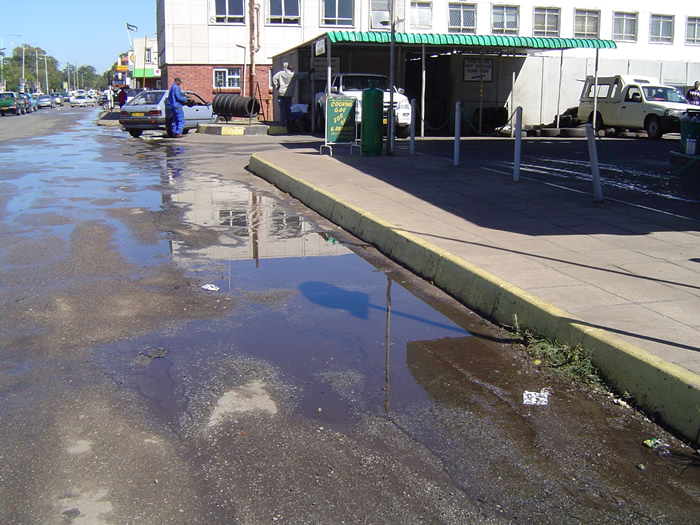
I do a lot of running and on my way through Newlands Shopping Centre over a week ago I ran past a very badly leaking water pipe. The road running through the shopping centre had become a river.

I sent a text message to the Mayor of Harare, Mr Masunda, asking him if he could send someone to attend to it as soon as possible. A week later, the pipe was still madly spewing water. It is important to point out that this shopping centre, along with the majority of Harare, suffers from crippling water cuts. So I sent another text to Mayor Masunda asking for an emergency number to call so that the problem could be fixed. I didn’t receive any replies to my text messages – yeah, he’s a busy man I know – and in the meantime I heard that the leak was over 3 weeks old and that the BP petrol station attendants had tried, in vain (understandably because they’re not plumbers), to fix the leak with pieces of black rubber. The petrol station had asked the city works department to come and fix the leak but it seems like they haven’t put this problem on their list of Things To Do.

What are we to make of this? Shop owners and residents of Harare pay their rates; motivated citizens report problems and yet the City of Harare, knowing that the provision of water is an essential service, allows major water leaks to remain unresolved for weeks at a time.