Here is a personal and moving account from Nokuthula Moyo, the current chairperson of the Legal Resources Foundation detailing her experience on the 8th May 2007 when several members of the Zimbabwean legal fraternity gathered in Harare to protest the abuse of police power.
Nokuthula Moyo writes:
The Law Society of Zimbabwe called a protest march for lunchtime today, to end with the presentation of a petition to the Minister of Justice, Patrick Chinamasa, and the Commissioner of Police, Augustine Chihuri. The protest was sparked by the unlawful arrest of lawyers Alec Muchadehama and Andrew Makoni, but was against the abuse of the legal profession and the defiance of court orders by the police generally.
I had a good breakfast, and I packed my make up and soap into my handbag. I anticipated arrest, but I did not want to ultimately get to a court (after whatever number of days), looking like something the cat dragged in.
At 12.34, I left my office and walked across town to the High Court, the meeting point for the march. As I walked up, I overtook another lawyer, and asked if he was ready. He said he was ready, whatever it took. A handful of lawyers were outside the High Court when I arrived, as were a number of riot policeman, standing a few meters away. Our fearless president, Beatrice Mtetwa, carrying in her hands the petitions to be delivered was already there. As were David Morgan, Fraser Edkins and John Meyburgh, partners from my own firm, Pat Lewin, and Prof Geoff Feltoe. Beatrice asked the riot squad what they were doing there, and they said they were under instruction not to divulge their orders. They could be there to break up the march, to beat us up, or to escort us. A few more people arrived, including T. Fitzpatrick, who later was in a scuffle with a police officer. Most of us were in our gowns.
As more lawyers arrived, so also did a woman in a tracksuit, and a man in plain clothes. They asked, in Shona, what we were doing there. I looked around me, and noticed that most of us were not Shona speakers. We did not respond. Still speaking in Shona, they said they were police, that we were not allowed to stop where we were, that we were to disperse. They were waving baton sticks around in a menacing manner. I noticed that baton sticks are very long; I do no think I have been at such close range to one before.
We shuffled off a few feet, and Beatrice suggested we move into the High Court courtyard, though we did not get to do that. Many other lawyers were arriving then. Innocent Chagonda, Eileen Sawyer, a veteran human rights activist, Mordecai Mahlangu, Raymond Moyo, Peter Lloyd, Chris Seddon, Dickson Mundia, Colin Kuhuni, a Councillor of the Law Society, and many others whose names I cannot list. More police and riot squad officers arrived in truckloads, and were moving us along in a solid line. Beatrice stood her ground. A senior police officer arrived then, whose arrival stopped the menacing advance of the police. He spoke to Beatrice for a while. By that time I was a few meters away in the path of retreat, and did not hear the conversation, but Beatrice told me the officer was saying they had sent a letter to the Law Society offices banning the march. I understood from Beatrice also, that the march would be banned, but the Law Society Councillors would still present the petition to the Minister. The Minister himself was in cabinet, and we would try and present the petition to the Secretary for Justice, David Mangota.
By this time, the numbers of lawyers were swelling; at least 50 lawyers were there, with more arriving. They were walking past the lines of riot squad to join us. A car drove out of the High Court gate. I did not see the occupants, but a ripple went round that it was the Judge President. A short while later, the Honourable Justice Hungwe drove out. I was personally disappointed to see them drive out. It is their orders that are being defied. It is the officers of their courts that are being abused and arrested for carrying out their work as officers of the court. I had had delusions of the entire bench joining us in solidarity, if only to protect the integrity and independence of the bench. It is sad that the bench has done nothing to protect itself from the sheer disrespect shown by the police to its existence and the unmitigated contempt of its orders.
The senior police officer had gone to his car. He returned carrying a loud hailer. He spoke to the growing number of lawyers. He told us we should not be there. First, he said, we had not given notice at least 4 days in advance. Second, they had replied in writing, and also exchanged telephone calls, to say we could not proceed with the gathering. Third, all gatherings are banned in Harare, and that ban still holds even for professional bodies. That position is legally disputed, but I will save that debate for another forum. He then told us that we were in an unlawful gathering. He would tell us three times to disperse, and if we did not obey, they would do what they had to do. He then said in quick succession, ‘Please disperse, please disperse, please disperse.’ Many of us looked at the baton-wielding police, who started moving on the third announcement. We dispersed.
Initially, we moved very slowly, and the police fell in behind us. We wanted to be seen to be moving away to avoid being beaten up, but we were not giving up. I was suggesting we walk to the Ministry anyway, with the police behind us, when the police started assaulting some lawyers who were in the back of the column. We had to move pretty smart then. We were driven as far as the corner of Second Street and Samora Machel Avenue (may his liberating soul rest in peace!). We went our various ways then, meeting more lawyers as we went, who were on their way to the march. Some of the lawyers who were assaulted include Beatrice Mtetwa, Mordecai Mahlangu, T. Fitzpatrick, and Chris Seddon.
What was the march about? For quite some time now, the police have threatened and even assaulted lawyers for representing people. It seems to be the attitude of our Government that if they want to arrest you, you should give up all your rights. No legal representation, no defence. The state is the policeman, the prosecutor and the judge. Any lawyer who dares represent you incurs the wrath of the State. The police have often threatened to arrest lawyers for simply doing their duty. The threats have grown in recent weeks, and last Friday, the police did arrest two lawyers, and a day or so later, they beat up another lawyer. Alec Muchadehama and Andrew Makoni have been representing MDC activists who were arrested in the last few weeks. More than 40 activists are reported to be in custody, many have been severely assaulted, and they have been denied food, medical attention, and even access to family members and lawyers. Both Andrew and Alec’s wives have been threatened. On Friday afternoon, the two lawyers were leaving the High Court when they were arrested. No reasons were given initially. Detective Inspector Rangwani refused to allow access by legal practitioners and family. The two lawyers were even denied food. Lawyers who sought to represent the two were themselves threatened with arrest and assault. Three High Court orders were issued for various things, including access by lawyers and doctors and family, and food, and ultimately, for their release. All the court orders were totally ignored by the police. A representative of the Attorney General, Richard Chikosha, was assaulted by Assistant Commissioner Mabunda, for consenting to a court order.
I have not heard of any official protest by the Attorney General, on the assault of his officer, Richard Chikosha; on the usurpation of his Constitutional duties by the police; on the disrespect and defiance of court orders. The police should act on the instructions of the Attorney General, not the other way round. I had hoped that the Attorney General would make a very public protest, if only for the protection of his officers. The Minister of Justice has also continued to be quiet. He clearly is not concerned about the violence and chaos that is affecting his Ministry. Now that we have an ‘indigenous’ bench, one would expect the Minister to protect the bench, but the current bench is suffering the fate of the previous one. What goes round, comes round. The bench itself has not complained about the defiance of its orders. It does not seem to see any threat to itself. If lawyers can be arrested and beaten up by the police, judges run the same risk. But in this country, you do not act until the monster has eaten all your neighbours and gets to your gate. The Commissioner of police, of course, is not expected to do anything about all this. Such violence and abuse would not be perpetrated by the police without his express or tacit authority. None of the regional and international police bodies have condemned our Commissioner of Police for any of the actions of his police force.
Ours is a country by name. It no longer deserves to be called a state, let alone a sovereign one. We traded our sovereignty the day we allowed violence to determine and run our lives. We are a flock without a shepherd. We have no hope of protection in this country, and certainly not the protection of the law. But for the sake of this country, for those who have died in its defence through the years, for the sake of the children whose school fees we can no longer afford, for the sake of the unborn ones, our children and our children’s children, we will continue to stand up for what is right. Other dictatorships have fallen, this one will also fall. The darkest hour is just before the dawn.


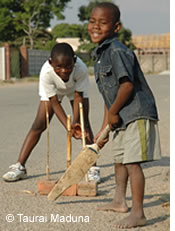 However there are other options for them to consider, especially in the light of the fact that the US$2 million fine will be going into the coffers of the Zimbabwe Cricket Union. Normally one would think that the money would be put to good use, like in the development of facilities and coaching of youngsters like this playing dusty township cricket. But a more likely scenario is that the money will be sucked up by the “chefs” of Zimbabwe cricket for their own misuse. And clearly we don’t want that to happen.


