Kubatana.net ~ an online community of Zimbabwean activists

Beautiful acts of defiance

del.icio.us TRACK TOP
Posted on August 31st, 2007 by Bev Clark. Filed in Uncategorized.
Comments Off

In these times of food, and other shortages, being invited out to dinner is a real celebration of community spirit. Breaking bread with friends has always been special but right now in Zimbabwe it takes on even more significance. Last night I shared a delicious roast chicken with some friends. Amidst the doom and gloom in which we’re living, I mentioned that gatherings such as the one we were having should be seen as beautiful acts of defiance, and of strong spirit.

My host suggested two reasons as to why we are in such a bad state in Zimbabwe. First, he cited a lack of leadership. Not only on the part of incumbent politicians but also on the part of those politicians waiting in the wings; waiting for power. And most importantly, he also mentioned you and me – us; contributing to the lack of leadership. How do we apply creative leadership in our families, our relationships, our schools, our companies – our every day lives? Yes, there’s an amazing amount of leadership in terms of “survival” but how much effort are we making in the area of solution?

His other suggestion for our collective national disaster is that most change occurs through Hope, and not through Despair. So if we are waiting for the “peasants” to rise up because full scale starvation has set in then we’ll be waiting for quite some time. He said that most often poor, starving people don’t rise up, they quietly die.

As I sit here this morning contemplating how to be usefully and creatively involved in working for Zimbabwe’s rehabilitation I smell fuel on my hands. Not even Marks and Spencer’s Olive Green body butter can mask the smell! My early morning was spent siphoning fuel so I could make a trip to the airport. And it got me thinking about how we, all of us (Mr Tsvangirai as well), can ignite our imagination and frame our future and our actions in hope, rather than despair.

A wild patience can take us only so far.

“Values” as impediments to progress

del.icio.us TRACK TOP
Posted on August 31st, 2007 by Natasha Msonza. Filed in Uncategorized.
1 comment filed

I learnt from The Standard of August 26 with great shock that the decision to introduce sex education in India’s schools is being widely opposed by so-called elders. Some teachers in Uttar Pradesh even threatened to make a bonfire of books. The training kit aimed primarily at creating awareness about HIV and AIDS is being condemned on the grounds that it is too “graphic”. How crass can the Indians get? How ironic and funny too for a country with a population of one billion+ people. Clearly a majority of them are having a lot of unprotected sex. You know what’s funnier? When applying for an Indian visa one of the questions on the form is: “Upon arrival in India, if you test HIV positive, will you return to Zimbabwe?” Talk about discrimination! All this is in the name of protecting the “Indian value system”. Whatever that means!

I recall also Zambia’s Information Minister Mike Mlongoti being quoted in the Mail and Guardian (24/08/07) as saying that the region “can’t pressure Zimbabwe because it is a sovereign state”. Whatever that means! The Zimbabwe government insists there is enough food when the supermarkets have become shelf brokers and some NGOs are implementing feeding programmes in parts of Harare urban. The UN will tell you it does not and cannot intervene where a government’s actions do not constitute a threat to international peace. Yet neighboring South Africa spends millions just trying to get rid of illegal Zimbabwean migrants daily while other Zimbabweans flock into other neighboring countries where they are reportedly hoarding commodities at a rate that locusts demolish a maize field. Another unprecedented number leaves daily to the “Diaspora”. I mean come on, what is it with people and refusing to see things as they are? What do people gain from pretending not to see certain things? Surely the UN can see the impending disaster here? Are we going to ask ourselves again whether this could have been avoided, just like the Rwanda holocaust could have been?

I do not recall where exactly I read it, but someone was imploring Zimbabweans not to despair commenting that AU members will live to regret ever bootlicking Mugabe for they did not foresee how our crisis can so easily affect them. Already Botswana, “small Botswana” is complaining of shelves being wiped clean in seconds every time Zimba’s walk into their supermarkets. I feel so much like saying, “that oughta teach em” but somehow, that just doesn’t seem to cut it.

It’s not funny any more

del.icio.us TRACK TOP
Posted on August 30th, 2007 by Taurai Maduna. Filed in Uncategorized.
Comments Off

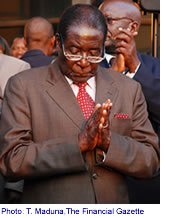
Robert Mugabe addressing veterans of the liberation struggle. Photo: Taurai Maduna, The Financial GazetteToday the electricity at my cottage went just after 5am. I was about to wake up and do my ironing. That was the first challenge.

Challenge number two was knocking at my landlord’s door and kindly asking him to switch on the borehole to allow me to fill up the numerous water containers in my small kitchen. I have not had running water for the past seven days and the borehole has done very little to help because there is no ZESA and when ZESA comes I’m not usually at home to do the boring chore of filling up buckets and empty Mazoe containers. Yes, it’s simply not funny anymore.

Yesterday was a big day for me. I got my first shot of President Robert Mugabe at ZANU PF Headquarters. I was allowed inside thanks to my press accreditation card from the Media Information Committee (MIC). The wait was over five hours in the blazing sun as I discussed how to get the best photo of Mugabe with my colleagues from other media houses. However the five hours were not dull at all. We were entertained by the War Veterans who had assembled as early as 8am for their solidarity march. They chanted their revolutionary songs, the women danced, while most of the men seemed tired from toyi toying in town earlier in the day where they marched ‘peacefully’ with a police escort. Imagine that happening to the NCA, MDC or the lawyers.

The president finally arrived. He was smart. Dressed in a brown suit, striped shirt and matching tie. He got thunderous applause from his supporters. In his eloquent English and Shona he thanked the war vets for their support and how they should prepare for the coming elections. Then he mentioned that he was not going anywhere and that people should forget about an exit strategy. I looked at him and gently smiled as he said, “here I was born, here I have lived..” and we all silently joined him as he said, “..and here I shall die”.

I wish it was funny but it’s not any more!

What’s my contribution to the solution?

del.icio.us TRACK TOP
Posted on August 29th, 2007 by Amanda Atwood. Filed in Uncategorized.
Comments Off

At the Kubatana Creative Visioning meeting the other morning, Luke Tamborinyoka’s piece 71 dark days in Mugabe’s jail came up. In particular, his comment that:

Another reality struck as I walked out of the prison complex, that in fact the whole country was just another big prison. Harare Remand was simply a microcosm of what the whole country has become. There is no food on the shelves; starvation is stalking the nation and people can no longer afford to visit each other because of prohibitive transport costs. Zimbabwe has simply become a big prison with Mugabe as the chief warden.

It got us talking about the need to reclaim our country and redefine our role in it. Zimbabweans have slipped into the “us versus them” mentality that puts “those people” at fault for our problems – thus removing the burden of responsibility from our shoulders. But, in our own ways, we are all “those people” – when I elbow others out of the way so that I can secure my own spot on the back of the open bakkie to get home, when you race to get into the queue for the bread, the sugar, or the beer, when we plot how to make our own lives more comfortable, rather than tackling our current crisis at its roots, we are part of the disease, not the cure.

So we asked our subscribers: if our country has become a prison, how do we distract the warden and make him drop the keys, how do we sneak into his office and grab the keys for ourselves, or how do we take the prison apart brick by brick from the inside? How do we change our attitude and get ourselves out of this disempowered mentality that gives away the responsibility for our own liberation?

We received a range of thoughtful, inspiring suggestions, a few of which are listed below:

Zimbabweans of all political and religious persuasions must admit that we are all of us to blame for what we find ourselves in. The politicians’ politics has failed us (both governing and opposition politicians); the prayers or lack thereof of religious Zimbabweans have not yielded the Zimbabwe we want yet. The complaints of the complainers has not brought about the change we want, (if change is what we want) But what change? Of culture, politics, work ethics, relationships one with another or of religion? If change is what we want, lets go beyond the slogan and define the change we want; and that slogan must be a slogan for all Zimbabweans and not for certain sections of the Zimbabwean populace.

How about we grow some vegetables, takes away some of the helpless feeling, plant a container garden! Get a jik 2 litre bottle, cut of the top part of it, poke some smallish holes into the sides, dig it into the ground, leave it so you can fill with water and plant your seeds / seedlings around it. Keep the container filled with water, so your veggies have water. Water wise and economical and it works. Smile, laugh, even when things really get you down, it is truly amazing the difference it can make to a bad day.

1. All of us admit and own up to ourselves our contribution to the mess. If we are honest we won’t think hard to find the part we have played or omitted to play.
2. Decide decide decide! To build good relations with all other Zimbabweans and to become part of the solution and not part of the problem.
3. Engage our minds in unity to find solutions. Ask ourselves “what is my contribution to the solution?”

Prison, maybe, but even prison has hopeful people, I know some of them. My husband was arrested, but their attitude was “make the best of a bad thing” 17 people in one holding cell, 4 blankets on a cold floor, mosquitoes and they talked and sang. They came out smiling.

No one person can bring down a great country like Zimbabwe and no one man or woman can build it up. Everyone has a part to play, yes Everyone.

Life is what you make it, this was the first thought that came to mind. It is a struggle yes, but the struggle is made worse if we have a pessimistic attitude. We are in a position to make the change, to all we touch, to all we do. I have been teased recently because I have been eating more veggies and fish, I haven’t eaten this healthy in a long time! Whenever I have the opportunity, I buy what I can, from vendors in the local flea market, I buy avocado’s, tomatoes, onions and potatoes, cabbage, etc. I haven’t had oil for a while, a margarine, milk and bread is a luxury. When we travel, I buy from street sellers, often a sack of potatoes, oranges etc. Life is not as easy as we have previously had it, but we can still make it work. A great deal is your attitude, in our positions we need to be positive, we need to be an example. Whining and complaining does nothing but add to stress levels, yes, we have much to complain about, we can also complain about the healthcare, lack of drugs etc, we can complain about the pensioners – has anyone recently been to a home to see what they can do to help? A visitor makes one person or many so much happier for a little while. Many of these people are far worse off than we are, they have no friends or family here, or if they do have family, the family don’t like to visit because of the guilt they feel afterwards . . .

We live in a throw away society, how about we recycle and we become a society that is no longer a rubbish pit, but a proud and thriving community.

The ones Amnesty International left out

del.icio.us TRACK TOP
Posted on August 29th, 2007 by Natasha Msonza. Filed in Uncategorized.
Comments Off

I was one of those lucky enough to receive from Kubatana a hard copy of Amnesty International’s latest report on Zimbabwe; Between a rock and a hard place: Women human rights defenders at risk.

The report had very good observations, as I expected. The researcher really did justice to her work. However, going through the report, you really get the feeling you are reading a Women of Zimbabwe Arise (WOZA) corporal abuse report. In the forty paged report, most of the researcher’s examples are the activities of WOZA. Not that I have anything against them, as a matter of fact; I am a huge fan and admirer of their resilience. But those women are not the only outstanding human rights defenders in this country.

How is it possible for one to talk about women human rights defenders, and leave out Beatrice Mtetwa, President of the Law Society of Zimbabwe who in May of this year was made to lie on the ground and get thoroughly beaten up together with her male counterparts in public? Is she not at some sort of risk too? What of her long record of sterling work as a defender of the very fundamental and most important right to freedom of expression? Mtetwa is the recipient of the CPJ’s International Press Freedom 2005 Award. I kept the picture of her from the Standard, half naked with bruises all over. I was glad at least that Grace Kwinje was mentioned in passing as being one of the MDC members who got severely injured and needed hospitalization.

How about the women who risk breaking their backs or literally dropping dead carrying impossible weights of groceries across hostile borders to feed not only their families but also you and I? They come back with scarce commodities like cooking oil from South Africa for you and me to buy. These are informal cross border traders who have been pushed by the harsh economic climate and food shortages to go for days on end away from family in territories where Zimbabweans are considered the enemy. They are especially vulnerable to harassment, abuse and health risks, spending extended periods in high HIV transmission areas where those who command authority, e.g. border/customs officials/money changers/ taxi drivers often take advantage.

These women, Reiko Matsuyama – Project Officer with an IOM programme called Partnership on HIV and Mobility in Southern Africa (PHAMSA) – aptly described as “a largely invisible population”. Just for the realization of the right to live; they are in constant friction with the police, sometimes braving cold nights in the open trying to get visas. Does being an activist necessarily mean you have to first get a thorough beating before you are recognized as such? So many other rights defenders go unnoticed everyday of their lives, but fight tooth and nail for the well being of this country. But then again, I guess it just had to be a forty-page report!

As for going through the recommendations, I could not help but feel a certain kind of despair. I mean the researcher writes that, “Where injury is caused by use of force, police must ensure that assistance and medical aid are rendered to the injured . . . at the earliest possible moment . . .” Is this a joke? Injury, especially by the police to non-violent protesters is not by accident.  The researcher also recommends that the perpetrators ensure aid comes through. How about a recommendation to confront the errant police themselves? No one is above the law. Why treat them like they act absent mindedly, the I-slid-my-foot-under-yours kind of mentality. Being a cop does not mean you are always right and are following rules. It would be nice to see a sentence that reads, “Errant police terrorizing innocent and non-violent protesters should be prosecuted, despite rank or office.”

As for recommendations to Mbeki, I think lets rather forget about those, and look at how best to deal with the next theatrical piece coming from the Mwanawasa productions. The last annual SADC summit in Lusaka provided an excellent preamble to what we should anticipate.

Vision and imagination

del.icio.us TRACK TOP
Posted on August 24th, 2007 by Amanda Atwood. Filed in Uncategorized.
Comments Off

Inspired by this piece by Brian Chikwava, Kubatana recently sent a text message to our SMS subscribers asking their thoughts on Chikwava’s comment that “Mugabe aside, there is also the failure of the opposition to articulate its vision.”

We got mixed responses, with some agreeing with Chikwava, and others attributing the MDC’s difficulties to the constrained democratic space and absence of rights like freedom of expression.

Some of their replies included:

Well, yes there is need to re-check and weigh the seriousness of the current opposition and leadership, then develop the way forward.

No. The opposition is denied a chance to air it’s views to the people by the ruling party thru a network of legislation – POSA, AIPPA, etc. The overall impression will be that the opposition is not doing enough.

No matter how brilliant the opposition’s vision may be without genuine and active support from the masses they can only go so far

It is so becoz of the failure by the opposition to form one force & the failure to get the much needed publicity to their audiences.

I dont agree entirely. There is no political space 2 articulate.

I don’t think it’s the opposition that has failed, the evil regime has created conditions that have curtailed the efficacy of the opposition

Haisi yaTsvangirai to free this nation. Pliz do not point finger. Iwe neni tinebasa (It’s not (MDC leader Morgan) Tsvangirai’s job alone to free this nation. . . We all need to play our part.)

Instead of coming up with clear national policies and formulating strategies to win the elusive rural electorate they spend time mudslinging each other much to the glee of Zanu PF. The opposition must revisit its charter and really try articulate its envisaged vision and goals or else it could find itself in the dustbin of Zimbabwean politics.

A member in Masvingo sent us an email saying:

I feel that the only party that once demonstrated a lot of vibrancy at its inception is now failing to live up to its original promise of fighting for the suffering masses. Instead of focusing at the mammoth task at hand MDC has shamefully dismantled itself into factions a feature that does not only spell doom onto the restless electorate but further entrench the Zimbabwean populace into a serious economic and political logjam.

What these two factions are supposed to do is to unite and fight for the electorate who are the worst recipients of gross violation of human rights, abject poverty brought by mismanagement of our resources and serious misrule. Tsvangirai and Mutambara should not take us for granted .If they can’t lead to the much awaited political glory where democratic principles are jealously against decay and our battered economy is brought back on track then they have to call it quits and let those who are strong enough to absorb the political heat currently prevailing. Mugabe can be underrated at the opposition’s risk as he has vehemently denied to step down as required by the constitution and as if that is not enough the old man like wine is getting better with age in ZANU PF’s perspective.

Our subscribers’ comments are a sobering affirmation of Trevor Ncube’s contention that “Zimbabweans right now are confused by the division within the MDC. They are disheartened and indeed feel the pain of abuse that comes from Zanu-PF. They are running around looking for a home and they are unable to find it. For me the third way has been a rejection of the politics of Zanu-PF, a rejection of the politics of the MDC and an opportunity to offer a new beginning for Zimbabweans. But I have realised that the third way is an idealistic position…an idealistic position that in this particular time might be a luxury.”

As the prospect of 2008 elections draws ever closer, I’m finding an increasing need to suspend my own cynicism. I am seeking hope and encouragement that the prospect of this “third way” is not so naive or idealistic after all – that somehow it is possible to re-imagine the terrain of struggle in Zimbabwe, shake up the ways we articulate issues and position ourselves. I’m looking for ways to move to a space where “politics” isn’t about whether I belong to one political party or another, but is instead, to paraphrase Martha Gellhorn, about “my standard of living, my health, my job, my rights, my freedoms, my future or any future.”