Kubatana.net ~ an online community of Zimbabwean activists

Potentially unviewable experience

del.icio.us TRACK TOP
Posted on October 22nd, 2007 by Amanda Atwood. Filed in Uncategorized.
4 comments filed

Eyes on Zimbabwe is a new feature on Zimbabwe on the Open Society Institute website. They are trying to raise awareness about the crisis in Zimbabwe in advance of Parliamentary, Presidential and local government elections to be held next year. The highlight of the site is “Zimbabwe: The Fight to Free a Country,” a video which apparently “combines footage from inside Mugabe’s police state with testimony from torture survivors, activists, and lawyers who have witnessed the regime’s repression first hand.” The site also features links to additional resources, and a petition and letter to the UN which you can fill in on line.

It sounds like an interesting video – and one which plenty of people here could benefit from watching. It seems like people living outside the country, with the benefits of TV and the internet, often have greater access to independent, accurate news on events in Zimbabwe than do the vast majority of people living here.

I’m lucky enough that the broadband connection at the office means I can see the Timeline (which I couldn’t view on my dial-up access at home), even if it’s a Flash Player page which on my browser remains stuck on 1980. But even with the high-speed connection at work I can’t watch the video. Instead, an error message appears: “This player requires a faster connection to enable smooth playback of video. The connection speed detected will cause a potentially unviewable experience.”

VOA also recently posted a video of activism in Zimbabwe. That one at least includes a dial up version which can be viewed from here, even if the image quality is so poor as to make it barely watchable. This page also links to other VOA videos on tourism, food shortages and hyperinflation.

I’m hoping some people out there in the developed world of high speed connections can view these materials and leave some comments that help people here know what they are all about.

These videos are just the latest contributions to a growing pool of information on Zimbabwe that is conceptualised and developed outside the country. The government’s Gukurahundi massacres in the 1980s which left over 20,000 dead, were well protected from the bulk of international news attention, and at the time went largely unnoticed. The age of Internet, digital photography and satellite connectivity means that the current economic collapse and political turmoil are captured, recorded, and beamed around the world. But ordinary Zimbabweans don’t have access to satellite television or high speed Internet connections, and they remain stuck with state radio, state television, and word of mouth.

I’m all for increasing international awareness in the hopes that it eventually increases international pressure which, in turn, eventually contributes to the change here. But where are the local actions from this global thinking? Is the Soros foundation burning thousands of DVDs of its film and distributing them in the high density areas of Zimbabwe’s cities, where DVD players have become surprisingly common place? Is Studio 7 VOA News making newspaper versions of its Shona and Ndebele broadcasts and distributing them among rural communities?

International attention matters. But it’s no substitute for local pressure. And critical to building that local activism is making a range of materials that inform, inspire, challenge and motivate Zimbabweans readily accessible to them. Let’s see more international support for these locally produced and locally disseminated information initiatives – rather than one more internet video that is potentially unviewable for Zimbabweans.
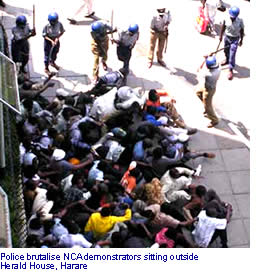
Needless, paranoid brutality

del.icio.us TRACK TOP
Posted on October 19th, 2007 by Amanda Atwood. Filed in Uncategorized.
Comments Off

View more images from this demonstrationNot that police brutality is ever acceptable. But treatment of National Constitutional Assembly (NCA) activists this week challenge hopes that talks between Zanu PF and the MDC, and the two parties’ recent agreements on Constitutional Amendment 18, mean a softening in the government’s position on freedom of expression. The state may be planning on revising repressive legislation such as and AIPPA, but in the meantime, freely expressing dissent remains as challenging as ever.

According to the NCA, over 400 people participated in a peaceful march in Harare against the 18th Constitutional Amendment. The demonstration was interrupted by the police, and those demonstrators who did not run away in time were rounded up by the police and forced to sit outside Herald House while the police took turns beating them. The photo on the left gives an evocative image of police’s heavy-handed treatment of these demonstrators, even once they were seated and clearly not posing any physical or immediate threat to anyone. You can see more on the SW Radio Africa website.
The NCA reported that 34 people sustained serious injuries from these beatings, and were taken to hospital for treatment.

The dangerous acts these activists committed which caused the police to lash out at them like this? Daring to hold a demonstration and carrying placards reading things like: “No to Amendment 18,” or “No to treachery.”

Home based neglect?

del.icio.us TRACK TOP
Posted on October 19th, 2007 by Amanda Atwood. Filed in Uncategorized.
2 comments filed

A friend of mine volunteered in Masvingo for a few months doing household surveys of rural families in that province. The main focus of the project was to find out how families were being affected by HIV/AIDS, and what kind of coping strategies they had developed. She was shocked by how poorly the majority of families she interviewed were doing. HIV was hitting the adult population hard, making it difficult for families to carry out the basic chores and activities they needed to do to survive. Home based care had been an option for some of these families, but she commented that it was becoming more a case of “home based neglect.” When the price controls hit and goods vanished off the shelves, relatives and caregivers in many cases stopped visiting. Whether they were too busy trying to feed their own families, or too embarrassed to visit their charges empty handed, she didn’t know. But either way, they stopped visiting, and those dependent on their assistance were suffering.

Her story reminded me of Tafadzwa Muropa’s recent reflections on home based care. As she put it,

I would like to share my experiences and views in relation to how I see the state of Home Based Care in Zimbabwe and how it is evolving, since most care givers are women, who have a double burden of taking care of the clients who are bedridden in most cases, and also have other responsibilities at home.

My concern lies in the state’s response to the question of not acknowledging the efforts put by women in HBC, by offering them stipends, allowances, or remuneration, especially during these harsh economic times.

Her piece raises concerns similar to those my friend found. Home based care provides individuals with care and support which the state is not currently providing them.

In a recent interview, Lynde Francis, the director of The Centre, observed that the current economic situation is so bad, some Zimbabweans are trying to pretend they are HIV-positive, so that they can benefit from the services and food parcels that those living with HIV have access to.

But when will government prioritise care for its citizens and step into the void which home based care givers and other service organisations are now trying to fill? As those who can increasingly opt-out of Zimbabwe and try their luck in the Diaspora, who is left to care for those in need? How do we support care givers so that they stay engaged, and don’t give up because the are feeling overwhelmed or taken advantage of? Home based care givers are currently providing an essential service of physical, nutritional, moral, psychological and even spiritual support to many of the quarter of all Zimbabweans currently estimated to be infected with HIV. Ever adaptable, Zimbabweans are finding new and creative ways to adapt to the growing strain of life here. Even as we do so, let us not forget the importance of demanding that government also fulfill its responsibilities.

ZBC’s penga poll: readers’ responses

del.icio.us TRACK TOP
Posted on October 19th, 2007 by Amanda Atwood. Filed in Uncategorized.
1 comment filed

In our latest email newsletter we asked our subscribers to send in their thoughts on the ZBC poll and what was missing from their list of causes of the current shortages of basic commodities. Here are a few of their responses:

The government is responsible.

————-
With interest I saw your poll on your website regarding who is to blame for shortages. May I suggest to add other possible culprits: the pricing control commission, the ministry of commerce and the cabinet.

————-

I was interested to see that you are carrying a poll on your website re the shortages, but I do feel you are not providing the viewer with sufficient choices to make the poll meaningful as they are limited to manufacturers, retailers, black market, western sanctions. May I suggest that you add government to the list – this may provide you with a more credible result.

————-

My strongest opinion is that shortages have been caused mainly by the ruling party chefs as they are the only ones with meaningful business properties in Zimbabwe. They own up everything. How many opposition members we know who are operators of all sots of businesses beside Zanu PF stalwarts. It is a wonder that Mugabe stands there pointing his finger at western sanctions when he cannot ask his politburo friends what they are doing within their businesses. They are all in agreement that goods are extremely expensive when they stand in their meetings but cannot wait to run straight back to their organizations to push upwards prices then claim later suppliers have cut back supplies because of price controls. They are not a clean lot. They are the greatest shortages causers.

————-

The range of options is too narrow, and tends to show that the author of the survey has a superficial appreciation of how economies function. In fact the question should be: why are Zimbabwean producers not satisfying the demands of the market? In respect of the present, superficial question my response would be: NONE OF THE SUGGESTED ANSWERS -
Manufacturers – do not have the inputs required, as they cannot afford them
Retailers – do not manufacture anything, they are just intermediaries
The black market – is always created by bottlenecks in supply, and can disappear as quickly as it can appear if there are changes in those areas
Western sanctions – what sanctions? Preventing a megalomaniac dictator and his cohorts from gallivanting all over the world at will talking nonsense certainly does not equate to sanctions.

The real cause is the subordination of everything else in that country and economy to uncontrolled hunger for dominance of everything and everyone! All other ’causes’ are just symptoms and consequences. My two cents worth.

————-

My views are retailers are to blame because when they have goods which are scarce they take advantage and sell these to their staff who later transfer this to the black market. Black market is at other times responsible, but their contribution to this can be cut straight right easily. If supply is increased. On the term of the Manufacturer it is difficult for them to fill the market even, if they are responsible for commodity shortages but they have corners to hide about this they blame low production, high running costs, lack of foreign currency and poor electricity supply.

So as my point of view before these 4 above have been resolved I think shortage will continue and builds up more opportunity for black market. For us to have a good point of view let’s think what are factors that builds black market.

————-

ZBC should be on the list, broadcast the truth of the matter and you get off the list clean.

Our own racists

del.icio.us TRACK TOP
Posted on October 18th, 2007 by Natasha Msonza. Filed in Uncategorized.
11 comments filed

One of these past few days I entered one of those high security buildings where they scan you with those metal detectors and things for security reasons. This is the process that follows immediately after signing your details in a visitors’ book and handing in your I.D, among other things. Whilst I was still at stage 1 (of filling in personal details), one white lady who had been behind me waltzed past the guards manning the inner entrance after enquiring which floor such and such an organization was. When it was my turn, the female guard quickly moved into place to start zapping me with the metal detector. Instinctively, I stepped back and demanded to know why she had not also zapped the white woman who had entered before me. With a puzzled (if not surprised) look, she just shrugged and without answering my question, told me she had to scan me for security reasons. I neatly refused although I had nothing to hide, and demanded free passage. What criteria did they use to decide who got subjected to that annoying and almost embarrassing ritual? I noticed I was slowly gathering a small crowd and felt I was also getting red in the face. But I was determined, and so were both guards. The male guard told me in my face I had a choice to either get searched or leave. I chose the latter, spun right round, demanded my I.D back and left a puzzled audience. My business there could wait.

My dad was telling me the other day that one afternoon at lunch, he and a fellow (white) workmate set out to hunt for sustenance around the shops. As they drove around town, the most they came across after almost half an hour of searching were a couple of Chelsea buns selling at $100 thousand each. Between them they needed at least ten, and that meant parting with 1 million bucks. They decided they’d rather forego lunch. As they drove back to work, my father spotted a hawker by the roadside and bought two packets of maputi from her; one for him and the other for his workmate. As the two stood outside the car and ate, they realized they had gathered around them a small crowd who were visibly shocked at the sight of a murungu (white man) eating maputi. Someone apparently shouted that: “Nzara yazotiyenzanisa manje baas.” Loosely translated to mean hunger has now made us equal. Apparently very fluent in Shona, my father’s workmate lashed out asking the man who had shouted what the kind of food anyone ate had to do with anything? Did the man think all Zimbabweans were only black? I thought those were good questions.

Then I was reading in the Independent about the few remaining white farmers who were recently served with eviction notices with a 90 day grace period to wrap up and vacate their properties. The farmers have appealed to the regional Southern Africa Development Community (SADC) Tribunal in an effort to stop government from illegally expropriating their properties. According to Vice President Joseph Msika, these few remaining are “remnants of die-hard unrepentant racists. These farmers have done their best to prevent agricultural production in many parts of the country; and have made a significant contribution to the country’s economic collapse.”  I couldn’t help agreeing with Muckraker when he/she wrote: “…primitive racism is now the official creed of Zanu PF.” Now before anyone starts labeling me an unpatriotic born-free who doesn’t understand the sovereignty our ancestors died for; will the real racists please stand up?

Zimbabwe Broadcasting Corporation’s penga poll

del.icio.us TRACK TOP
Posted on October 18th, 2007 by Bev Clark. Filed in Uncategorized.
4 comments filed

The Zimbabwe Broadcasting Corporation (ZBC) is currently running a poll on their website.

They are interested in finding out who is responsible for the current shortages and they give us four “culprits” to choose from: manufacturers, retailers, the black market and western sanctions. So far the ZBC poll indicates that Zimbabweans think that the black market is responsible. Next in line with 31.23% is western sanctions, followed by manufacturers and lastly, retailers. It seems like the ZBC needs a little bit of help in expanding their list . . . email your suggestions of other causes of the current shortages to news@newsnet.co.zw