Kubatana.net ~ an online community of Zimbabwean activists

Postcards from the Edge

del.icio.us TRACK TOP
Posted on November 9th, 2007 by Bev Clark. Filed in Uncategorized.
Comments Off

Just now as I wandered through Newlands Shopping Centre in search of cash a vendor tried to sell me an automatic Italian umbrella, whatever that is.

I’d like to be able to flush the toilet at work except I can’t because we haven’t had water for the whole of this week. I’m starting to drink less, all the tenants in the building are starting to drink less, but its Not Working. The toilets are foul and our collective tempers are explosive. But back to the cash – imagine not being able to withdraw your money from the bank – admittedly there’s not a helluva lot you can buy with it, but still, it’s Mine.

What else? When it rains here our already demented drivers, drive even more poorly. Zimbabweans reckon that the best way to approach non-working traffic lights is to put their foot down on the accelerator, turn their hazards on, and go like the blazes. This might be a worthwhile tactic if you’re being pursued by a naked Oppah Muchinguri but its not helpful to other motorists who are trying to negotiate some right of way.

OK. So you can tell I’m stressed. In an effort to engage in some self-help I read a Time Magazine article on stress management last night. It said one should avoid TV and junk food if you’re feeling a bit edgy. Just before I read this I’d been watching So You Think You Can Dance while eating 4 liquorice strips.

Survival of the biggest in Zimbabwe

del.icio.us TRACK TOP
Posted on November 9th, 2007 by Amanda Atwood. Filed in Uncategorized.
Comments Off

Harare’s many non-functioning traffic robots provide frequent opportunities for contemplating human nature. As a friend of mine was saying the other day as we tried to turn right at a busy, robot-down, intersection, why do so many of us move with a sense of rushed-ness and our own importance that somehow gets in the way of our own decency.

Of course, it’s never as simple as that. Through all the murk a few moments always stand out. The girl walking home from school who runs alongside me for a bit of a chat. The cyclist who smiles an apology when his bell gives me such a fright I jump clear into the bushes.

But some days those gems feel more the exception than the rule. Watching the traffic at another intersection on my run the other night, I thought to myself, “it’s survival of the biggest.” The pushiest, largest, flashiest 4x4s muscle their way into the intersection however they so choose. And the rest of the traffic just has to comply.

It reminded me of what someone had been telling me earlier that day. She works as a nurse and does the rounds of Harare’s government hospitals. Zimbabwe’s health sector has drastically deteriorated in recent years, and it is not uncommon for clinics and hospitals to lack even the most basic of medications and supplies.

According to this nurse, however, this isn’t because the hospitals lack the foreign currency to import these items, or because of a lack of donations from well-intentioned foreigners. Zimbabwe’s government hospital doctors are severely underpaid. Many also maintain a private practise where they can see patients separately from the hospital, and charge more for these visits. The nurse I met claims that these doctors take the supplies from the hospital shelves and sell them to the patients they see in their own practise.

It’s a serious allegation which needs to be further substantiated. The hospitals’ empty shelves may well be a combination of fewer goods in the first place, since the hospitals can’t afford the foreign currency to import what they have to. And those doctors who can get away with it might well be skimming off medications to resell and top up their meager income. If that it is the case, it’s the traffic robot scenario all over again – if you’re wealthy enough to afford private health care, chances are you’re wealthy enough to pay for marked up medication as well. And if you’re not? You’re left to sit in the car park outside the hospital untreated. The chefs get smugger. But what’s the outcome for the rest of the population?

Hero to zero

del.icio.us TRACK TOP
Posted on November 5th, 2007 by Amanda Atwood. Filed in Uncategorized.
2 comments filed

The Solidarity Peace Trust recently released a new DVD. Hero to zero: A brief history of the Zimbabwe dollar, tells the story of the nosedive of our precious Zimbabwe Kwacha, from Independence in 1980 – when 1 Zimbabwe dollar would return you 2 US dollars, to today, when 1 billion (old) Zimbabwe dollars isn’t enough to exchange for 1 US dollar.

Get the DVD! We’ve already had a massive clamour in response to our SMS invitation to receive the DVD. But not to worry. We have some copies reserved for our loyal Kubatanablog readers. Be among the first 20 people to write to info [at] kubatana [dot] org [dot] zw to request this DVD, and we’ll post it to you. Please make sure to let us know that you’re writing in response to this blog, and include your postal address in your email. Regret – this offer is only available for addresses within Zimbabwe.

It doesn’t take a rocket scientist to understand the Zimbabwe dollar’s dismal trajectory, and economist Rob Davies, one of the main interview subjects in the video, charts it beautifully. Countries that really want to control inflation, he says, get concerned when money supply rises more than 5% in a year. In Zimbabwe money supply increased by 120% in May of this year alone. Granted, money supply is the immediate cause, but it’s not the sole culprit causing inflation – why does the government print so much money so rapidly? To protect the incomes of the people who support it.

Davies comments that the national cake has shrunk drastically. And when the cake shrinks, someone has to eat less. The politicians, he says, have used their influence over instruments of the state to make sure it’s not them or their supporters.
The DVD also touches on the rise of the informal sector – despite the government’s best attempts to choke it, through actions such as Operation Murambatsvina. As one school teacher points out, if you’re a teacher struggling to make ends meet, at what point do you decide if it’s more worth your while to sell airtime on the streets, knowing that as a vendor you can make eight times more than you can as a teacher.

Finally, Davies asks, why are Zimbabweans so patient with something that is messing up their lives? If this economic decline was happening elsewhere, would it not have sparked some kind of popular uprising or resistance? Davies describes Zimbabweans as tolerant, and says this tolerance is a mixed blessing. On the one hand, it makes the country more open to difference, more relaxed and integrated than it might otherwise be. On the other hand, perhaps it means we’re stuck with these injustices longer than others might be.

So why aren’t people here organising into a more effective resistance movement? It’s a question well worth asking. But the answer, I suspect, lies in a range of factors including intimidation, repression, leadership, logistics and vision. Change is daunting for anyone. We are either pressured into it when we realise we have no other option, or when we’re presented with an alternative so compelling it motivates us into positive action.

As Davies points out, the people who are really suffering from inflation and the shortages aren’t going to be the leaders of change – they’re more concerned with day-to-day survival. Sadly, our political leaders haven’t been able to paint that vision of the new Zimbabwe in colours vibrant enough for people to believe in it and risk everything for it.

The art and soul of building peace

del.icio.us TRACK TOP
Posted on October 25th, 2007 by Bev Clark. Filed in Uncategorized.
Comments Off

The Moral Imagination is an important book to get hold of and spend some time with if you’re involved in conflict resolution and peace building. The author, John Paul Lederach, has mediation experience in a variety of countries including Nicaragua, Somalia, Northern Ireland and the Philippines. According to Lederach, peace building is both a “learned skill and an art”. He believes that people working for peace should regard their pursuit as a creative act.

In Chapter 2 Lederach includes four powerful stories of peace building from different countries including Colombia. In the Colombian example he looks at the emergence of a group called the Association of Peasant Workers of Carare (ATCC) and says “their first act was to break the code of silence. They developed ways of organizing and participating. Participation was open to anyone. The quota for entry was a simple commitment: Your life, not your money. This was expressed in the phrase “We shall die before we kill”. They developed a series of key principles to guide their every action.”

During these challenging times in the pro-democracy movement in Zimbabwe, I think its useful for us to consider how we can apply these principles while working for peace:

1. Faced with Individualization: Solidarity.

2. Faced with the Law of Silence and Secrecy: Do everything publicly.

3. Faced with Fear: Sincerity and disposition to dialogue. We shall understand those who do not understand us.

4. Faced with Violence: Talk and negotiate with everyone. We do not have enemies.

5. Faced with Exclusion: Find support in others. Individually we are weak, but together we are strong.

6. Faced with the need for a Strategy: Transparency. We will tell every armed group exactly what we have talked about with other armed groups. And we will tell it all to the community.

Polyester and plentiful shelves

del.icio.us TRACK TOP
Posted on October 24th, 2007 by Amanda Atwood. Filed in Uncategorized.
3 comments filed

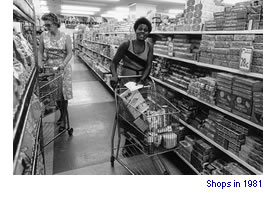
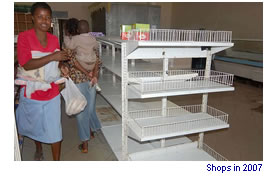
Shops in 1981Shops in 2007I had a look at the SW Radio Africa website, Spot the Difference, and I hardly knew where to begin.

In the picture of the shop in 1981, the shelves are stocked, the shoppers’ trolleys are full, the electricity is on inside the shop, and best of all, the prices? 28 cents.

Today? Barren shelves, empty trolleys, no power, and prices heading towards hundreds of thousands and millions of dollars, not fractions of them. When Reserve Bank Governor Gideon Gono delivered his Mid-Year Monetary Policy Review on October 1st he said, among other things:

It is against this background that I can say without fear of retraction or of being misquoted that it will not be very long before we see visible supply improvements on the ground. We should, by the end of this month [October], see the return of mazoe [orange syrup], soft drinks, cooking oil, soap, milk, bread, sugar and animal feeds on the shelves at affordable [cost to consumers], but economically viable prices to the suppliers.

With one week to go in the month, Gono’s promises of affordable, abundant commodities in our shops are looking increasingly unlikely. To be able to nip out to the shops and buy a packet of biscuits for 28 cents, I think I could stomach the polyester dresses and the over sized glasses. Now if only I had enough ZESA to recharge the battery in my time travel machine . . .

Bridging security in Harare

del.icio.us TRACK TOP
Posted on October 24th, 2007 by Bev Clark. Filed in Uncategorized.
Comments Off

You wouldn’t imagine coming across cars doubled parked in the official Meikles Hotel car park would you? But there they were blocking up the works when I was trying to find parking last Friday. A colleague and I were visiting one of those high security places which Natasha referred to in her blog, Our Own Racists. Unsurprisingly we had a similar experience except this time we were two white women albeit with a sizable age difference. So at the front door the female security guard insisted on looking in our bags and that we hand over our cell phones. She gave my bag a cursory glance which is just as well because she’d need to don latex gloves on account of the fetid bits and pieces that lurk within. My colleague’s bag had a much more thorough going over and finally the security guard demanded that she hand it over. But she pointed indignantly at me and said, well what about her bag then? In response the security guard just shrugged and both our bags bridged security.

After our meeting we thought we’d treat ourselves to coffee and something to eat in the lounge at Meikles Hotel. One of the problems in Zimbabwe right now is trying to work out the correct value of goods to ascertain whether the price is a rip-off. I looked at the menu and saw that a toasted sandwich cost Z$1.3 million which means that a teacher’s salary is equivalent to about 12 toasted sandwiches per month. I thought I’d rather go for a piece of anchovy toast, some marmite toast and a coffee. The waiter returned 5 minutes later to say that there wasn’t any anchovy so I changed my order to marmite toast and a scone. The waiter returned 5 minutes later to say that there wasn’t any marmite. So I had a scone, without butter. And this is a 5 * hotel.

When we left and went to get the car I asked my colleague how much money she reckoned I should take out for 3 hours parking. We agreed on Z$300 000. Turns out it cost Z$40 000.

This upside/downess of Zimbabwe reminds me of an email I got recently from a friend who suggests . . .

Someone this week compared life in Zimbabwe at the moment to ‘living in a blender’. It is very apt. People are discernibly more stressed than they were 3 months ago. The effects are quite disturbing – as people fight to survive – there seems to be less tolerance and love available somehow and a narrow feeling of isolation and separation emerges. It is challenging to be in this space as we go through periods when we lose the thread to that which affirms and connects our lives.