Kubatana.net ~ an online community of Zimbabwean activists

Fear breeds intolerance

del.icio.us TRACK TOP
Posted on May 8th, 2012 by Amanda Atwood. Filed in Activism, Governance, Reflections.
Comments Off

I got a bit depressed this morning when I read The Herald article COPAC in gay storm. For all the bombast of the headline, and the frenzy around keeping gay rights out of Zimbabwe’s new Constitution, there really isn’t much of a story – which just makes the intolerance of the article all the more apparent.

The article references the Constitution’s Bill of Rights, where a non-discrimination clause provides that “Everyone has the right not to be treated in an unfairly discriminatory manner on such grounds as their nationality, race, colour, tribe, place or circumstances of birth, ethnic or social origin, language, class, religious belief, political or other opinion, custom, culture, sex, gender, marital status, age, disability or economic, social or other status.” It latches particularly onto the phrase “circumstances of birth,” and then proceeds to report feedback from a number of lawyers and analysts who acknowledge that yes, hypothetically, this could be used to make an argument to the courts against discrimination on the basis of sexual orientation. Of course, depending on where you fall on the nature versus nurture debate, I suppose one could also make the same argument using the protection of opinion, custom, culture, or other status. But does this mean we must remove the broad notion of tolerance from our Constitution – because some group we might not like might use it to their own benefit? Racism, sexism and xenophobia remain prejudices in some people’s minds – which is why the Constitution explicitly protects people regardless of race, sex and nationality.

Regardless of whether it is used to make an argument in favour of tolerance for homosexuality, including protection against discrimination regardless of circumstances of birth demonstrates the sort of broad tolerance a Constitution should provide. This means it doesn’t matter whether your parents were married when they had you, if you were born in prison, on an inauspicious day, as the child of rape or incest, malnourished, premature and in need of extraordinary medical support, exposed to narcotics in utero, as conjoined twins, as an intersex baby, or any of the other myriad ways in which you might be different from others. You still have the same rights everyone else does.

All human beings are equal. That why they’re called Human Rights. We all get them, regardless. But all human beings discriminate. That’s why fundamental rights and freedoms are including in Constitutions, and why we need protection against intolerance – our own and other people’s. Finding yourself trying to take out a part of a clause designed to promote tolerance? Is all the more reason to work for its inclusion.
‘I’m constantly learning how to be confident’: Beth Ditto

del.icio.us TRACK TOP
Posted on May 7th, 2012 by Bev Clark. Filed in Inspiration, Media, Uncategorized.
Comments Off

Beth Ditto, living life large and proud. This feature from the Guardian is well worth a read.

Clearly, the public fascination with her went way beyond her music, homing in on her evident ease with her body size and shape and her willingness to sound off at the drop of a hat on the issues she felt strongly about, whether it be the iniquities of the fashion industry or the urgency of furthering civil rights legislation. Most simply, she clearly didn’t care. The Daily Mail, for example, once pictured her getting out of a car in slightly inelegant fashion, noting censoriously that “Someone needs to remind Beth Ditto about the rules of stepping out of a car when there are teams of photographers on hand to capture the moment.” It rather fantastically missed the point, which is that she’d have most likely done exactly the same if the entire world’s photographers were there – or not.

The Global Quarter

del.icio.us TRACK TOP
Posted on May 7th, 2012 by Upenyu Makoni-Muchemwa. Filed in Uncategorized.
Comments Off

#HIFA2012 Two minutes with Tariro Ruzvidzo

del.icio.us TRACK TOP
Posted on May 7th, 2012 by Upenyu Makoni-Muchemwa. Filed in Media, Uncategorized.
Comments Off

Acoustic Night debuted at HIFA this year on the Coca Cola Green, how did that go?
It was amazing! We had such a good time and the response was overwhelming! The artists really enjoyed it. It was also their first time at HIFA as well. For a virgin experience it was amazing!

How are you finding HIFA so far?
I’m enjoying it; I just haven’t had time to see all the shows. But I think there are a lot of new people, a lot of new faces. It’s very different from the past years where you had the same faces. We’re enjoying the new talent.

Of the shows that you’ve seen which one is your favourite so far?
Jamaram, not just because its ZGS, but because they’ve got such a lively reggae act. They’re very energetic on stage.

#HIFA 2012 Two minutes with Ommie Mushandu (Granny’s Peanut butter)

del.icio.us TRACK TOP
Posted on May 7th, 2012 by Upenyu Makoni-Muchemwa. Filed in Inspiration, Uncategorized.
Comments Off

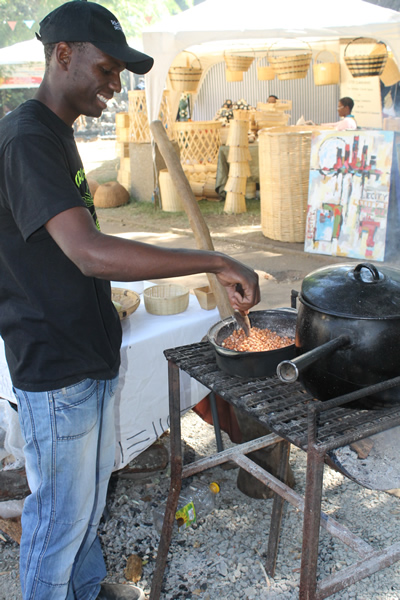
I’ve seen you guys at HIFA for a few years now…
This is our fourth year.

What does your stand sell?
Peanuts, peanut butter and roasted corn.

What is the idea behind your stand?
We want to promote our traditions beginning with food. Some people think that tradition is not good. As you can see I’m a youth, so we want young people to be able to appreciate our traditions.

Citizen journalism can help improve service delivery in Zimbabwe

del.icio.us TRACK TOP
Posted on May 7th, 2012 by Lenard Kamwendo. Filed in Activism, Governance, Media, Uncategorized.
Comments Off

Since the introduction of the Internet in Zimbabwe a lot of people have started to embrace social media as a means to share information and to socialize. In countries in the Middle East social media was mainly used to cover the Arab spring protests where citizen journalists, only armed with a camera phone and Internet connection, managed to cover the events. Recently in Zimbabwe the press has been awash with stories of poor service delivery. The most recent and painful one being of a child who was seriously burnt by naked ZESA cables, the child eventually died. The good thing about citizen journalism is its done by citizens reporting on issues relating to their day to day lives and one can it do it without incurring any costs. Since an informed citizenry is a basic principal of self-governance, citizen journalists are the people who report from the ground and this makes their stories more credible than most of the profit driven articles we now read from the established media houses.