Posted on September 21st, 2012 by Bev Clark. Filed in Governance, Uncategorized.
Comments Off
Tsvangirai’s appeal has faded fast.
This is Zimbabwe’s tragedy: the mantle of leadership has rested too long on the shoulders of the man who currently leads Zimbabwe, and it will sit uneasily on the man who wants to unseat him. But voters are likely to conclude that Tsvangirai is the lesser of two evils. Flawed as he is, he may just make it.
More from Petinah Gappah here
Posted on September 21st, 2012 by Bev Clark. Filed in Activism, Governance, Reflections, Uncategorized.
Comments Off
Only in Zimbabwe … how much shit from this incompetent government will we continue to tolerate?
Bulawayo City Council has come up with a system that will see all residents flushing their toilets simultaneously to prevent sewer blockages caused by the water-shedding programme.
“The public is advised that there is a need to schedule a flush exercise of the reticulation system in all areas that do not use septic tanks,” council spokesperson Nesisa Mpofu said yesterday.
“This is due to the recent water shedding programme by council, which has seen a reduced amount of water entering the sewerage system.
“All residents of Bulawayo are invited and expected to participate in this exercise.
“Every household is requested to flush their toilets systematically at 7.30pm the very day after the 72hours of water shedding.
“This is done to prevent any sewer blockages as we anticipate longer periods without water in the reticulation system.
“Please note that this is in addition to the normal flushing that will occur during the day.”
She appealed to residents to conserve water in order to minimise the impact of the shedding exercise.
Industrial and the central business district are exempt from the water-shedding programme.
Bulawayo is facing severe water shortages after two main supply dams were decommissioned.
Posted on September 21st, 2012 by Bev Clark. Filed in Uncategorized.
Comments Off
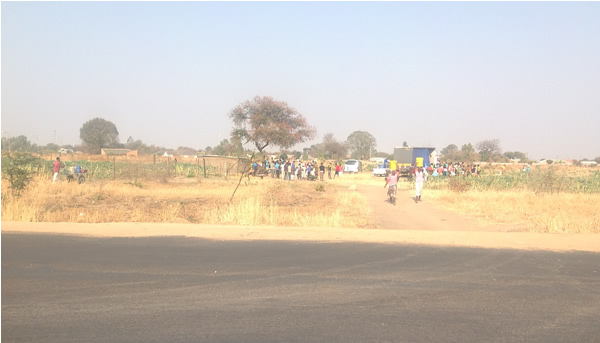
People collect water from a borehole near Emakhandeni Township in Bulawayo. This was the 3rd consecutive day without water.
Posted on September 20th, 2012 by Marko Phiri. Filed in Activism, Governance, Uncategorized.
Comments Off
So, Minister Kasukuwere just woke up and realised that there are 144 colonial-era laws that “stifle the easy empowerment of our people.” Easy empowerment of course being the catch. He says he will be taking up the matter with Cabinet to have these laws amended or repealed. How noble. Of course this is the same chap whose same political party has used the very same colonial-era laws to suppress political activism and dance and stomp on civil liberties. But obviously the irony is lost as these crusaders have made political careers out of brazen double standards. This is yet another reason why sober-minded and progressive Zimbabweans must dispense with the Kasukuweres in the coming polls. Why? Because the same colonial era laws he is choosing not to complain about are being used to deny you the right to support the political party of your choice. Nothing worse than tolerating a hypocrite doubling as a cretin!
But then, Zanu PF has insulted people’s intelligence for so long the party thinks it can get away with anything.
Posted on September 20th, 2012 by Lenard Kamwendo. Filed in Activism, Governance, Media, Uncategorized.
Comments Off
The growing media polarization between “pro-MDC” and “pro-ZANU-PF” camps has reached a toxic level as it is now difficult to distinguish journalists from political activists. The prevailing political situation in Zimbabwe has exacerbated the rivalry and the media is being used for political ends.
The Annual Media Stakeholders’ Conference 2012 was held in Harare yesterday at a time when the country is at a deadlock over the new constitution and the increasing uncertainty of whether there is going to be any constitution at all. The conference, which was hosted by the Media Alliance of Zimbabwe (MAZ), brought together media practitioners and members of civil society from across the nation to take stock of media reforms, which have taken place so far under the coalition government operating the Global Peace Agreement (GPA). Article 19 of the GPA refers to a free and diverse media environment but not much has been done to address this as many journalists and media practitioners have been arrested and charged under Access Access to Information and Protection of Privacy Act (AIPPA).
According to a presentation by Andy Moyes of Media and Monitoring Project of Zimbabwe (MMPZ) the government has established the Zimbabwe Media Commission and since the establishment of the Commission the number of registered media organizations has risen to 65. However it should be noted that the Commission is still a government-controlled body as it still operates under the provisions of Access to Information and Protection of Privacy Act (AIPPA). The Zimbabwe Media Commission has recently come under attack from some sections of the media who view its establishment as an attempt to stifle media plurality, expression and press freedom. The same Commission has been criticized for lack of transparency in the awarding of licenses, which has resulted in a number of private radio stations crying foul. In what can be viewed as a deliberate move to stall reforms before elections no community radio station has been granted a license to operate to date.
Multiplicity does not necessarily mean the licensing of two radio stations can evidence diversity in content. The two stations, which came into operation recently after being granted commercial broadcasting licenses. One of the two radio station Star FM comes from a state run media house and the other one Zi FM is operated by a former Zimbabwe Broadcasting Corporation news anchor who has denied strong links to the former ruling party ZANU PF.
The continued use of hate language, fabrication of stories, biased reporting and publication of highly opinionated stories is another sign of the high level of unethical practices which some journalists and media houses practice. To some extent the increased invasion of privacy especially by state media related to the Prime Minister’s private life has left many wondering if there are still any ethics being practiced in the media profession. The standard of journalism in Zimbabwe has deteriorated to that extent that the content being produced is now regarded as being unreliable.