Kubatana.net ~ an online community of Zimbabwean activists

Archive for the 'Uncategorized' Category

High price for freedom

del.icio.us TRACK TOP
Friday, October 12th, 2007 by Amanda Atwood

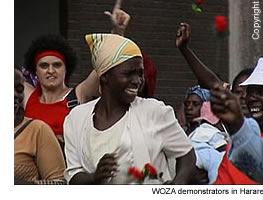
050214woza_hre2.jpgAcross Zimbabwe, Women of Zimbabwe Arise (WOZA), is known for its courage and determination. It is one of the few organisations which is regularly in the streets, protesting against government policies and demanding that its concerns be heard.

Since 2003, WOZA has been conducting non-violent actions across the country as women (and more recently men) join together to fight for their rights. They have held sit-ins at Zimbabwe Electricity Supply Authority (ZESA) offices to demand power to the people. To raise funds and protest the NGO Bill in 2004, they walked 440 kilometres from Bulawayo to Harare, facing blisters, hunger, dehydration and arrest along the way. They have held demonstrations in Bulawayo, Harare, Mutare, Masvingo, Lupane, Gweru, Filabusi and more. Their Valentine’s Day actions, to show that the power of love can overcome the love of power, have become annual events across the country.

Their bravery inspires Zimbabweans. But a recent report highlights the price WOZA women pay for defending their freedoms, and those of the nation. The report takes a random sample of just 15% of the 2,200 WOZA members interviewed earlier this year about their activities and human rights violations they have experienced. The survey data from the larger sample is still being processed, but the preliminary report provides a powerful reminder that freedom certainly comes at a price.

WOZA member are at risk not only during their demonstrations, but are also victimised by the police for their participation and are isolated for later mistreatment. According to the document:

As this report was being finalised six women and a one and a half year old child were abducted by Law and Order police officers from their homes in Bulawayo during the early hours of the morning. They were taken to a mountain overlooking a river and told to tell the ‘truth’ about the whereabouts of their leaders (Jenni Williams and Magodonga Mahlangu). They were shown ropes and rocks and told they would be thrown into Khami Dam if they did not divulge information required by police officers. It was only the casual appearance of tourists, presumed to be journalists, which alarmed the officers who decided to return them to their homes, threatening that if they exposed their ordeal they would be killed.

Another recent incident was the arrest of 19 members, both male and female, from a sports stadium in Masvingo where they were playing netball and soccer. They spent 48 hours in custody and then had to ‘buy’ their freedom by paying admission of guilt fines. Another two members who went to the police station to bring them food were arrested and spent 48 hours in custody before having to also ‘buy’ their freedom.

The survey reports that 73% of WOZA members have been arrested at least once. Some members have been arrested over 25 times. Over half have been detained longer that Zimbabwe’s statutory limit of 48 hours without being brought to court. 40% of the sample have suffered physical assault, most generally at the hands of the police who arrested them, and 26% needed medical treatment for their injuries.

Despite this mistreatment WOZA marches on. Their humour, action, song, fliers, banners and creativity feed a spring of hope that may one day flood the nation.
Take it. Or leave it?

del.icio.us TRACK TOP
Thursday, October 11th, 2007 by Amanda Atwood

Raymond Majongweaudio.gif Listen to Raymond Majongwe, Secretary General of the Progressive Teachers Union of Zimbabwe (PTUZ) speak about teachers standing up for themselves.

Following a two week teacher sit-in and a one week strike in which an estimated 90% of teachers across Zimbabwe refused to go to work and demanded higher salaries, government has agreed to increase teachers’ wages to Z$14 million per month for the lowest paid teacher and up to Z$24 million for the highest paid.

This is a marked improvement over the paltry salaries teachers were previously earning but sees teachers still earning below the Poverty Datum Line. Taken at the widely used parallel market rate, the teacher’s wage increase translates to USD 28 a month for the lowest paid teacher – less than a dollar per day. And that is at today’s exchange rate. As inflation further erodes the Zimbabwe dollar, that wage will be worth even less in a week’s time, and next to nothing by the end of the year.

So what do the teachers do? Do they accept the offer on the table, or hold out for something better?

The wage increase currently being offered is a victory for the Progressive Teachers Union of Zimbabwe, which led the call for the strike. Even though the PTUZ claims a membership of around 13,000 of Zimbabwe’s 110,000 teachers, 90% of all teachers participated in the strike. At meetings of PTUZ structures in Harare, Mashonaland West, Manicaland, Masvingo, the Midlands and Bulawayo on Tuesday 9 October, all provinces except for Bulawayo were in favour of extending the strike until a new demand (Z$65 million per month basic salary plus transport and housing allowances) is agreed to. Again, at the parallel market rate, this would work out to less than USD 175 / month – not an exorbitant amount for a teacher to ask to be paid.

But compared to other industries in Zimbabwe, it sounds like a lot. Currently, doctors gross Z$6-10 million per month, and have also been on a go-slow of late to demand a wage increase. A deal was struck last week with the Apex Council, which negotiates on behalf of all civil servants. While details of this agreement haven’t been released, it looks like the 420% wage increase being offered to teachers is what doctors and other civil servants will also be given. If other civil servants accept this, but PTUZ members refuse to go back to work, they risk distancing themselves from their fellow civil servants at a time when they need to be working together. They might also lose public sympathy from parents and other Zimbabweans who are struggling to make ends meet and are themselves earning far less. If other teachers go back to school and PTUZ members remain on strike, these teachers might be isolated and lose their jobs.

The PTUZ leadership faces a difficult decision as national and provincial representatives meet in Harare today. But regardless of the outcome the fact that teachers are even willing to consider demanding more than they are being offered is an encouraging indicator of things to come.

Africa has produced great leaders of liberation and conciliation. Now it needs leaders of development

del.icio.us TRACK TOP
Wednesday, October 10th, 2007 by Bev Clark

An essay entitled Beyond Mandela by Onyekachi Wambu caught my eye today and it reminded me of a quote that we included in a recently published Kubatana electronic newsletter. Michelle Gavin, an international affairs fellow at the U.S.-based Council on Foreign Relations suggests that it is necessary to avoid the trap of embracing “an anyone-but-Mugabe approach while the system stays the same”. She recommended an emphasis on better governance – adherence to the rule of law, an end to political violence, and free and fair elections.

As we approach yet another election how are we, the citizens of Zimbabwe, investigating, analyzing, debating and reviewing what the political opposition stands for? If we don’t snap out of this “anyone but Mugabe” mode it is almost certain that we will, if a free and fair election takes place (very doubtful), be voting in a new government with the same corrupt and flawed systems in place.  As Onyekachi Wambu states in the context of South Africa, and the same applies to Zimbabwe, “we require a partnership between leader and led, where there is genuine two-way communication and accountability as we move to deliver on the promises of liberation – peace, safety, economic prosperity and dignity.”

Below is the full text of Wambu’s essay

Last weekend I drove through Parliament Square to catch my first glimpse of the Nelson Mandela statue. As I drew closer to the monument, which was smaller than I expected, I saw a black family sitting at the foot of the outstretched arms, having their picture taken. Mother, daughter, father – drawn to the square, to Nelson.

Two days later I was passing again, on a bus. The scene was repeated: another black family, in Mandela’s embrace, pride on their faces. Nelson, drawing black people into this public space, his healing magic melting away years of exclusion and bitterness, redefining the meaning of the square for us. In time, might we even begin to speak of Nelson’s Square?

There is a reason to cheer – but cheer what, exactly? What does his statue symbolise for the black families who will visit? Some, including the great man himself, have spoken about it representing freedom and liberation. But this is too simple in a way, neatly packaging a messy period, and one with consequences that have yet to unravel.

But in discussions about black leadership some of my friends and colleagues have over the years voiced great hostility to Mandela, believing he was lauded by the west because he sold out on the key issues of land and the economy – and nobody ended up in The Hague for crimes committed under apartheid. For them, the statue might then encapsulate this story of betrayal, from the idealised clarity of militant imprisonment to the later, post-prison compromise.

Even if one accepts the underlying sentiment of such an analysis regarding the deal struck, on a human level it overlooks any appreciation of the suffering endured by Mandela and the generation who spent decades in prison. His detractors seem to demand even more sacrifice – like their martyred heroes Steve Biko or Patrice Lumumba – rather than the gentle denouement of honourable retirement. The heavy burden of black leadership was suddenly immediate and sobering.

Looking at the range of post-independence African leaders, the common perception has been of corrupt and venal individuals, brutal dictators and tyrants, and sit-tight presidents for life – very few of whom have improved the lot of their people. Like all stereotypes, it captures an element of truth, but the reality is more complex. Later this month Mo Ibrahim, one of the continent’s richest men, after assessing the performance of the continent’s leaders in a sort of beauty contest, will offer the “winner” $5m – effectively a bribe to persuade them to do the right thing.

In this year of commemoration of the abolition of the slave trade, I hope the statue and Ibrahim’s award will enable us to open a dialogue about black leadership. After all, Mandela and his Robben Island colleagues evoke another great generation from an earlier period on San Domingo, in the Caribbean, who secured the first victory against slavery, constitutional racism and white dictatorship. Toussaint L’Ouverture, the great conciliator and leader of that group of liberators, had been imprisoned by Napoleon Bonaparte, who betrayed his own promises to L’Ouverture as well as the ideals of the French revolution. As the struggle for liberation continued, L’Ouverture was replaced by the uncompromising Jean-Jacques Dessalines, who massacred whites on the island on the way to establishing an independent and free state, Haiti.

Two hundred years later, Mandela would forgive white South Africa. We are now in the post-liberation phase, and the quest for development is now the measure of the leadership needed from Africans.

Ali Mazrui, one of the contributors to a book on African leadership I have edited, rightly points out that over this 200-year period, people of African descent have produced an extraordinary number of leaders of liberation and conciliation, but have been poor in producing effective leaders of development – something the Ibrahim “beauty” index should address. I don’t believe these leaders of development need be Moses figures.

We require a partnership between leader and led, where there is genuine two-way communication and accountability as we move to deliver on the promises of liberation – peace, safety, economic prosperity and dignity. In the end, finally looking up into those outstretched arms, I was glad the statue of Nelson was not that big, that it had human proportions. After all, it is in our hearts that men become mountains.

28 Stories of AIDS in Africa

del.icio.us TRACK TOP
Monday, October 8th, 2007 by Bev Clark

I’ve been reading a book entitled 28 Stories of AIDS in Africa compiled by Stephanie Nolen. The publicity for the book states

In 28, you’ll meet the doctor dodging bullets as she runs a makeshift clinic in war-torn Congo, hear why Nelson Mandela decided to go public about the cause of his son’s death, encounter the trucker who has spent a lifetime picking up prostitutes on the lonely highways of East Africa, and have an audience with the Botswanan beauty queen proud to be crowned ‘Miss HIV Stigma-free’. Stephanie Nolen’s eloquent and sympathetic book paints a fresh and inspiring portrait of Africa in crisis, making it impossible for us to ignore and impossible to forget.

Zimbabwean, Prisca Mhlolo shares her story in this remarkable book. You can read her account here and we encourage you to buy 28 Stories of AIDS in Africa online. Below is a short excerpt from Prisca’s story . . .

All the anger shock and pain of that moment were clear in Prisca’s face twenty later years later. “The way she said it was something else: AIDS! Where did the AIDS come from? I looked down at my daughter in my lap and she was not a child any more, she was something-she was now AIDS to me. I didn’t want anything to do with that child. I took her and threw her-she hit the corner of the desk and got a big cut. She collapsed. And I ran from that hospital into the street screaming. Doctors were coming and they wanted to get hold of me but they couldn’t because I was running. In Mazoe Street, just by the entrance, I collapsed. The next thing I knew, I woke up and it was two weeks later.”

When she awoke in a hospital bed with her husband standing next to her, she turned to him in anguish. “I said, ‘Bruce, we are dying, we are already dead.’ He said, ‘Why?’ I told him about Agnes. I told him, ‘Because of AIDS. ‘I’m a moving grave as you see me.’ That’s what I told him.

Two thirds support the status quo?

del.icio.us TRACK TOP
Monday, October 8th, 2007 by Amanda Atwood

If there was a bit more food in the shops and a bit more hope for times ahead, I wouldn’t have been quite so surprised to learn that almost two-thirds of Zimbabweans surveyed across the country intend to vote for Zanu PF in next year’s election, as compared with 35% for the Morgan Tsvangirai MDC, and 2% for the Arthur Mutambara MDC.

This is the surprising revelation of The Zimbabwe electoral process and attendant issues: the voter’ views, the recent summary report of the Mass Public Opinion Institutes’s survey of voters across Zimbabwe.

The survey asked people a range of questions, including whether they thought voting was important, if they had registered to vote, and who they might vote for in next year’s elections.

Granted, it’s difficult to make any conclusive analysis from this survey finding. How does one assess opinion or predict trends when 83% of the population intends to vote in the election, but only 51% of them claim to have decided what party they might vote for.

This large percent of self-professed “undecideds” isn’t a new phenomenon in Zimbabwe. We’ve seen it often over the past seven years with voters claiming they are undecided or “don’t know.” Typically, the opposition interprets an undecided as someone who doesn’t trust the survey recorder, or is sympathetic to the opposition but fearful of the consequences of that, and so declines to reveal their opinion.

But it’s dangerous to assume that all 51% of those undecideds are going to vote for one of the two MDC formations. And if even some of those who say they haven’t yet made up their minds really don’t know, or are leaning towards voting for the ruling party, the MDC needs to rethink its confident assertion that it has the support of the people, and needs only a free and fair election to prove it.

Regardless of the science and speculation of polling, we need politicians who are willing to take risks, think creatively, roll up their sleeves and take on the challenge of genuinely leading people out of the mess we’re currently in. Statistics and numbers can tell one story. But we need to be spending more time with the meandering, intricate tales of what’s on people’s minds, what’s in our hearts, what we dream of for the future, and how we hope to get there.

Stay put or stay poor

del.icio.us TRACK TOP
Thursday, September 27th, 2007 by Amanda Atwood

Zimbabwe’s Central Statistical Office has pegged the current Poverty Datum Line at ZW$12 million a month for a family of five, as compared with ZW$11 million last month and ZW$8.2 million the month before.

Like most Zimbabweans, teachers have spent the better part of this year trying to have their wages keep up with inflation. Earlier this year, Raymond Majongwe, the Secretary General of the Progressive Teacher’s Union of Zimbabwe (PTUZ) was detained by the police for stating the simple truth that, at the time, a teacher’s salary was only enough to afford four and half bananas a day.

Last week, the teachers rejected the government’s offer of a 91% salary increase. The increase would have added ZW$2.6 million to the present basic wage of ZW$2.9 million, making a total of Z$5.5 million dollars. But PTUZ described the offer as “pathetic,” and is standing firm on its demand for a monthly minimum wage of ZW$15 million.

To achieve its demands, the union had been on a “sit down,” in which teachers were reporting to school each day, but sitting at their desks and not teaching. This week, the PTUZ changed tack. It is now urging its membership to stay away from work altogether. “Stay put or stay poor,” it advises, and is hoping that fellow teachers’ unions, the Zimbabwe Teachers’ Association and the Teachers’ Union of Zimbabwe, will join the action. As inflation spirals, the teachers’ demands have increased – they are now demanding a basic salary of ZW$18 million plus another ZW$14 million in housing and transport costs.

This would put teachers just barely above the Poverty Datum Line – for now, until it goes up again. It would certainly leave them far better off than those in the agricultural sector.

Recent increases in the agricultural sector wage mean that the highest paid agricultural worker’s wage is gazetted at ZW$2 million – up from Z$440,000. This still is not enough to buy yourself a loaf of bread (or a beer) a day – not that you could find either one, anyway.

The Week has picked up on a particularly mind-boggling take on all of this. In July, an official from Zimbabwe’s Finance Ministry was reported in the Cape Times to have dismissed Zimbabwe’s deepening food crisis, saying:

The unpatriotic hoarding of food gives the impression that we have a problem, which clearly we haven’t, except in the South African media’s mind. We do not call it starving, we call it fasting. Fasting is actually good for you. Lots of famous people have fasted for the benefit of their people. Gandhi, for instance. In our case, the people themselves will be encouraged to fast, thereby strengthening themselves against the onslaught of colonial imperialism. We have no objection in principle to people eating. Those of us in government all eat, but only because persons in our important positions have to. What we must guard against is the belief that people have the right to break the law if they are hungry.

All this, as a friend pointed out yesterday, in Independent Zimbabwe.