Kubatana.net ~ an online community of Zimbabwean activists

Archive for the 'Uncategorized' Category

People’s shops? What a laugh!

del.icio.us TRACK TOP
Wednesday, January 30th, 2008 by Natasha Msonza

Call me a pessimist or whatever you may, but the government never ceases to amaze me each time it rolls out newer, albeit ill-thought-through measures to ease the prevailing economic crunch. As March 29th quickly approaches, it figures that the government should suddenly be so concerned about “disadvantaged, low income earners” who are failing to access basic commodities whose prices are ever escalating in shops now mostly selling imported goods.

The Minister of Industry and International trade, Mr Obert Mpofu was quoted in the Herald of 29 January, 2008 saying that the people’s shops will provide basic commodities aimed at low income earners for “it is our belief that the disadvantaged and less privileged community should access basic commodities. The shops will be useful in beating rampant price increases, shortages and monopolistic tendencies in the market.” So the government is under the illusion that everyone else who falls outside their bracket of the ‘underprivileged’ is somehow easily accessing basic goods and commodities.

From the little economics I understand, there is a shortage of basic commodities because local manufacturers are failing to produce for obvious policy and economic reasons, albeit the government would like to believe and make believe it is simple sabotage. Wouldn’t it be more practical for government to first seek to resuscitate and stimulate production that will see the locally manufactured goods come back onto the market, as well as find ways to mend the dent in foreign investor confidence? As a matter of interest, I am anxious to know where the ‘cheap’ goods that will stock up the people’s shops will come from.

Does the government honestly think the so-called pauper’s – er – people’s shops will make life any easier? You know what’s most likely to happen? More queues and more hoarding for resale (especially if the goods will be cheaper) by those with the time, ability and energy to spend a whole day in shop queues. I’ll tell you what’s more, civil servants will probably get first preference, just like what was/is happening at most bank queues. Just come in your uniform, or take out your pay slip or whatever it is they present in order to jump the queue.

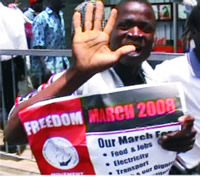
Lastly, the government substantiates its new idea by conveniently mentioning the fact that the concept was taken from Angola, whose government set aside US$1,5 billion and ” has been successful in implementing the project.” People, I hate to burst your bubble but, take a look at this picture taken outside one such people’s shop then you know all is not rosy in Angola. While the long queues that have become a common sight, if not an eyesore seem to be disappearing from most banks, it seems our government really loves seeing them and cannot wait to introduce something else that will make queues re-appear.

People’s shops? What a laugh. There are some people’s shops already in this country – zhing-zhongs – which are supposed to sell the cheapest quality products but still expensive as hell. And people of all walks of life, no matter what they earn, converge there. For God’s sake, let market forces control the prices of goods. Unusually or exceptionally cheap products will only be hoarded, quickly disappearing from the shelves to reappear on the black market at inflated prices.
Crisis in education must be unmasked

del.icio.us TRACK TOP
Monday, January 28th, 2008 by Amanda Atwood

Zimbabwe’s education sector has been hard hit by the political and economic crisis of recent years. As schools opened for the new year, teachers are so poorly paid, some couldn’t afford transport back to their schools. Parents, meanwhile, are struggling to afford the school fees, uniforms, and supplies their children need.

Last week, Kubatana sent a text message to ask our members what could be done to resolve the challenges in the education sector in a way that improves things for parents, students and teachers alike.

In addition to Dennis Nyandoro’s blog on the subject, here are some replies from our subscribers:

The situation is a nightmare. It’s not only teachers, what of health professionals? Where is NSSA & NAC fund going to? ARV’s coming from NGO’s cover 3 quarters of patients.

————

The crisis in education must be unmasked by us in conjunction with the media. Once parents understand the depth of the crisis, they can stop their children attending school unless there is an overhaul. Teachers seem to be satisfied with their earnings. If not, they should not have attended until they got reasonable amounts in their accounts.

————

Nothing can be done to the education sector in Zimbabwe until the bankrupt regime goes on the 29th of March & the new government goes back to the drawing board. Everything needs cash.

MDC freedom march goes ahead, despite police harassment

del.icio.us TRACK TOP
Saturday, January 26th, 2008 by Amanda Atwood

Watch this video (30 sec, 2MB)Despite a lengthy back and forth with the courts, and harassment by the police, the Movement for Democratic Change went ahead with their freedom march on January 23, 2008.

In this clip, recorded by a journalist on the scene, MDC members run from tear gas which was thrown by the police to disrupt their gathering. They quickly regroup, and toyi toyi their way through Harare’s streets, waving their posters and singing their protests of Zanu PF’s governance.

Another journalist was not so lucky – an Al Jazeera cameraman was stopped by the police and prevented from filming, despite the fact that his network is the only foreign television station tolerated by the Zimbabwe regime.

With our “mother of all polls” now scheduled for March 29, 2008, prospects of a free and fair election are non-existent. In these conditions, some are advocating a stronger stance from the MDC, urging them to develop a genuine programme of democratic resistance. Others are more sceptical of MDC protests.

Leave a comment or send us an email on info [@] kubatana [dot] org [dot] zw and share your thoughts. What do you think the opposition – or Zimbabweans more generally – can do to snatch some kind of satisfactory result from the jaws of what is certain to be another rigged election?

Country for sale

del.icio.us TRACK TOP
Friday, January 25th, 2008 by Bev Clark

I love a good mechanic. Especially a mechanic who doubles as a fiery, passionate conservationist, and who has a sense of humour. Zimbabwe is extremely fortunate to have Johnny Rodrigues, head of the Zimbabwe Conservation Task Force, working hard to protect our wildlife. And these days a sense of humour is essential to living in, and surviving Zimbabwe. At the end of one of his recent emails he included this

COUNTRY FOR SALE: ZIMBABWE
1980 MODEL
ONE OWNER SINCE NEW
NON-RUNNER
NEEDS COMPLETE OVERHAUL
OFFERS IN USD, POUNDS OR EUROS

What Do You Stand Up For?

del.icio.us TRACK TOP
Friday, January 25th, 2008 by Natasha Msonza

Last year December I had the opportunity to observe all the proceedings of the ANC’s annual conference in Polokwane, South Africa on television. Though personally not a huge fan of Mbeki, I witnessed a sad but humiliating rebellion against a president who took South Africa through a decade of solid economic growth in support of one who sincerely believes that taking a bath after having unprotected sex with an infected partner minimizes risk of infection. I’m sorry but I am one of those who will never forgive, nor forget such ignorance especially coming from one who wants to rule a people someday.

Anyway, that was not my major concern. Watching the Polokwane proceedings got me really thinking about our own upcoming March harmonized elections. I long for the day opposition/dissent or whatever else ZANU- PF calls anyone that’s not for it, will not be demonized and brutalized for having a different opinion on things or for merely existing. I long for freedom of speech and expression. I long for accountability from campaigning political candidates like what’s happening in the USA. A chance to grill would be leaders on how, why and when they plan to deal with crucial aspects bedeviling this country, ranging from an economy in chaos to the collapse of the public service delivery system.

Above all, I worry what course of action each fellow citizen will take come March. I know most bone- weary, depressed and hungry Zimbabweans occupy one of three spheres: those who are apathetic, almost to the point of indifference and will not vote in the upcoming election. Those who would rather the MDC boycott the election and let ZANU- PF go it alone because they feel the latter should not be allowed to steal another election but concede to a transitional constitution and election postponement. The last group is of individuals who, no matter how impossible any effort on their part may seem, will still play their part.

March is not so far off and it is time we each start thinking which group we are joining come March. Understandably, a majority of us are really rather preoccupied with matters of survival alone but a decision still has to be made.

Though I know that most people intend to boycott the election, I feel one should not willingly neglect one’s duty to vote, no matter how hopeless it all seems. If not just for the hell of it, I wouldn’t grant any party such an easy victory, but give them a run for it.

At the risk of almost sounding crass, I ask, why deprive ourselves of hope? We have to believe there is a way out of this mess otherwise, what’s the point? Why study, why work, why do anything if it’s all going to hell? I recall vividly the words of a mentor who said, “No matter how badly any football team performs, have you ever seen them giving up mid match and sitting down on the pitch because there is no point in continuing? No. They play to the last whistle, even if they come out with nil.”

Vaclav Havel describes Hope as not ‘the willingness to invest in enterprises that are obviously headed for early success, but, rather, an ability to work for something because it is good, not just because it stands a chance to succeed . . . Hope is definitely not the same thing as optimism. It is not the conviction that something will turn out well, but the certainty that something makes sense, regardless of how it turns out.’

I am currently reading The Impossible Will Take a Little While, a compilation of short, inspirational, anecdotal stories by Paul Rogat Loeb. In one of the stories: The Optimism of Uncertainty the author points out the deliberate metaphor; Life is a gamble. Not to play is to foreclose any chance of winning. To play, to act, is to create at least a possibility of changing the world.

He goes on to chronicle historical victories that were so unpredictable to be almost impossible:

“Who foresaw the revolution to overthrow the Tsar of Russia? Who would have predicted the bizarre shifts of World War II – the defeat of the German army with Hitler huddled in his Berlin bunker, waiting to die? And then the post war world, taking a shape no-one could have drawn in advance: the Chinese Communist revolution which Stalin himself had given little chance. In other places, deeply entrenched dictatorships seemed suddenly to disintegrate from Portugal to Iran and Iraq. The end of World War II left two super powers with their respective spheres of influence and control, vying for military and political power. The United States and the Soviet Union soon each had enough thermonuclear bombs to devastate the earth several times over. The international scene was dominated by their rivalry, and it was supposed that all affairs, in every nation, were affected by their looming presence. Yet the most striking fact about these super powers was that, despite their size, their wealth, their overwhelming accumulation of nuclear weapons, they were unable to control events, even in those parts of the world considered to be their respective spheres of influence.”

Looking at this catalog of huge surprises, it is clear that the struggle for justice should never be abandoned because of the apparent overwhelming power of those who have the guns and the money and seem invincible in their determination to hold on to it. That apparent power has again and again, proven vulnerable to human qualities less measurable than bombs and dollars: moral fervor, determination, unity, organisation, sacrifice, wit, ingenuity, courage, patience.

There is a tendency to think that what we see in the present moment will continue. We forget how often in this century we have been astonished by the sudden crumbling of institutions by extraordinary changes in people’s thoughts, by unexpected eruptions of rebellion against tyrannies, by the quick collapse of powers that seemed invincible.

Political power, however formidable, is more fragile than we think. (Note how nervous those who hold it are.)

People do not have to engage in grand, heroic actions to participate in the process of change. Small acts, when multiplied by millions of people, can transform the world. To be hopeful in bad times is not just foolishly romantic. It is based on the fact that human history is not only one of cruelty, but sacrifice, courage and compassion.

So, should March arrive, and ZANU-PF still refuses a transitional constitution and election postponement and all the other demands we have, would you really rather sit and do nothing at all?

Zimbabwe on millions of dollars a day

del.icio.us TRACK TOP
Friday, January 25th, 2008 by Natasha Msonza

So, today I get to Fourth Street my usual time early in the morning on my way to work and I find a rowdy mob of people grouped where I board my commuter omnibus to Newlands. The fare is suddenly $2 million. Yesterday it was $1,5 million, and a few days before that, $1 million. Ok you might think so what, talking about the country’s problems has just become a cliche, nothing is newsworthy anymore. I tell you, witnessing a group of respectable men and women in their suits haggling with hwindis is newsworthy to me. Often, they would just meekly pay an arm and a leg to get to work and avoid the hassle. I mean, for some of us, we now fork out $8 million a day to get to and from work.

A friend of my mom’s resigned yesterday. I found the circumstances almost a tad comical. Her husband phoned her from the office of an optician where he was meant to collect a new set of spectacles for her. He told her that the cheapest, ugliest frame cost $46 million. He highlighted that her transport from Chitungwiza is $6 million daily and she is earning $50 million monthly. There was clearly no point in continuing work so he demanded she resign immediately that very day.

Well, I’m sick and tired of it all, no food, no water, no lights, no cash, and expensive transport. The list keeps growing. I live from day to day wondering what else will go wrong . . .