Kubatana.net ~ an online community of Zimbabwean activists

Archive for the 'Reflections' Category

Talk isn’t cheap

del.icio.us TRACK TOP
Tuesday, February 23rd, 2010 by Zanele Manhenga

I tell you I have tried, tested and proven that what Jesus said is true. He was not telling a lie, he was truly speaking from experience and for the first time I sympathize and empathize with the Lord Jesus Christ. The past week I have been sent out to do a survey on vendors. When I was given locations to do the research I marked Mount Pleasant as one place that was going to be a one-stop shop for me. Mount Pleasant is like home to me although I don’t stay there anymore. Stay with me now and let me explain. I was sent to ask routine questions on vendor experiences and when I saw the questions I felt that my former home location would be the place of a great harvest of information. It is hard to speak to a perfect stranger and start explaining yourself to them. So when I went to Mount Pleasant I was very confident I would get pretty good answers. You see in my mind I was thinking I have bought tomatoes and veggies in this place for well over four years and it wont be so difficult to ask my a.b.c. Questions. Well I was wrong. The minute I said to the ladies at the msika could I please ask these simple questions on how you operate it was as if I had opened a can of worms that was waiting to burst. The ladies started shouting at the top of their voices “… if you don’t pay money we are not saying a word to you, does this thing have money, we don’t do things for mahara here.” As a woman on a mission I tried to reason with them. I asked that if I was to return to work and tell them that there are some ladies who want money how much would they want. Wait a minute – this a classical answer from one of the ladies “… how much do you want to pay us, coz kusina mari ha pana zva tiri ku taura.” My simple reaction to this was to ask again how much they would want to be paid. At that time I felt exactly the way Jesus felt when he went to Nazareth and was asked if he was not the son of the simple carpenter and why he had come with such a project of calling souls to the Kingdom of Heaven and what benefit he was to them. The words he spoke gave me the strength to leave that place and go to a location that appreciated what I was doing just like he went to the next town and performed even greater miracles. I went on and spoke to more people than the few ladies I found in Mount Pleasant. A prophet is appreciated anywhere else but his hometown.
Witchcraft and the Zimbabwean constitution

del.icio.us TRACK TOP
Monday, February 22nd, 2010 by Dydimus Zengenene

The law is silent about witchcraft yet people believe that it exists and is affecting them on a daily basis. In Zimbabwe for example, more than ninety percent of the people believe that their lives are in one way or the other being tampered with through witchcraft. However once one claims to have been bewitched by someone the present law punishes the victim and does not bother to establish fact from the allegations. This points to a view that there is no such thing as witchcraft. Surprisingly people are losing their wealth, beasts, goats and cash through community cleansing activities, like trough the Tsikamutandas, other traditional healers and prophets.

Now that the country is running towards a democratically made constitution, what will people say with regard to witchcraft? Will the law still be made to remain silent about this issue? If not, who will be empowered to physically preside over such offenses created in the spiritual realms and be assured to live there after?

The problem is how to prove the allegations of witchcraft beyond reasonable doubt. Whereas a postmortem can prove a case of murder, no technology can prove witchcraft activities. Even if three n’angas are consulted, they never agree among themselves. Some think that the n’angas are to blame for all the cases around witchcraft as they are the suppliers of the magical tricks. Should the law ban the n’angas then? To what extent have the n’angas contributed to moulding the present day Zimbabwean culture?

Some feel that it is high time the constitution of the country does something about witchcraft because of all the stories around like people seen with goblins, naked and performing unfamiliar rituals and some killing each other on allegations of bewitching one other.  Some feel that witchcraft is of the spiritual world, and no earthly law can stop or regulate it unless spiritual means are employed. This gives rise to the question of how the so called n’angas and prophets who see beyond the naked eye are important in the present day society.  What about the role of the church?

Will all people join the debate?

Promiscuous sexual activities, homosexuals, drug addicts

del.icio.us TRACK TOP
Friday, February 19th, 2010 by Bev Clark

Last night I watched an interview with Sir Ian McKellen, the celebrated British actor, on Hard Talk, one of the BBC’s most popular programmes. Ian said that he only “came out” when he was 49 because there was so much violence and bigotry surrounding the issue of homosexuality. His advice to young gay people is to come out as soon as possible because being open and honest about who you are will, more often than not, enhance your life.

I was curious about the amount of time the interviewer spent on Ian’s sexuality rather than other aspects of life, like his career, his beliefs and his general experience of the world. Gay people are so much more than their sexual orientation. Why is it that gay people are peppered with questions about their sexual orientation when heterosexuals are not? When did you ever see Meryl Streep being questioned about what made her straight or how being straight impacts on her life?

Just today I got an unsolicited email from an organisation in Zimbabwe selling a product. Their product is a “a publication containing behaviour statistics of a teenage behaviour survey conducted in 2009 in all major towns of Zimbabwe”. The survey was compiled based on ten questions. One of the questions reads as follows:

10.   Are there any promiscuous sexual activities, homosexuals, drug addicts amongst the Zimbabwean youths?

I just wrote to the authors of the report saying that I’m a lesbian and that I find it unacceptable that they lump homosexuality with promiscuous sexual activities and drug addiction. Of course I should clarify that I see nothing wrong with safe promiscuous activity and safe drug use. But the agenda behind their inclusion of homosexuality along with addiction and promiscuity, is sinister in my view. Perhaps I’m wrong but I sense a witch hunt of young gay people with a view to fixing them or punishing them.

Yes, some Zimbabwean youth are gay – I was young once! It’s about time that people realised that the expression of sexuality is not confined to heterosexuality. We have an organisation called Gays and Lesbians of Zimbabwe (GALZ) in Zimbabwe that has a broad and diverse membership of gays and lesbians.

Our communities should be embracing diversity and making it safe for young people to express their true selves.

If you have the time and energy to question the motivation behind surveying homosexual activity please write to them at info@thebehaviourreport.com

Getting Harare clean again

del.icio.us TRACK TOP
Wednesday, February 17th, 2010 by Upenyu Makoni-Muchemwa

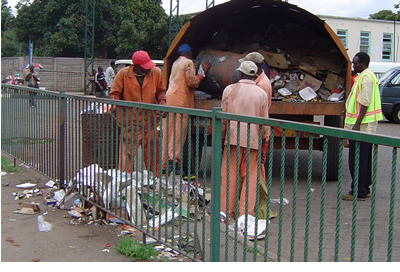
I’ve used the Fourth Street combi rank in my comings and goings around Harare for almost five years. In all that time I’ve watched as piles of trash accumulated on the pavement around the taxis. It was a terrible place to be especially during the rainy season, when humidity and moisture combined with metre high mounds of rubbish resulted in the most unholy smells (odour is too good a word to use to describe it!). I had resigned myself to it, as I sure had most other commuters. So imagine my surprise when today as I approached the rank I spotted a City of Harare Refuse collection crew . . . WORKING. It seems that the Harare City Council may be doing something useful with the ratepayers money after all . . . ok at least what was left over after they bought themselves cars and things.harare_clean_up

Dangerous toilets

del.icio.us TRACK TOP
Wednesday, February 17th, 2010 by Dydimus Zengenene

I’d like to walk you through one day at a rural school mainly with the intention to explore that place we all use, the toilet.

Upon arrival at the school what welcomes you is the mixture of colours of clothes that children are wearing. A good percentage of the children have never afforded a uniform possibly since their first year into school. Step closer and you will discover that almost all children are bare foot. It used to be the trend that the few children who put on a pair of shoes would be children of teachers who unquestionably belonged to a different social class. But now when teachers are so lowly paid their children appear as good as any other.

The Blair toilets are so dirty that children tip toe as they enter in an effort to avoid the mess on the floor. In the boys’ section it is as if water is continuously being poured on the floor for the whole day, it is never dry. It is not unusual to see big white worms making their way out through the entrance or to see some lying dead as one or two kids will have taken the courage to step over them.

At the end of the day the children struggle to carry water from the bore hole or some river kilometers away to clean the toilets and this is when the broom guy whom they sarcastically call the “Matenyera” has to make as though he has no nose because it is his job to clean the mess close up. If one imagines that these toilets are shared with little grade zeros and ones who usually have more experience in using the bush than a toilet, then maybe you get to comprehend how dirty the toilets will be by end of the day.

Finding ways to survive

del.icio.us TRACK TOP
Tuesday, February 16th, 2010 by Bev Reeler

For so long now, Zimbabwe has held me in its challenging grasp
watching the unbelievable madness and violence take reign
feeling my soul shrink
perhaps there are times when we connect too deeply
in too narrow a field
and we forget we are part of an astonishing universe

as if with scales over my eyes
I stand waiting to see
living with grief . . .

I sit in this newly born, newly bathed, sun-slanted morning
Listening to the almost-silence

In a small pool on the rock
ephemeral lives dance this microscopic magical moment atop granite mountains
a breathing, procreating, creative memory of last night’s rain

do these minute fragments remember the stars?

There are times when we need to climb the mountain,
for the story catcher to listen to the distant stories
and weave this vision into the threads that cross the planet

‘ama poto, ama poootooo, ama poootoooooi, ama poto’
a chanting echo down the suburban street
a man with his hand-held welding machine
advertising his skills in mending what has been broken

The sekuru with two young nephews churn their battered truck down pitted dirt roads in rural Motoko
buying mangoes
with sheer willpower, they drive the old car the 150k to Harare
and camp on the side of the street till the mangoes are sold, or rot
8 mangoes for US$ 1

Tawanda brings bananas from Chimanimani
tied to the top of a smoking, crowded bus
In Harare they are arranged in neatly piled rows in his brothers’ barrow
and sold down Chiremba road
12 bananas for US$1

Mai Chipo sells the mealies and tomatoes she has grown in a small piece of wasteland
arranged in meticulous patterns on old tyres
outside her small hut

Tichafa slogs his way home with thirty pillows tied to his back
To sell at a small profit, to a distant rural store

From early morning purchases at Mbare Msika
vendors sell fruit and vegetables on the suburban roadsides
Straw hats made in China
old cloths sent in bales from Europe
windscreen wipers, seat covers, plastic watches, shoes, ironing boards, cell phones
that have been brought on overloaded mini busses from South Africa

Sekuru Peter has a sign on his  bike
and a very old camera in the basket
‘go fast photography
best service’

there are signs on the side of the road:

‘Tree cutting – best experts
Cell:0912 000 000’


‘anaconda worms
take me fishing with you’

‘honey’
bottles arranged in golden rows outside Marondera

‘voulantery work.
plse help’

three young men carry buckets of mud and stone
making their best attempt to fill up the huge potholes
long abandoned by the city council

Mike runs his small business
roasting mealies on a small fire on the side of Quendon road
- fast take-away hot meals for homebound workers

Tafadzwa opens her hair plaiting business in a small nook under the masasa outside the local store

Umbuya Moyo stands at the door of her hut
watching the 12 grandchildren left in her care
their parents dead or lost or fled to South Africa
now her work of love

Nhamo and Rodgers and Jane and Mike and Abby
dedicate their lives to healing torture victims like themselves
taking their workshop into rural communities

what resilience is this?
what echo is it, that threads through the bones of this land
bones that tremor and shake
then stand firm in the wake of the storm
shorn of their outer shells
their homes and livelihoods

finding a way to survive