Mixing good and rotten tomatoes


This text message we just received sums up one person’s perspective on Zimbabwe’s inclusive government:
We mixed good and rotten tomatoes in the same basket
Kubatana.net ~ an online community of Zimbabwean activists
This text message we just received sums up one person’s perspective on Zimbabwe’s inclusive government:
We mixed good and rotten tomatoes in the same basket
Downstairs at Libby’s restaurant, football fever is alive and well. People of all shapes and ages and sizes are streaming in to watch the Brazil-Zimbabwe World Cup warm up match being played in Harare as we speak.
But unfortunately, the facts behind the match provide a demoralising reminder of the business side of the sport. As The Telegraph reports:
Cash-strapped Zimbabwe, which struggles to pay its teachers and doctors, had to fork out 1.8 million dollars to the Brazilians to get them to play in Harare, financed in part by corporate donations.
We sent out the following text message to our subscribers asking what they thought of this.
Kubatana! Fly the Zimbabwe flag today. Go Warriors! While civil servants get peanut salaries Zim pays US$1.8 mil to get Samba boys to play here. Wot do u think?
Many were less than impressed. The first messages we’ve received are below:
As one of the civil servants, that’s inhuman we are really suffering togther with our kids strikes have proved fruitless
——
Desperate theives
—
Good it reliefs stress at times.
——I think vanofanira kupa mari ma civil servants inotenga
——I wonder what exactly the country is set to benefit from playing Brazil when we wont be at the WC. Maybe someone else knows?
——
I ws deadly embarassed too by dat
——
If i say they are mentally disturbed it’s mockering them.Ngatiti ndibaba vanosiya mumba musina hupfu vachindosasana
——
Its inhuman
——
It’s not fair. Wait til elections are here. It’s time for change.
——ITS TERRIBLE
——Nonsense.they.don’t.think
——Not fair. What do we gain frm that game. Chasing history wl civil servants wallow in poverty.
——That’s crazy!
——
The authorities are cruel and shameful. It was even more demeaning that they chose to give the servant time to watch da game yet they don’t have to spare
——
The move is worth the money!
——They must strike and pasi nehurumende yeuori
——
Unrelistic & Outrageous
——
Wasteful gvt
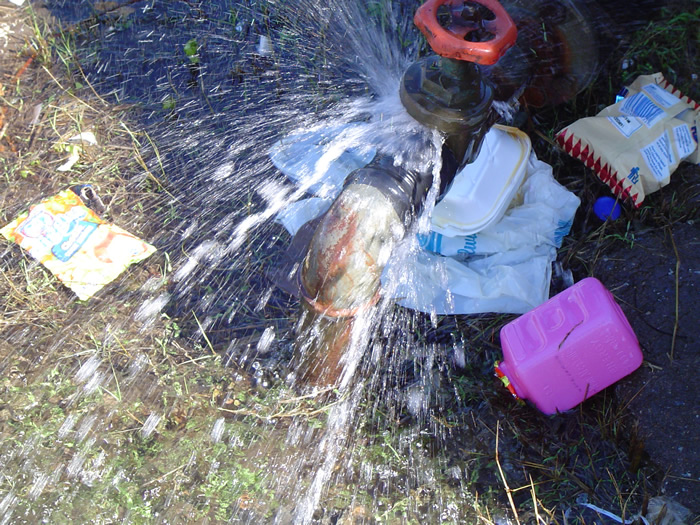
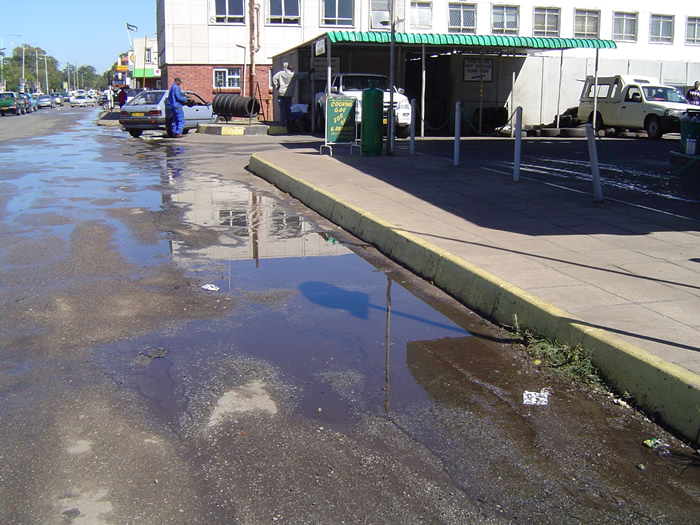
I do a lot of running and on my way through Newlands Shopping Centre over a week ago I ran past a very badly leaking water pipe. The road running through the shopping centre had become a river.
I sent a text message to the Mayor of Harare, Mr Masunda, asking him if he could send someone to attend to it as soon as possible. A week later, the pipe was still madly spewing water. It is important to point out that this shopping centre, along with the majority of Harare, suffers from crippling water cuts. So I sent another text to Mayor Masunda asking for an emergency number to call so that the problem could be fixed. I didn’t receive any replies to my text messages – yeah, he’s a busy man I know – and in the meantime I heard that the leak was over 3 weeks old and that the BP petrol station attendants had tried, in vain (understandably because they’re not plumbers), to fix the leak with pieces of black rubber. The petrol station had asked the city works department to come and fix the leak but it seems like they haven’t put this problem on their list of Things To Do.
What are we to make of this? Shop owners and residents of Harare pay their rates; motivated citizens report problems and yet the City of Harare, knowing that the provision of water is an essential service, allows major water leaks to remain unresolved for weeks at a time.
Hypothesising about Zimbabwe’s next elections, a colleague commented that Zanu PF wouldn’t have to engage in much violence at all, but still would be able to control much of the population through the threat of violence. The image she used seared my heart: Beat a dog badly enough, and eventually all you have to do is show it the stick and it will cower.
Several months ago, I was throwing steaming hot coffee grounds out in my garden, and accidentally splashed some on my dog, who came running past at the same moment. To this day, he runs away, tail between his legs, if he sees me pick up the coffee pot.
Yesterday I got a text message that fourMDC activists had fled their homes in Mazowe, following threats by “Zanu PF militia members.”
A recent meeting organised by the Organ on National Healing was disrupted by Zanu PF youth militia.
The headline of today’s statement from the Youth Agenda Trust caught my eye: Herding sheep with wolves. How can Zimbabwe even begin to speak about national healing when harassmet, intimidation and violence persist? What hope is there for any future election if people continue to feel threatened – and therefore cower?
The recent disruption of a conference organized by the Organ on National Healing and Reconciliation by ZANU PF youth militias and self proclaimed liberation war veterans in Harare on Saturday 22 May is a clear indicator of the dark cloud of political polarization and intolerance characterizing the Zimbabwean political terrain. The national healing, reconciliation and integration programme which came as a result of Article 7 of the Global Political Agreement signed between ZANU PF and the opposition MDC is yet to make any meaningful progress or impact on the ordinary Zimbabweans. The national healing process despite being led by three senior members of each of the three political parties in the GPA has frantically failed to achieve its intended objectives of reconciling the polarized communities and fostering cohesion and tolerance amongst people with different political and ideological orientations. This recent outbreak of violence at such a high level decision making conference should be strongly condemned in the strongest terms possible and should also be treated as a serious warning to the Zimbabwean political leadership over the implications of a snail pace reconciliation programme crafted by three political elites whose implementation plan is totally disconnected from the people who have been the victims of three decades of genocide, misrule and political conflict. It is sad to note that ZANU PF through its Harare provincial leadership continues to abuse youths within their party structures to be agents of intolerance through their traditional busing and disruption of national events such as the Constitution All Stakeholders Conference and the National Healing Indaba.
The chaos also came in the wake of recent media reports highlighting the possibility of the nation going through an election in May next year. The Youth Agenda Trust would want to reiterate that free and fair elections are only feasible under a new, democratic and people driven constitution. The continued political bickering characterizing the constitution making process coupled with the lack of political will and insincerity in the implementation of the national healing programme as highlighted in the Global Political Agreement remain as the major setbacks towards a free, fair and democratic election in Zimbabwe. A partisan state media, compromised electoral commissions, a partisan security sector and the general unwillingness to respect the constitution by some elements of the executive are a few of the many indicators of the negative political environment for a free and fair election in May 2011.
In conclusion Youth Agenda Trust calls upon the leaders of the inclusive government to reconsider their strategy towards attaining national healing and reconciliation. In fact the commitment and capacity of those appointed to administer this important exercise should be urgently critiqued. A proper national healing framework based on the principles of transitional and restorative justice which is adequately funded from the national fiscus and interested partners which employs a down to top approach remains a key recommendation by the Youth Agenda. The reported plans to re introduce the notorious and violent Border Gezi national youth training programme should be halted forthwith and the political leaders should collectively speak out against the abuse of young people for political expediency.
- Youth Agenda Trust
The Research and Advocacy Unit, in collaboration with IDASA (an African Democracy Institute), the International Centre for Transitional Justice (ICTJ), and the Women’s Coalition of Zimbabwe (WCoZ) recently launched a report titled Women, Politics and the Zimbabwe crisis.
The report was the first of a set of findings from a survey taken in November and December 2009. The poll was conducted throughout Zimbabwe’s 10 provinces, and included 2158 individuals. Most of the women interviewed were from Harare, Manicaland, Mashonaland East and West, with the average age of the women being 38. Some of the women polled were located in the Diaspora, which is Botswana and South Africa.
The purpose of the survey was to gauge the opinions of women regarding four issues, namely: what women thought about elections; what women thought about violence; what they thought about peace and finally their thoughts on the Inclusive Government.
In general women believe that they should participate in politics. In comparison with previous Afrobarometer reports, this report found that an increasing number of women are voting, however they are still fewer than the total number of women eligible to vote. A small percentage of women thought that women should be involved in politics at all, or that they should only be involved in politics with the permission of their husbands.
With regard to elections and violence, the majority of women believed that violence was caused by political intolerance and the struggle for power. 68% of women said that they did not feel safe during the 2008 election period; 52% reported having experienced violence. Surprisingly, 9% of women from across the political divide said that violence during elections was acceptable. It is distressing to note that a significant number of women believe that violence and elections are inseparable because of the violence they have personally experienced over the last decade.
The report state that, in general, there was a greater frequency of violations reported at the hands of non-state agents. This corroborates the findings of several human rights reports over the past decade. Violations at the hands of non-state agents were twice as frequent as those at the hands of state agents. 3% of women reported that they had been subjected to sexual violence. Interestingly, the witnessing of rape was much more frequently reported that the actual experience of rape. It may be concluded that women in Zimbabwe are reluctant to talk about their personal experiences of rape. Credence is lent to this theory by the fact that Zimbabwean women in the Diaspora were more willing to report incidences of personal rape during elections.
Women were asked for their views on the Inclusive Government. 71% stated that Zimbabweans should have been consulted about the formation of the Inclusive Government; 43% felt that the new government did not represent the interests of women. The results of the report suggest that Zimbabwean women have significantly declining faith in the Inclusive Government compared with a previous Afrobarometer report. Apart from food security, education and health, the majority of women sampled expressed distrust in the Inclusive Government’s ability to deliver change. Popular support as noted by previous Afrobarometer surveys has significantly declined over the last 20 years. This report found that only 9% of those sampled expressed support for ZANU PF as compared to the 51% that expressed support for MDC-T. A significant number of respondents did not want to say where their party affiliations lay, indicating conditions of fear and intimidation.
In the discussion following the presentation, a few members from the floor feel that more needs to be done to help alleviate the situation of women in the country. One woman pointed out that NGOs were not doing very much to bring justice to women, with the Organ on National Healing and Reconciliation being largely felt to be redundant. It was also pointed out that very little research about the perpetrators of violence was being conducted by civic organisations, yet this information would be a necessary tool for addressing the root causes of violence. Among the criticisms of the report was that issues of patriarchy with regard to violence were not mentioned. It was noted that this is very critical in a culture that is buttressed by traditions that look at women as subordinate to men. Further, the report failed to identify the gender of the perpetrators, leading to the assumption that all the perpetrators were men. However, in some cases this was not so. It was reported during the discussion that women were also perpetrators of violence against women.
Zimbabwe Poets for Human Rights recently held a poetry and discussion session with the theme Press Freedom at the US Embassy Public Affairs Section.
The session began with youth activist George Makoni, representing the Youth Alliance for Democracy, discussing media freedom in Zimbabwe since 1963. Mr. Makoni interrogated the notion of Press Freedom saying that it was ‘the ability of people to express themselves through media platforms’. He gave the audience a brief historical background of the issues of media freedoms in Zimbabwe, and examined the use of the media by the state for repression. He pointed out that the methods used by the colonial government had been made use of and extended by post independence government, during and after the 2000 election period. He also made note of the legislative tools used by the ZANU PF government such as POSA and AIPPA to repress media freedom.
Zimbabwe Poets for Human Rights comprises talented spoken word artists and poets. Samuel Mahuntse was amongst the first poets to take the stage. His poem, recited in English, Ndebele and Shona was celebratory in tone. It invited the world to take advantage of the World Cup in South Africa and to come and see what the real Africa looks likes. Another poet, Gargamel recited his poem ‘Pull, Pull, Pull and Pass’. While short, I found the poem to be very witty. Gargamel evoked the traumas of Operation Murambatsvina, and examined the state of Zimbabwean youth whom he charged had become a ‘clownish cast’. Mutumwapavi, with his poem ‘Izwi’ spoke about the power of words. In ‘Chigaro’, he examined the power of position.
The gathering of young people who attended the session, while small, was enthusiastic and eager to share their ideas. Of the questions from the floor the most difficult to address was, “What is propaganda? And who determines what it is?’ Consensus was reached in the definition that propaganda is a message designed for political means. Participants also discussed the infringement of the right to information and freedom of expression. Debate arose over the right to freedom of expression insofar as it does not infringe on another persons rights. Poet Cynthia Flow Child, discussed patriotism with regard to propaganda. She stated that in Zimbabwe patriotism has come to mean an association with a certain political party.


| Blog: |
| Kubatana.net |
Topics: |
| Zimbabwe, community, activists |
Kubatana Zimbabwe Blog is powered by WordPress 3.5 and Mesozoic theme by Lasse Havelund.
"http://afrigator.com/track/kubatana-none.gif" width="0" height="0"
alt="Afrigator" />