Burn Mukwerekwere Burn – Video Clip


This video shares a clip from the HIFA performance Burn Mukwerekwere Burn, which discusses xenophobic violence in South Africa through the story of two Zimbabweans caught in the middle of it.
Kubatana.net ~ an online community of Zimbabwean activists
This video shares a clip from the HIFA performance Burn Mukwerekwere Burn, which discusses xenophobic violence in South Africa through the story of two Zimbabweans caught in the middle of it.
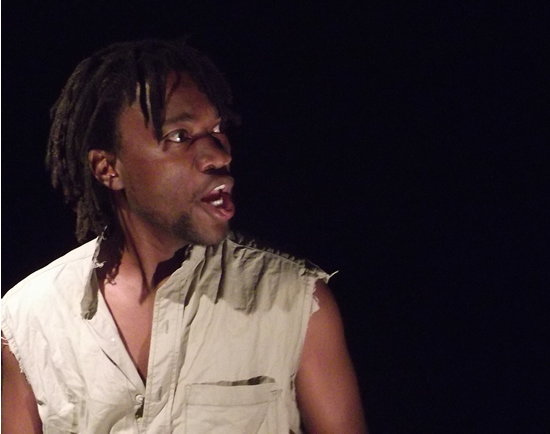
The xenophobic violence in South Africa has grabbed headlines in South Africa. Gangs of angry young South Africans frustrated by poverty and unemployment took to the streets of townships like Kayelitsha in Cape Town brutally assaulting and killing hundreds of foreigners.
Burn Mukwerekwere Burn is the story of two Zimbabweans caught in the middle of the maelstrom. The play is at times brutal in its honesty and assessment of the reasons why there are an estimated three million Zimbabweans resident in South Africa. As they attempt to journey to safety, they reflect on the predicament they find themselves in and characters are forced to deal with their own tribal differences. Njabulo is a Shona teacher reduced to carving trinkets for foreigners to buy. Farai, is Ndebele and a trader in South Africa to restock in time for the holidays.
Written by Blessing Hungwe, featuring himself and Michael Kudakwashe, this narrative is the woven perspectives of both protagonists, trying to survive a night of horror in South Africa. Ultimately they come to understand that the things that bind them together, a love of country and life, are greater than the things that keep them apart.
Bhekumusa Moyo is a talented young Zimbabwean writer. Here are his reflections on the impact of HIV in the small border town of Beitbridge:
The sex worker in a developing town in a developing nation
Beitbridge is characterized by a hive of activity and business ranging from formal to informal, legal to illegal. Life is fast and the cost of living is double that of other towns like Harare and Bulawayo. One is either robbing or is being robbed. One is either bribing or is being bribed. One is either selling sex or someone is buying.
I have followed closely the life of Chido who has been in the sex industry for 23 years. She is being called by her first name even by young boys of her son’s age. Her life has been revolving around being fucked and sucking from sex hungry men. I met her at Kalahari Sports Bar. She is 39 though she looks younger because of skin peeling creams.
Narrating her ordeal, she quickly demanded beer as we talked. Like many young women who end up hooked into the evil net of the world’s oldest profession, she came into the business not by choice. She was on her way to South Africa. On her first quest to cross the border via the Vembe crossing spot which many border jumpers use, she met the horror of her life, which transformed her to what she is today. She was raped in exchange for favors to cross the river. None of the rapists managed to get her across the river until one Mpisi (a man who escorts border jumpers across the Limpopo River), took her to Baghdad Squatter Camp in Beitbridge. Baghdad was situated by the Beitbridge long distance bus terminus back then. It was destroyed during Muramatvsina invasions, as it was a breeding ground for all crime and ill activity.
The man introduced her to Mai Tinashe who was the aunt of the prostitutes in the area. That is how she came to surrender her life to the twin devices of sex and booze risking her life to HIV. Now she doesn’t even give a damn.
At 18, she had her first child with a Zambian truck driver. A year later the affair with the Zambian ended as he changed routes and all contact was lost. There was no one to support her. The option that was always there for her was the obvious. She continued putting herself at risk as a way of supporting her child.
She remains earning her income, reeling under different sizes of men and enduring the penetration of all sizes and shapes of shafts. Her life is surrendered to the grave. She speaks of her clients as fools. On the subject of HIV, she shows no remorse. Straight faced she told me to fuck off because anytime, anyone can die. She says death is death.
During our discussion, a couple of things came up. The subject of making prostitution a legal profession was top. This, she says, will make all players safe, the client and the service provider. She says that parents who do not love their children, ignoring them and exposing them to conditions that disturb their minds, cause moral decadence.
It was around midnight. She looked me in the eye and said “How about us tonight? $50 only. “ I said “no”. She insisted. I told her that I was only 23, two years older than her son and asked her what she thought of this. She said pussy is pussy, whether from a granny or schoolgirl and she accepts any stick that comes her way, for a price. I gave her $30 and we parted ways.
Beitbridge is at risk because of HIV. Médecins Sans Frontières (MSF) says that there are almost 8000 prostitutes in the border town. A lot needs to be done before the town is wiped out.
By Bhekumusa Moyo
Bhekumusa is a civic activist, a poet, researcher and freelance writer based in Bulawayo, Zimbabwe and can be contacted on bhekumusamoyo [at] gmail [dot] com
I’ve just been reading about Facebook and Twitter being blocked in Uganda. Museveni is worried about new media helping people to organise protests in response to state repression and economic hardship. I’m pretty sure that Mugabe wouldn’t feel a move like that was necessary in Zimbabwe. People don’t protest here, no matter how much we get kicked in the teeth. Reading Peter Godwin in the New York Times, I have to agree that the pressure from neighbouring states helps to turn up the heat on dictators. Neighbours can’t ignore wide scale protest. But they can ignore silence. Which is what Zimbabweans are very good at. We’ve had stolen elections, detentions, torture, mind blowing inflation and food shortages. We didn’t respond. Will we ever? What is certain is that SADC, the AU and Showerhead will continue to ignore the crisis in Zimbabwe because we let them.
I’m reminded of a quote from Viktor Frankl; What is to give light must endure burning.
Here’s Godwin’s latest:
Making Mugabe Laugh
Barely was Laurent Gbagbo, wearing a sweat-damp white tank top and a startled expression, prodded at rebel gunpoint from the bombed ruins of his presidential bunker in Ivory Coast, than Secretary of State Hillary Rodham Clinton announced this conclusion: His ejection, more than four months after he refused to accept electoral defeat, sent “a strong signal to dictators and tyrants throughout the region and around the world. They may not disregard the voice of their own people in free and fair elections, and there will be consequences for those who cling to power.”
Zimbabwe’s 87-year-old president, Robert Mugabe, who began his 32nd year in power this week, must have chortled when he heard that one.
The parallels between Ivory Coast and Zimbabwe are striking: both were once viewed as the singular successes in their respective regions, the envy of their neighbors. Both Mr. Gbagbo, a former history professor, and Mr. Mugabe, a serial graduate student, are highly educated men who helped liberate their countries from authoritarian regimes.
Both later clothed themselves in the racist vestments of extreme nativism. Mr. Gbagbo claimed that his rival Alassane Ouattara couldn’t stand for president because his mother wasn’t Ivorian; Mr. Mugabe disenfranchised black Zimbabweans who had blood ties to neighboring states (even though his own father is widely believed to have been Malawian).
The two countries have also been similarly plagued by north-south conflicts. And when they spiraled into failed statehood, both leaders blamed the West, in particular their former colonial powers – France and Britain – for interfering to promote regime change.
Finally, the international community imposed sanctions against both countries, including bans on foreign travel and the freezing of bank accounts that have largely proved insufficient.
But here’s where the stories crucially diverge – why Laurent Gbagbo is no longer in power, while Robert Mugabe, who lost an election in 2008, continues to flout his people’s will.
The most important point of departure was the sharply contrasting behavior of regional powers. The dominant player in West Africa, Nigeria, immediately recognized the validity of Mr. Ouattara’s victory in United
Nations-supervised elections, and worked within the regional alliance, the Economic Community of West African States, to unseat the reluctant loser. But Zimbabwe’s most powerful neighbor, South Africa, played a very different role. Instead of helping to enforce democracy, it has provided cover for Mr. Mugabe to stay on.
Partly this is due to what is called “liberation solidarity.” Most of the political parties still in power in southern Africa were originally anti-colonial liberation movements – like those in South Africa, Mozambique, Namibia and Angola – and they tend to abhor the aura-diminishing prospect of seeing any of their fellows jettisoned.
It is also because South Africa eyes the Zimbabwean opposition – which morphed out of a once-loyal trade union movement – through the suspicious lens of its own trade union movement’s contemplation of opposition politics.
As a result, instead of supporting the Zimbabwean opposition in 2008, Thabo Mbeki, then the South African president, bullied it into a power-sharing government of national unity headed by Mr. Mugabe. This democracy-defying model has threatened to metastasize into the mainstream of African politics; that same year it was also applied to Kenya, where a unity government was set up to end post-election bloodshed. When Mr. Mbeki was deputized by the African Union to broker a solution in Ivory Coast, that was the Band-Aid he reached for – but it was rightly rejected by Mr. Ouattara.
Of course, the other crucial difference is that in Ivory Coast, the dictator’s ejection came at the hands of men with guns. The northern rebels moved on Abidjan. The United Nations peacekeepers, trussed by restrictive mandates as always, nevertheless protected Mr. Ouattara until the French expanded an airport-securing operation into something altogether more ambitious. They basically prized Mr. Gbagbo from his bunker, though to avoid bad postcolonial optics, they brought the rebels in to make the final move.
In contrast, for refusing to plunge the country into a civil war, Zimbabwe’s democratic opposition has been rewarded by the international community by being largely ignored.
Next month, a group of southern African nations will discuss Mr. Mugabe’s continued resistance to agreed-upon reforms intended to pave the way to free elections. Either South Africa must get Mr. Mugabe to honor them, or it must withdraw its support for him. If it won’t, then the international community needs to push South Africa out of leading the negotiations, and engage more directly.
Zimbabweans need help if their voices are to be heard. If the United States wants to prove that Mrs. Clinton’s words were more than empty rhetoric, it should begin by pressuring South Africa. Otherwise Zimbabwe’s hopes for freedom will founder, even as Ivory Coast regains its stolen democracy.
Peter Godwin is the author of “The Fear: Robert Mugabe and the Martyrdom of Zimbabwe.”
Here’s something from BOOK Southern Africa:
At the recent launch of Lloyd Sachikonye’s When a State Turns Against its Citizens at Lobby Books, the author spoke with passion about the changes he hopes to see in his home country, Zimbabwe.
Here is the full text of his address:
I am enormously grateful to be here today to share in the launch of this book, When a State Turns Against its Citizens. I am really happy to meet many friends, guests, compatriots who have come to grace this occasion. My profound thanks go to the organizers of this event, SALO and Lobby Books, and to the publishers who have made the publication process possible within two months from the initial submission of the manuscript…The turn-around of the process and the publicity have been superb and professional, thank you.
This is a publication about Political Violence in my country, Zimbabwe. A country of enormous contradictions: on the one hand, it has one of the highest rates of literacy on this Continent, and one of the largest proportions of educated and skilled professionals. A country that showed great promise three decades ago, that was described variously as ‘a jewel’ and ‘breadbasket’.
But as the narrative of this book chronicles, it is now a country deeply mired in political violence and moral crisis. The roots of Political Violence go back not only to 2000 as some analysts assume, but to the 1950s and 1960s, half a century ago. The roots are to be found in:
* The ruthless suppression of moderate African nationalism by the colonial state; they used beatings, dogs and guns for example.
* Violence by nationalists between their parties in the early 1960s, the original ZAPU and ZANU in 1963-64; they employed stones, sticks and petrol bombs, for instance.
* Violence against civilians by colonial regime forces but also by liberation forces during the 1970s, and Use of violence to settle differences within liberation armies themselves.
After Independence in 1980, the post-colonial state inherited the apparatus and techniques of violence against those who criticized it. As years went by, that arsenal was used against rival parties such as ZAPU till 1987, against ZUM in 1990 and the MDC since 2000.
This culture and practice of violence were celebrated by leaders of Zanu PF who openly boasted of having ‘degrees in violence’. As the country witnessed, these were not empty boasts.
The book observes that the consequences of the culture of violence reached a peak in 2008 when the citizens’ bid for political change was blocked like in Kenya, and now Cote d’Ivoire. The incumbent party and the state used their apparatuses to frustrate a free and fair run-off election.
Subsequent chapters of the book show that the consequences of Political Violence include widespread trauma, scars, fear, stress and apathy. The full magnitude of these psychological and physical conditions is not known. It is partly because Zimbabwe is a society under trauma that it has experienced an exodus of up to 3 million, or a quarter of its population.
This situation of Political Violence needs to change because the consequences are terrible. Other countries that experienced large-scale Political Violence have demonstrated great political will to stop it. Take this country, South Africa. In the 1994 election, about 1 000 people were killed in Political Violence, many were maimed. In the last several elections, like in 2009, no single person died in Political Violence.
Why should Zimbabwe be exceptional? Why should its elections be marred always be marred by Political Violence? Why should impunity be tolerated? These are some of the questions raised in this book.
The book concludes with a few recommendations. Zimbabwe has great human resources but also resilient moral resources, and potential for civic values and democratic change. Let them be harnessed against Political Violence and the authoritarianism which sponsors it. Let them be harnessed for a credible process of transitional justice, and reform of security sector institutions. Let our knowledge of the history of Political Violence and various negative effects propel us to do something about it.
Book details
* When a State Turns Against its Citizens: Institutionalized Violence and Political Culture by Lloyd Sachikonye
EAN: 9781431401116
The SADC Troika Summit of the Organ on Politics, Defence and Security Cooperation met in Livingstone, Zambia yesterday. The Summit was chaired by Rupiah Banda, President of Malawi, and attended by the heads of state and government of Namibia, South Africa Mozambique and Zimbabwe. The purpose of the meeting was to consider the political and security situation in the region, in particular the republics of Madagascar and Zimbabwe.
On Zimbabwe, the Summit received the report on the political and security situation in the country from President Jacob Zuma. He was commended for the frankness with which the report was presented and also on the work that he has been doing on behalf of SADC.
The Summit noted with disappointment the insufficient progress in the implementation of the GPA, and expressed its impatience with the delays. It also noted with grave concern the polarization of the political environment, characterised by a resurgence of violence, arrests and intimidation in Zimbabwe.
Among the resolutions made was a commitment to the full implementation of the GPA and another to the immediate cessation of violence, intimidation, hate speech, harassment and any other form of action that contradicts the letter and spirit of the GPA.
The Troika Organ also resolved to appoint a team of officials to join the Facilitation Team and work with the Joint Monitoring and Implementation Committee (JOMIC) to ensure monitoring evaluation and implementation of the GPA.
While it is heartening to see that Mr. Zuma’s candid report on Zimbabwe was endorsed by the Troika, previous meetings of regional heads of state and government have made similar resolutions on Zimbabwe without them being translated to reality.
Both the President and Prime Minister have made repeated calls for an end to violence and intimidation with no effect. In fact, the violence has greatly increased. In an article published in Newsday on 22nd February 2011, co-Chairperson of JOMIC is quoted as describing the Committee as a “toothless bulldog” with no legal or statutory powers to implement its resolutions. It will be interesting to see how and if this will change with the appointment of SADC officials to the Facilitation Team.


| Blog: |
| Kubatana.net |
Topics: |
| Zimbabwe, community, activists |
Kubatana Zimbabwe Blog is powered by WordPress 3.5 and Mesozoic theme by Lasse Havelund.
"http://afrigator.com/track/kubatana-none.gif" width="0" height="0"
alt="Afrigator" />