Kubatana.net ~ an online community of Zimbabwean activists

Sexual stereotypes not helping Aids fight

del.icio.us TRACK TOP
Friday, August 23rd, 2013 by Marko Phiri

What many see as a sudden crackdown on women in Harare’s CBD by police accusing them of loitering for the purposes of prostitution actually dates back to as early as 1983 according to local researchers working on the link between prostitution and HIV/Aids.

In June 2, 1983, the police launched Operation Chinyanda/Scorpion, where hundreds of women were rounded up on allegations of prostitution.

After a long hiatus, another operation was launched on March 2, 2007 where the systematic arrest of women was intensified.

Four years later, Operation Keep Your Dignity was launched in January 2011, with the following year, in December 2012, seeing Operation Dyira Bonus Kumba where women became the target of a crackdown that was supposed to keep men in their homes to spend their end-of-year bonuses with their families not prostitutes!

Sounds silly, but researchers working with sex workers in Harare and Nyamapanda say the fact that this is an operation sanctioned at the highest level of law enforcement misses the point of addressing the core structural issues that have forced women to the streets in the first place, beyond even interrogating if those arrested in these operations are indeed prostitutes.

Yet the irrationality of these sweeps on women points to failed methodologies in understanding and addressing women’s economic imperatives and opportunities, researchers argue.

But not only that, an unapologetically patriarchal society has skewed the sexual power dynamics where men do the labeling, and every single or unmarried woman, becomes a prostitute because they are found in the CBD during hours when married women are in their homes!

A story was narrated about how cops swooped on a block of flats in Harare’s CBD arresting every female on site and barged into an apartment where a man and his wife were watching telly. The cops allegedly dragged the woman to the waiting Black Maria amid protests from the husband.

But because this is Zimbabwe where citizens have no recourse to litigate against the State, that was the end of the story. All the couple had was bitterness against the system after the wife was released.

It has become laughable how cops carry out their duties, and with the issue of arresting all women seen in the CBD after hours, it has raised yet another disturbing trend where women have become very open to abuse, local researchers allege.

After Operation No Loitering was launched in February this year, followed by Operation Amai Ngwenya in July, then Operation Zvanyanya now carried about by an all-female cops crack unit, complaints that emerged centred on the sexual abuse of these females (whether prostitutes or not) by arresting officers.

It is a good thing that the ZRP has acted on these reports, and it is just one of many reports seen across the world where police demand sex from prostitutes in exchange for their freedom.

And that is yet another HIV/Aids hotspot. Do these males in positions of power use condoms, are these females in any position (pardon the pun) to negotiate/demand condom use when it is their freedom at stake?

Yet in all these operations, researchers are asking: has this worked to curb the spread of HIV/Aids and succeeded in creating “a morally upright” society as the prudes would put it?

One female contributor put it bluntly and said prostitution will always be around whether we like it or not so get used it!

Yet despite that blunt truth, what remains obvious is that there remains very little being done to protect sex workers, be it from STIs or physical/sexual violence.

Small wonder then that there were gasps last year when one MP dared the prudes and called for legalizing the operations of what she rather stupidly called “pleasure engineers” which effectively stripped the debate of its gravity.

And with the UNTWO General Assembly almost here, it cannot be ignored that sex workers are seeing an opportunity of a lifetime, and while Walter Mzembi has said legalizing the profession is out of the question, truth is, some delegates will turn their sojourn into a sex tourism excursion of sorts.

Like one young lady suggested, instead of bashing these women with haughty claims of immorality, other countries are providing sexual health care for sex workers and in the process minimising the spread of HIV/Aids.

Perhaps instead of futile efforts to get them off the streets and encouraging them to sell tomatoes instead, the focus should move from throwing only them into filthy holding cells, but extending the crusade to clients who remain invisible in the whole narrative.

It takes two to screw right?
Job vacancy: Programs Officer with local Zimbabwean NGO – Apply!

del.icio.us TRACK TOP
Friday, August 9th, 2013 by Bev Clark

Programs Officer: Local NGO
Deadline: 19 August 2013

Purpose of the job
The Programs Officer is responsible for facilitating palliative care and related training for Home Based Care organizations. He or she is also responsible for providing support for the provision of quality care to people living with HIV and AIDS.

Overall responsibilities
- Plan for and conduct palliative care and related home based care training activities for partner organisations
- Participate in development and distribution of Palliative Care and Home Based Care IEC materials
- Prepare appropriate training materials
- Provide information whenever necessary, to trainers and caregivers
- Plan, coordinate and hold regular mentoring and support meetings with partners on HIV treatment, care and support
- Assist with the preparation of budgets for programme activities
- Conduct follow up visits and document
- Facilitate networking of project partners and sharing of information among stakeholders
- Represent the organization at provincial and district levels on matters relating to Palliative Care, Home Based Care and project activities
- Promote community awareness on Palliative Care, ART and Psychosocial Support for PLWHA
- Facilitate linkages and information sharing between organizations within the district
- Participate in developing monitoring tools for the projects
- Ensure maintenance of accurate records
- Present written reports to the Clinical and Technical manager at stipulated times
- Participate in activities to disseminate programme evaluation findings

Minimum qualifications and experience
Nursing Diploma/ Degree
Experience in Palliative Care is an added advantage
A minimum of five years’ experience in nursing
Experience in training and facilitation in home-based care issues
Highly innovative and a self starter
Experience in HIV and AIDS, home based care and community health care
Good written and verbal communication skills
Clean class four driver’s licence a must

To apply
If you are interested and meet the above requirements please send your application letter, detailed CV and copies of your certificates to the following: programs13 [at] hotmail [dot] com by no later than August 19, 2013.

A Q&A with Zimbabwean author, Tendai Huchu

del.icio.us TRACK TOP
Thursday, August 8th, 2013 by Marko Phiri

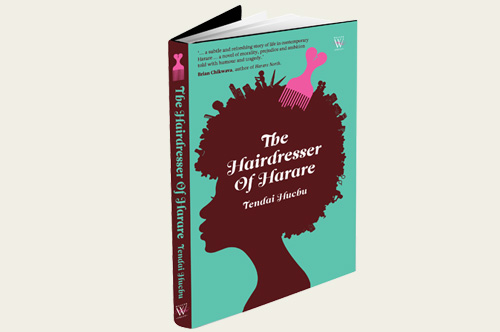
Hairdresser

What inspires your writing?
Day to day life, the ordinary and mundane, flashes of imagination in which lies the possibility to peer behind the veil. People. Cities. Other writers.

Have you always been a writer? How did it all begin?
It’s almost impossible to pinpoint the exact point at which I became a writer. Was it my apprenticeship in my high school newspaper, could it have been a proto manuscript written when I was sixteen, perhaps it was when I first read Dostoevsky in my early 20s and decided to have a go. The true answer probably lies in a constellation that joins all these dots.

Have you found it limiting living abroad but writing about Zimbabwe?
No.

Which local or international novelist do you recommend to read right now?
NoViolet Bulawayo, the author of We Need New Names.

What are you currently working on?
A new manuscript called The Maestro, The Magistrate, & The Mathematician.

Your brief thoughts on Zimbabwe’s contemporary literary scene – alive and well or “alive but dead”?
We have a few good writers I can point to, Bryony Rheam, Petina Gappah, Irene Sabatini, Brian Chikwava. You’ll notice most of the people on this list are female. If you look at Zimbabwean literature today, and thinking of other writers still in the shadows but emerging, Novuyo Tshuma, Barbara Mhangami, Melissa Tandiwe Myambo, etc, it becomes even more evident that male writers such as myself are at the periphery while the female writers occupy centre stage, and this is through pure merit alone.

When you aren’t reading or writing, what are you doing?
Dealing with real life, paying bills, stressing about one thing or the other, worrying the world is coming to an end, you know – the usual stuff.

What’s the best piece of advice you’ve ever received?
Being dropped by my publisher, which showed me the weaknesses in my own work, but more importantly helped me to realise that self-belief was important, and ultimately, for all the romantic myths we spin about writing, it is just business.

What is your favourite journey?
Wtf?

Would you call the Hairdresser of Harare political in any way?
It is political in the sense that everyday human life is lived within politically defined parameters. Where you may or may not go, who you may or may not marry, what you may or may not smoke, the things you can or cannot say – all these things are embedded within a political framework. The Hairdresser of Harare is political only in the sense that all literature is political.

Got any personal anecdotes from visits to your barber!
I wear dreadlocks, in case you haven’t noticed. A visit to the barber is quite out of the question! (whoops … interviewer)

What do you miss most about home?
The people.

Sadza, rice and chicken or “fast food”?
You can never go wrong with sadza.

News headlines

del.icio.us TRACK TOP
Thursday, July 18th, 2013 by Bev Clark

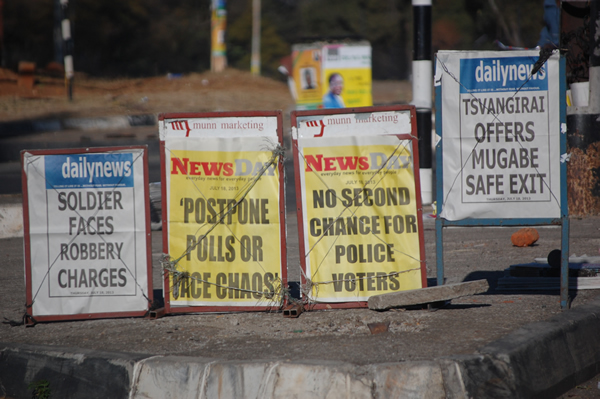
News headlines

Research consultant: ActionAid

del.icio.us TRACK TOP
Tuesday, June 11th, 2013 by Bev Clark

Research consultant: ActionAid
Deadline: 12 June 2013 (4pm)

ActionAid is an international non-governmental organisation working with people living in poverty in 40 countries to end poverty and injustice in the world.

The Assignment
AAIZ requires the services of experienced Researchers/ Consultants to carry out research on the capacity of selected rural and urban Local Authorities to supply or deliver quality basic services to their residents in a gender responsive manner.

Background
To date AAI Zimbabwe works with eight (8) Community Based Organizations (CBOs) in selected Community development programmes called Local Rights Programmes (LRPs). AAIZ has set up LRP partnership structures in selected poor rural and urban communities

Purpose
To generate evidence to inform program and policy initiatives aimed at increasing women’s and youth’s influence in the decision-making processes that affect the delivery of basic services that address their rights and needs. This would be based on an in-depth study of selected local authorities i.e. 4 rural district councils and 2 urban councils.

Objectives
The objectives of this Research are:
1. To assess and document the levels of awareness of women in the planning, budget formulation and monitoring processes of local authorities
3. To analyse the effectiveness of communication platforms used by selected local authorities
4. To assess the perceptions of residents on the quality and gender responsiveness of services being delivered by the selected local authorities
5. To carry out an analysis of key underlying factors and constraints affecting local authority service delivery
6. Map stakeholder’s involvement and responsibility in local governance at local, national, regional and global levels

Research Approach
The research approach and tools to be used in the consultancy should be participatory and Consultant should ensure that the analysis in the final report reflect the perspectives of women, youth, residents associations and other key stakeholders involved local governance.

The consultant is expected to have the following qualifications and experience
1. Technical expertise in Gender and/or Social accountability and/or Citizen’s Empowerment
2. A minimum of 5 years research or consultancy experience in local governance related work that reflects an in-depth and practical knowledge of the ways in which local authorities function
3. Proven experience in facilitating similar processes with a traceable strong record in designing and leading researchers and ensuring timely submission of deliverables
4. Well-developed qualitative and quantitative data analysis skills with a track record of translating complex data into effective, strategic and well-written reports
5. Research team should be fluent in Shona, Ndebele and English.

Duration
The assignment should completed in twenty days

Applications
Interested Researchers/ Consultants should submit proposals showing:
- Understanding of the purpose and objectives of the assignment
- Proposed research approach and tools
- Estimated cost of the proposed Research

The proposals should be accompanied by detailed CVs of the principal Researchers/ Consultants.

Completed proposals must be submitted to:
The Human Resources Department, ActionAid International, 16 York Avenue, Newlands, Harare

Or emailed to: Jobs.Zimbabwe [at] actionaid [dot] org

Actionaid International Zimbabwe values all applications but unfortunately is only able to respond to short listed candidates. Whilst all applicants will be assessed strictly on their individual merits, qualified women are especially encouraged to apply.

The Friendship Bench, improving the lives of Zimbabwean women

del.icio.us TRACK TOP
Tuesday, June 11th, 2013 by Elizabeth Nyamuda

Ever since the day I watched a documentary called Wasteland on how a photographer changed the lives of rubbish pickers in Brazil by empowering them to make art with the recyclable materials they pick from the dump site my mind now forever boggles on how best people can make of the circumstances and scenarios they are in. The Friendship Bench at Harare Hospital is one of the many ideas across the country of how communities are being empowered.

I recently visited the Friendship Bench at Harare Hospital. An organisation created by Dr Chibanda to assist low-income people suffering from depression and anxiety. Patients come to the wooden bench for counselling from trained health workers. After realising that most of the people receiving counselling at the Friendship Bench had no source of income, the idea of Zee Bags was born. These women crotchet old plastic bags into colourful shopping baskets and fun handbags.

Now the women have been so empowered to make their own living. If you attended HIFA this year, you probably saw their stand, which was big and eye-catching. Being at HIFA and exhibiting was a great achievement for them and now they look forward to doing the same at the Harare Agricultural Show.

Being around this group of women you can see how this community development project has helped them to deal with their challenges with common mental disorders, depression and anxiety. During the interviews I gathered most of the women eluded that before joining this project all they could think of were their worries leading to stress, but now making these bags keeps their minds busy. And it’s also giving them some income to take care of their families.