Kubatana.net ~ an online community of Zimbabwean activists

Wild assumptions

del.icio.us TRACK TOP
Thursday, March 31st, 2011 by Mgcini Nyoni

I spent most of my life in Mutare even though I was born in Bulawayo and I am now a permanent resident of Bulawayo. This places me at a distinct advantage: I am very familiar with both the Shona and Ndebele worlds. There are a lot of things that both sides do not know about each and wild assumptions that damage relations are made.

Considering the history of Matabeleland: The slaughter of about twenty thousand people, there is always suspicion between Ndebele and Shona and a number of times I have to pull two warring sides apart as I happen to see things in a clearer light than a person who is exclusively Shona or Ndebele. I have a friend who believes every Shona person in Matabeleland is an enemy, planted in Matabeleland as part of the Gukurahundi agenda (the total disempowerment of the Ndebele people by flooding the region with Shona people and making sure that Ndebeles do not get any opportunities).

I cannot say for sure that the Gukurahundi agenda does not exist, but I believe individuals should be judged on individual merit not broadly based on the sins of a few mad people who did not have the people’s mandate to do what they did.

When my friend suggested that I happen to get opportunities because I have one leg in the Shona world and the other in the Ndebele world I knew the Shona-Ndebele thing had gone too far; I happen to have worked abnormally hard and continue to do so to get to where I am.  The so-called Gukurahundi agenda is now being used by lazy people who do not exploit opportunities as a crutch.

Whilst it is important to address past and current injustices, we have to remember that were we come from matters less than where we are going.

Why Owen and not Yvonne?

del.icio.us TRACK TOP
Thursday, January 27th, 2011 by John Eppel

In her obituary of Yvonne Vera, Ranka Primorac wrote: “The most courageous among them [her other books] is The Stone Virgins, the first work of fiction that openly exposes and condemns the government sponsored violence [Gukurahundi] against civilians in Independent Zimbabwe.”   Primorac goes on to praise its “stylistic mastery and political bravery.”  Yet The Stone Virgins has never been banned; Vera (who, curiously, received the Tucholsky Award of the Swedish PEN for a writer in exile or undergoing persecution) never went into exile, was never persecuted, never even harassed.  The novel was published in 2002 when the government’s policy of re-crafting and subverting the law to support its ideology of “patriotism” was in Operation [upper case deliberate].  How come they left her alone?  I can think of two reasons: first, that Primorac is wrong about Vera’s political courage; second, The Stone Virgins is a novel written in turgid English, and was never likely to influence the restless povo, for most of whom books are unaffordable, and English is very much a second or third language.

By blurring distinctions between dissidents, pseudo-dissidents, and soldiers; between war and massacre; by the timing of the atrocities described in the novel, Vera creates self-protecting ambiguities.  For example, the brutal murder of the shop owner, Mahlatini takes place in 1982, before the Fifth Brigade was officially mobilised.  His killers are called “soldiers”.  Just before he dies, the author puts a suggestive thought in his mind: “He did not want to see who was killing him, just in case he recalled something about the eyes, the forehead, the gait of this man.”  Just in case his killer was a local?

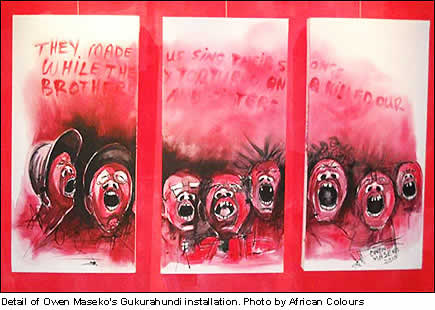
The saintly man, Cephas, associated with the mazhanje (umhobohobo) fruit of the eastern highlands, is Shona (his tagged on surname, Dube, notwithstanding); the diabolical man, Sibaso, associated with the marula fruit of Matabeleland, is Ndebele.  Dissidents and pseudo-dissidents did commit atrocities, some hundreds, mainly against whites and so-called sell-outs; but the Fifth Brigade, targeting innocent rural folk, killed, raped, and maimed tens of thousands.  Vera’s choice of perpetrator in this context seems somewhat skewed.  No wonder she wouldn’t allow copies of Breaking the Silence, Building True Peace, to be displayed in the Art Gallery shop when she was the Director – the same art gallery where Owen Maseko’s exhibition remains sealed off to the public.  So, Ranka Primorac is wrong – there is nothing in The Stone Virgins that” openly” condemns and exposes Gukurahundi.  On the contrary, it is full of lyrical self-censorship.

The second reason why the authorities might have left Yvonne Vera alone recalls the words of the writer, Stanley Nyamfukudza: “One of the best ways to hide information in Zimbabwe is to publish it in a book.”  The Board of Censors tends to overlook the written word because the vast majority of people in this country have little access to books, especially fictional books.  The visual arts, township drama, and performance poetry are another story!  The Kenyan author Ngugi wa Thiongo was imprisoned not for his novels in English but for his plays in Kikuyu.  The authorities don’t want the masses to get too excited.

So, why Owen Maseko?  Again, I can think of two reasons: first, his exhibition is courageous to the point of recklessness in its exposure of what has now been officially classified as genocide; second, as a visual artist his work is immediately accessible to the restless povo.  It speaks a universal language.

You can’t learn from reality if you bury it

del.icio.us TRACK TOP
Tuesday, November 16th, 2010 by Amanda Atwood

Giving this year’s Lozikeyi Lecture, the Minister of Education, Arts, Sport and Culture Minister David Coltart quoted Picasson on the role of art: “We all know that Art is not truth. Art is a lie that makes us realise truth”.

Impressively Coltart used the lecture to make a powerful argument against censorship, and in favour of artistic freedom of expression. In particular, he argued against the banning of Owen Maseko’s art on Gukurahundi, and described the ban on a more recent piece, in the interest of “public morality,” as “patently ridiculous.”

Whilst he didn’t go so far as to argue that the Censor Board itself be disbanded, or reconstituted, he was none the less far more outspoken about the issue than the MDC-T’s co-Minister of Home Affairs, Theresa Makone was on the same issue. For his troubles, Minister Coltart is now being threatened by war veterans who are insisting that he retract statements he made in the speech, suggesting that Gukurahundi was akin to genocide.

Read the full lecture here – it’s worth it!

F*!k censorship

del.icio.us TRACK TOP
Monday, September 13th, 2010 by Amanda Atwood

Now tell me. If in any given week we can have Freshlyground banned from performing in Zimbabwe, Owen Maseko’s work on Gukurahundi banned, and SW Radio Africa jammed, what’s the point of this inclusive government again?

Remembering victims of Zimbabwe’s Gukurahundi genocide

del.icio.us TRACK TOP
Friday, September 10th, 2010 by Amanda Atwood

In honour of his 50th birthday year, blogger and social commentator Rejoice Ngwenya launced the 2010% campaign in March.

In June, he said it was confession time, and demanded redress for the atrocities of Gukurahundi.

Celebrating his 50th birthday today, Rejoice sent us the piece below.

On a day, today, 10 September 2010, that I turn exactly fifty [50] years old, I would like not just to celebrate life in abundance, but also take a twenty-four hour ‘moment of extended silence’ to ponder over those who lost their lives.

In particular, I grieve with my sister Doreen whose daughter Tracey passed on under the cruel pain of leukaemia in England. Moreover there are those twenty thousand citizens of Matebeleland and the Midlands provinces of Zimbabwe – some of which I have heard of – Moliat Ndlovu, Cwayi Bhebhe, Charles Loxton, William Loxton, Dayan Loxton, Gifford Matandaware et al – who perished in the 1980s under the bayonet of Gukurahundi. Mr and Mrs [Luke] Khumalo, the intellectual couple of Tekwani High School, Plumtree, Zimbabwe, are yet to be accounted for, having given their entire lives to impart knowledge on thousands of young people.

My question: at a time when the coalition government of Robert Mugabe, Morgan Tsvangirayi and Arthur Mutambara pretend to offer the people of my country a chance for peace, why are the perpetrators of the heinous and barbaric acts of Gukurahundi still roaming free? ZANU-PF, under whose control the blood-thirsty North Korean-trained Fifth Brigade chose to waste innocent lives, has yet to confess its crimes against humanity. On a day, today, 10 September 2010, that I turn exactly fifty [50] years old, thirty [30] of those having lived under a brutal authoritarian dictatorship, I would therefore like to propose that ZANU-PF show their remorse by acknowledging that they were wrong, and instead of concentrating on further violating the liberties of white commercial farmers and black human rights defenders, invest money and time in financing a monument at Entumbane, Bulawayo, Zimbabwe – so we can forever remember those whose lives they needlessly took. In celebrating life, I therefore acknowledge the existence of death.

How will you make your birthday a day of action?

Confession Time – Ngwenya’s Forgotten List

del.icio.us TRACK TOP
Friday, June 4th, 2010 by Amanda Atwood

Political activist and commentator Rejoice Ngwenya recently sent this through to us. If you know someone who was killed during the Gukurahundi, email rngwenya [at] ymail [dot] com

In the 1980s, a decade of so-called ‘economic growth’, I and four million other Zimbabweans of Ndebele origin lost friends, fathers, mothers, brothers and sisters in an orgy of political madness that cost the lives of more than twenty thousand people of Matebeleland and the Midlands.  Repeated attempts by courageous Christians, progressive political parties, civic activists, sympathetic regional and international organisations to get the government of Robert Mugabe and ZANU-PF to acknowledge the massacres have failed.

Now that the organ of national healing – whatever that means – has been accorded a status to pursue the Gukurahundi issue as a good case for ‘reconciliation’, I propose that everyone in Zimbabwe who knows someone whose life was wasted by the cruel bayonet of the notorious Fifth Brigade send names to the e-mail address below so that I can forwarded them to this ‘organ’ as a first step in seeking redress, with eventual incarceration and prosecution of all perpetrators. Contact rngwenya [at] ymail [dot] com