Kubatana.net ~ an online community of Zimbabwean activists

Politics of condemnation

del.icio.us TRACK TOP
Tuesday, December 15th, 2009 by Amanda Atwood

Zanu PF held their National People’s Congress last week. The Congress resolved that “the Party’s national strategic objective for the next five years shall be the checking, containment and ultimate defeat of the West’s neo-colonial regime change agenda.”

Other highlights of the Congress resolutions include:

  • Congress has noted that the national economy continues to be under siege from the machinations of the Western detractors and their internal MDC surrogates.
  • Congress has noted that the Inclusive Government brings the Party into partnership with ideologically incompatible MDC Formations from which it must extricate itself in order to retain its mantle as the only dominant and ascendant political party that is truly representative and determined to safeguard the aspirations of the people of Zimbabwe.
  • Congress condemns, in the strongest of terms, the reckless actions of the Minister of Finance, T. Biti, in particular his abuse of constitutional authority to prevent the release of the US$510 million IMF Global Financial Crisis mitigation facility, his systematic denial of seasonal support to the agricultural sector and his peanut budget for the year 2010 in pursuance of petty personal ambitions and the parochial reactionary agenda of his MDC Formation.
  • There should be no movement on the concerns of the MDC Formations without corresponding and simultaneous redress of ZANU-PF’s concerns such as the illegal Western sanctions, Western Funded pirate radio broadcasts and Western interference in Zimbabwe’s internal politics through the funding of parallel government structures and the sponsoring of political activities of NGOs as a force multiplier for the MDC Formations.
  • Condemns, in the strongest terms, the continuing violation of Zimbabwe’s airwaves by the Voice of America Studio 7, Voice of the People, Short Wave Radio Africa and a myriad of Internet based platforms in blatant breach of the GPA.

Discuss these resolutions with your friends and family. Plan how you can get involved in rejecting intolerance – and building positive politics – in 2010. Read the full text of their resolutions here and leave us your comments below.

Mugshots

del.icio.us TRACK TOP
Thursday, December 10th, 2009 by Amanda Atwood

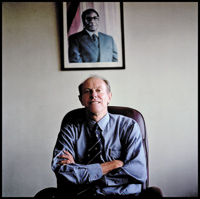
Photo Credit: Benedicte Kurzen/The New York Times/ReduxAs discussed in the previous post, the question of presidential portraits has symbolic importance for some Zimbabweans. As Bev Clark wrote in 2005, framed photographs of Mugabe hang on the walls of many banks, shops, and hotels – despite there being no law requiring this.  Contrast this with Cote d’Ivoire’s Laurent Gbagbo, who, soon after being elected in 2000, banned photos of himself in hotels and airports. This prompted a BBC listener forum asking if Presidential photos are a bad idea. (Gbagbo’s term expired in 2005 and yet Cote d’Ivoire has yet to hold elections fresh elections, but that’s another story.)

Even with the transitional, inclusive government, little has changed. In a recent interview with The Atlantic, Minister of Education, Sport and Culture David Coltart (of the Movement for Democratic Change) is depicted sitting below Mugabe’s portrait.

This week, we shared this photograph with our subscribers, with the question:

Should MDC members of the Unity Government uphold the portraits of the old Zanu PF guard? Write to us at info [at] kubatana [dot] net

We’ve been delighted with the volume – and variety – of feedback we’ve received. Read some of these responses below.

My thinking they should do away with the portraits of Mugabe

- VV

——

Yes the potrait should remain for now.
- CM

——

All portraits should be removed and never replaced.
- AC

——

I am against upholding the potraits of the old guard. If we have to then let both the Prime Minister’s and President’s potraits both be displayed.
- MD

—–

I say no, members of the unity governement should remove that portrait and replace with theirs. I am sure that portrait is now tired of hanging all these 2 decades. It simpy needs a replacement. Thats my opinion . . . as long as i will get my freedom after expression will keep on writting.
- TT

——

MDC T & M clearly seem happy to be pandering  and fawning over the old guard for reasons best known to themselves that they clearly haven’t shared with the resent of us. Attending their parties, eating their food and generally showing  a camaraderie that seems to be saying for them, as far as they are concerned the war is over now!
- MJN

——

I would like to put across my opinion on this matter (which you have sought opinions for from across the Kubatana family), which goes like this:

His Excellency, Comrade R. G. Mugabe is the President of the Republic of Zimbabwe. According to the agreement that ZANU (PF) signed with the 2 MDC formations, it is an agreed fact that he is also the Head of State and Commander of the Defence Forces. Now, in these 3 capacities, especially, the first 2, the portrait has every right to be put up in every important office and public place.

Maybe, the question we should be asking ourselves is, should the portrait of the Prime Minister’s be put up  there as well besides that of the President (in other words, should the 2 portraits share the same space)? My humble opinion is, maybe we need to look back into history to the time when the current President was still the Prime Minister. Did we have 2 portraits? I have done a little research, and I am informed that the 2 portraits of H. E. (the late) Canaan Banana and the then Prime Minister, Comrade R. G. Mugabe were pinned together (I stand to be corrected).

It is against this backdrop, therefore, that I opine that, maybe it will be pertinent to ask whether the portrait of the Prime Minister be pinned alongside that of the President.

Zimbabwe is a multi-racial country. A beautiful country with a beautiful people! I am thrilled to notice that in front of the President’s portrait (I am referring to the photo that you have circulated to spark this debate) we have a person of a Caucasian origin. This shows that, the portrait of the President is still accepted as a symbol of state leadership by all Zimbabweans.

In a nutshell, I feel the portrait of Comrade R. G. Mugabe who is the current Head of State and President of the Republic of Zimbabwe, should stay up there! We need to pin it up where everyone will be able to see it!

Thank you for giving me time to provide my own opinion on this matter.
- JC

——

1. Unfortunately, Mugabe is still the President. It is not possible to separate the President from the old ZANU(PF) guard. (Yet.)
2. Please stop calling it a Unity Government. It’s an Inclusive Government. We know there is no “unity”. So do all the parties involved. They don’t call it a unity government. They call it an inclusive government. The only people who call it a unity government are the press and commentators. Please use the name that says what it it, not what it is not!
- RS

——

I am so worried that as a nation we are not looking for the things that can build us and brng us closer to each other. We have in the last 27 years suffered a lot being divided by a fellow African. Should we at time time keep this division.. the Zanu and MDC to an extent of killing each other as we did running up to the presidential elections re-run…

What is a picture when there are more pressing issues, the continued tortue of the opposition, abuse and victimisation of women and children for poltical expendience. I warn your platform not to play in the hands of Zanu to further divide our people.

To hell with the divisions.
- JS

——

Nope. We either need to have no portraits (unlikely) or two portraits – one for the president and one for our prime minister (yes, the pronouns are intentional).
- LL

——

Zanu are not the masters of anyone. They lost the elections fair and square. Therefore a photo of Mugabe should not be hung . Imagine if a photo of Ian Smith was still hung what would be said by all and sundry. I for one will never accept a leader who has virtually forced himself on others.
- VN

——

Yes, the portrait of a politician can not be mandatory for public places and still less for private offices. In Germany it is unbelievable that the portrait of the president would hang from every wall. Also streets and public places are never receiving names of living persons. Not one living person would ever accept such a treatment. Only extremely proud and fallacious persons can accept or even demand such acts. It shows that they are personally not self-confident. Streets and public places all over the world should never be named after politicians and military people. Often you only hear years after their death what kind of scrupulous people they were. Would Zimbabweans ever have believed before independance who has freed them from the colonialists so to grant them less freedom after independance? Education in democratic behaviour must start in the family and is continued at school. Women must play a more important role in  family and society. At the top of crime statistics are always men. The woman is the future of humanity. This declaration is signed by a man.
- DK

——

They should be removed we dont want those old photos. Why should we want people’s photos anyway?
- AM

——

No, of course not! He is not a monarch – it is ridiculous. There’s a great entrepreneurial opportunity here – print the image onto dart boards!
- LM

——

The issue of the portrait that hangs in every public office (and some private ones too) is all about vanity on the part of the subject matter.  Many people do mistakenly think that the hanging of that portrait is legislated for – it is not. Rather, it is an instrument of intimidation – a constant reminder of who is boss.  Zimbabweans should revere the flag which will remain constant regardless of who is running the country.  Portrait worship remains the preserve of some African dictatorship, China and North Korea.  Never mind that it is a totally unnecessary public expense, unless it is someone’s brilliant idea to remind visiting foreignors of who exactly is the leader – yeah  I think thats it!
- AM

——

I do not think its a good idea under the inclusive government to put Mugabe’s potrait in offices of the MDC government office bearers. The inclusive government according to me should be based on equal share of power.
- PT

——

The continuance of the use of Zanu PF symbols and institutions has surprisingly been tolerated by the 2 MDC formations. I am not so sure if the guys don’t attach a lot of value to it or they are busy carrying out their onerous tasks so that they can make a difference. I hope that we do not have a situation whereby they are just happy with what they have got already and that will be disastrous.

I am given to believe that some of the MDC chaps (especially those that are ‘employed’ by politics) may have self actualized quite early and may even not be keen to see the elections coming their way! I hope I am wrong about this!

Besides, I am one of those people who do not believe in portraits for individuals as this tends to create a feeling among the leadership that they are demi-gods (mugabe is a typical example as he believes or has been made to believe that he is indispensable). If you look at the way people fall over each other to wear anything that bears his image as a sign of allegiance to the party; its unfortunate. I do not believe that wearing ‘President Morgan’ t-shirts is necessarily a measure of my allegiance to him.
- GN

Zimbabwe is changing

del.icio.us TRACK TOP
Thursday, December 10th, 2009 by Amanda Atwood

I'm not changing

Over dinner on the weekend, the conversation turned to how different this year has felt from the past few.

Of course, the difference is tinged with a mixture of relief and frustration. Economically, the relief of stable (even if high) prices, and goods (even when unaffordable) on the shelves has made the basic day-to-day requirements of getting by more predictable – but at the same time has made for a more expensive – and therefore even more tenuous – existence for many.

Politically, the negotiated settlement has left Zimbabweans increasingly outside a decision-making process that is run by politicians for their own interests. A recent report by the Research and Advocacy Unit condemned the constitution making process as “make believe politics,” in which the citizenry is increasingly left out. People spoke of an unfortunate fatigue with and disengagement from politics.

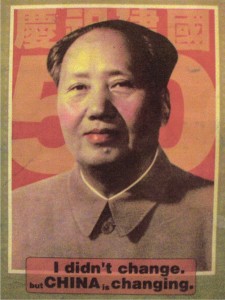
We spoke a bit about what “real change” would look like for each of us, a bit like the “what would you like in a new Zimbabwe” idea. One person spoke up immediately, and adamantly, against presidential portraits. For him, a new Zimbabwe would be one in which people took the portraits of Mugabe off their walls, and never put them back. He recalled being in China some 10 years ago, and seeing Mao’s official portrait redone as a table mat – simply, subtly and tastefully captioned with the words “I didn’t change. But China is changing.” He recalled his surprise at seeing something so controversial so openly displayed. Mugabe – and the rest of our politicians – might not be changing. But Zimbabwe is changing.

Conference room activism vs street push-ups

del.icio.us TRACK TOP
Monday, December 7th, 2009 by Bev Clark

Zimbabwean social and political commentator Rejoice Ngwenya discusses protest consumerism in his article entitled “Citizens are the real heroes” . . .

I am not a street activist, but more from the irritable pool of intellectual key-punchers who hope that Robert Mugabe and his cronies are literate enough to notice how collective resentment and hatred for shameless, fascist dictatorship is better expressed in the written word. This I say because there is a fallacy pervading Zimbabwean society that the number of times and period that one is beaten and arrested is the only means of verifying serious political activism.  And perhaps there is precedence to this malnourished viewpoint, given that the icons of Africa’s liberation struggle have, at one time or other, had a bruising encounter with local justice systems.

The tragedy is that nationalists, like Mugabe, have used this as a basis for extended stay in power, arguing that long periods spent in colonial gaol gives them the right to oppress their countrymen.  Critics of Professor Arthur Mutambara have raised the same argument that he never received as much political bashing and detention as Morgan Tsvangirayi, thus his claim to political fame is flimsy and frivolous. The good news is that this viewpoint is devoid of good judgement and destined for extinction.

In awarding Magodonga Mahlangu the coveted Robert F. Kennedy Human Rights Award, United States President Barack Obama mentioned that the firebrand Zimbabwean activist has been arrested more than thirty times. No doubt all progressive cadres of the struggle against Mugabe’s ‘scientific’ tyranny will and should applaud Mahlangu’s recognition, but I am one of the few who do not particularly subscribe to the theory that the number of times one is convicted for a good cause emits a force equal to or equivalent to the motion towards liberation. Moreover, the struggle  takes a further mortal knock when one, like Mahlangu does,  goes further to justify activism purely on the basis that his or her parents, friends, neighbours and relatives were at one time or another, victims of Mugabe’s Gukurahundi genocide.

More often than not, we Zimbabwean activists exaggerate our encounters in the struggle.  ZANU-PF has always been reminded that everyone fought against colonialism, thus heroism is not only a preserve of former Mozambican and Zambian exiles, members of the Central Committee or victims of post-independence detention and genocide.

Girl child activist Betty Makoni is currently exiled in England, advancing, like many of those Zimbabweans who inhabit that land, another case of persecution by the ZANU-PF government for exposing alleged ministerial girl-child abuse. No doubt she is in line for another award of recognition for her ‘struggle’ against tyranny. There is no doubt that other cadres like former political hostage Jestina Mukoko, human rights lawyer Otto Saki and constitutional activist Dr Lovemore Madhuku deserve all the accolades they get from the world movement for democracy. A crucial part of the struggle against oppression is confronting and defeating ZANU-PF it in its natural habitat – in the streets, but to limit recognition of this struggle only to the number of times one is arrested from the trenches belittles greater good.

My point is that the struggle to unseat tyranny is not about ‘rented’ college students doing street push-ups, old women and lactating mothers sacrificed on the altar of fiery fury of the dragon, merely to score political points. More often than not, strategic partners of governance and democracy have been accused of supporting only institutions that ‘raise hell and dust’ in running battles with Mugabe’s uniformed sympathisers in the alleys. This is a narrow view of resistance, for there is more like us who find pride in pounding tyranny from the keyboard. It may not be glamorous, elicit blood or swollen foreheads, but the message spreads far and wide. Street activists accuse us of ‘conference room activism’ because there is no glitz and glamour accrued from making interviews for CNN from hospital beds.

The moral of my argument is that when seminar attendance registers and police charge sheets become the only genuine evidence of political activism, strategic partners have taken the eyes off the ball.  ‘Anniversary’ day activism manifested in protest handbills and posters, glossy advertisements, angry press statements and red roses handed out at street corners are part of the continuum of the struggle against ZANU-PF dictatorship.

However, the demands of modern day transformative revolution require that we shift the gear from mere defiance to a higher pedestal of popular resistance. The answer lies in paralysing the business supply systems that keep the ZANU-PF dragon bite venomous. Restrictive and targeted sanctions are part of this exciting high-yield strategy; the other is embedded in protest consumerism.

Mr. Rejoice Ngwenya writes for AfricanLiberty.org.  He is founder of Coalition for Liberal Market Reforms, a Zimbabawean think tank.

Unrest at the University of Zimbabwe

del.icio.us TRACK TOP
Thursday, December 3rd, 2009 by Bev Clark

Just in from the Zimbabwe National Students Union (ZINASU):

Today’s Alert (03-12-09)

There is chaos and pandemonium at the University of Zimbabwe (UZ) after college authorities barred students this morning from entering the examination room over nonpayment of tuition fees. The end of semester examinations started today, 3 December 2009 and security guards have been placed on all entrances to the examination halls. This has prompted the ZINASU leadership comprising of the President, Cde B. Dube, the Secretary General, Cde L. Chinoputsa and other general councilors from various institutions in Zimbabwe to swiftly intervene in the dire situation and is trying to meet the College Vice Chancellor, Proff Levy Nyagura to reverse the absurd decision and allow all students to write examinations irregardliness of whether they paid or not. Failure to reverse that will lead to a serious riot by students.

The Ministry of Higher Education reiterated on Saturday, 28 November 2009 during the ZINASU All Stakeholders Conference on Higher Education reforms that no students should be barred from writing examinations over nonpayment of tuition fees. The tuition fees charged in most state instititutions are exorbitant ranging between USD150- USD850 and the majority of students cannot afford these steep fees.

About 42% of the students at UZ failed to pay the inflated fees and if nothing is done to solve the crisis it means the future is gloom for almost half of the students from the biggest and oldest institution of higher learning in Zimbabwe.

Make believe politics

del.icio.us TRACK TOP
Wednesday, December 2nd, 2009 by Bev Clark

Recently a group of “experts” (whatever that means – what makes an expert?) held a meeting in Harare to discuss a wide range of current concerns in Zimbabwe, including whether the Interim Government (IG) is “working”. A report of the meeting has been published by the Research and Advocacy Unit and IDASA and we’ve just put it up on the Kubatana web site. You can check it out here.

The report gives us a lot of food for thought especially in regard to civil society and the general public getting sucked into the “make believe politics” of the IG. According to the report “It was suggested that the donors had contracted what was referred to as the MDC disease of “GNUitis”. The donors thus appeared to a large extent to be setting the agenda, and an agenda which was not one that was required. This went to the extent of organisations such as the UNDP duplicating, and, to some extent, thus commandeering projects already being undertaken by the civics. ”

Below is an extract from the report:

The group noted that the State media, MDC media releases, and politicians from all signatory parties to the GPA were at pains to emphasise that the IG “is working” albeit with “unsurprising” “teething problems”. There are various facets to these statements:

* “Working” could be merely existential in the sense that the IG is intact and has not dissolved in the face of the divergent objectives of, and acrimony between, the signatories.
* “Working” could mean that some governance is taking place which is responsible for bringing a modicum of economic, social and political stability to Zimbabwe after a period of extreme turbulence in all of these spheres.
* “Working” could mean that the MDC’s stated objective of returning Zimbabwe to the rule of law and democratic governance is being incrementally realised.
* “Working” could mean that ZANU PF’s stated objective of “removing illegal sanctions” is a work in progress and the, probably unstated, goal of achieving legitimacy after unrecognised 2008 elections with a consequent easing of international pressure had been achieved.

The group noted that very little power had accrued to the MDC through the GPA, and that the MDC appeared to be reluctant to exercise the little power that it had. This led to an unpacking of the MDC’s concept of a “working” IG. In particular, the MDC argument that, while it recognised that the GPA was highly flawed and left Mugabe’s powers almost completely intact, it had little choice other than to sign and enter the IG. Failure to do so would have resulted in a formal or de facto coup by the security sector and a continued and intolerable humanitarian crisis. This had been avoided by the GPA and the tactic had thus “worked” to this extent. A corollary of this tactic is for the MDC to demonstrate that it is not a threat to ZANU PF – achieved in part by not seeking to exercise power in any sphere which ZANU PF regards as its exclusive domain – to thereby ameliorate the acrimony between the parties, calm the political waters, and for there to be a mutual “re-humanising process” to reverse the dehumanisation that had preceded the accord. This approach was designed to gradually “change the mindset” of ZANU PF stalwarts, and the MDC, simply by virtue of being in the corridors of power, would increase its leverage and be able to open up democratic space sufficiently for free elections to be held under an improved constitution. The approach demanded that the MDC claim that the IG was “working”. The group gave this approach the moniker “make believe” politics.