Kubatana.net ~ an online community of Zimbabwean activists

What’s up with Misihairabwi-Mushonga?

del.icio.us TRACK TOP
Monday, August 16th, 2010 by Bev Clark

We featured an article on aid and NGOs in one of our Kubatana newsletters recently. Seems like the MDC’s Priscilla Misihairabwi-Mushonga wants the government to monitor and audit the activities of NGOs in Zimbabwe.

All well and good but surely it should work both ways? When do Zimbabwean citizens ever encounter any accountability and transparency from the Unity Government? Like, for example, audited accounts of how revenue from toll gates is used? Or how revenue from City of Harare advertising is used?

Donors require strict financial and programming reporting from the beneficiaries of their funding. If NGOs don’t comply or perform to these high standards they lose their funding. Meanwhile, the Unity Government of which Ms Misihairabwi-Mushonga is a part of, seems to believe that they stand apart from any checks and balances.

Some of our subscribers responded like this:

Why does government all of a sudden want donors to account for its money? Do we know how government uses its funds; which by the way, come from tax payers? Why would government expect donors to be accountable to them when government itself is not accountable to its own citizens? I do not think this is a good move on the part of government, especially now when there is a dire need for funds and government is failing to meet its obligations. NGOs are providing the much-needed food, clean water, agricultural inputs to citizens. Government has clearly failed to meet its obligations. Look what happened in 2008 when we had the cholera outbreak. UNICEF and other NGOs moved in and provided clean water and treatment. Right now clinics are functioning, obviously thanks to NGOs, which ever ones they are. So, is this another example of government shooting itself in the foot?  It does not make sense for a man to start harassing someone who is feeding his family when he has no capacity to do so himself. Minister Misihairabwi-Mushonga should tell us the real reasons for this requirement; she surely does not expect us to believe that this is the norm everywhere in the world? Even if it is, other countries are normal with normal governments. We on the other hand, have a dysfunctional government and one would hardly describe our situation as normal. I hope the Minister does not think that we are all so stupid we would think government is worried about us-we know they are not, ZANU PF or MDC.

I do agree  with Jona Mapako who responded on ZimIand forum saying . . . I think the minister has lost it. The government can only decide where its own money goes. The fact that there are donors reflects failure on government’s part to care for its citizens. This however is very true . our country has made head lines not because of anything but our corrupt politicians whose corrupt minds and actions led to the fall of the Zimbabwean dollar. Channeling all funds to the government will only misuse this money just as they always do. Chakatanga ndicho chakachenjedza to hell with them wanting to own everything. Minister Priscilla is beginning to sound  Zanu pf or has she been promised something in all this. Is she being controlled by someone? “We try to put aid where it’s most effective, and I don’t believe having a rule that says everything must be one way or another. As it stands right now the bulk of our aid goes directly to communities and goes through NGOs,” as said. By the US Ambassador is very true. I believe there is nothing wrong with this. Even the Bible says there is more joy in giving than in receiving but rest assured if your efforts are directed to the wrong destination then you simply have not achieved your goal which is to help. My conclusion is NO to government control over the funds. Them controlling the NGO’s is okay but not their activities and funds.

I think the minister is very right, the government should know who the donors are dealing with, in a way it’s a matter of national security. This is our country Zimbabwe and it is the government which acts as custodian of our safety, our peace, and our resources. It is therefore prudent for them, as custodians, to know everything that transpires within or outside the boarders of Zimbabwe as long as it has a bearing on the life of any Zimbabwean. Whether it is aid or what, the government has to know because they are answerable to us, citizens of this beautiful country, Zimbabwe.  I salute the stance taken by Madam Honourable Minister.

I second the notion that the Minister, (Misihairabwi-Mushonga) has lost it, and has lost it big time. I am sure she has come along a saying which goes like, “beggars are not choosers”.Honestly , have they thought of what would happen if those donors decide to pull out?

Decision on NGOs threatens Western aid

A government decision to police non-governmental organisations working in Zimbabwe threatens future support from Western countries whose funds have been critical in curbing humanitarian disasters, a top diplomat has said.

Regional Integration and International Cooperation minister Priscilla Misihairabwi-Mushonga said the government last week told donors and ambassadors from donor countries that they should inform government of their activities, total funding into the country and the non-governmental organisations (NGOs) that they were working with.

But the United States (US), which is one of Zimbabwe’s biggest donors, warned yesterday that such a move would be disastrous, mainly because it was not practical to make such demands when donors were doing their best under the current environment where their options were limited due to restrictions levelled against some people in the inclusive government.

However, Misihairabwi-Mushonga insisted that donors and NGOs should abide by the rules and regulations government has set out for donor funding. Misihairabwi-Mushonga, who chairs the recently set up Government Development Forum in which 10 ministers sit with donors and ambassadors to discuss policy and problematic issues regarding donor funding, said government should be the dominant player in aid co-ordination and aid-distribution. She said she would soon be compiling a database of the total number of donors and the NGOs in the country, programmes that they finance, size and quantity of funding and the criteria they use to select their beneficiaries.

“It is the government that defines where aid should go. We now require everyone in the country to inform us about their aid work, how much they are spending and which areas they are working on. Right now we don’t know and are not sure who is doing what or working with whom and through which NGOs,” said Misihairabwi-Mushonga.

However, US Ambassador to Zimbabwe Charles Ray told the Zimbabwe Independent yesterday that he did not believe in a government dictating rules on how they should operate, adding that what worked at the moment, because of the restrictions on Zimbabwe, was to channel aid through NGOs or directly to communities.

“We try to put aid where it’s most effective, and I don’t believe having a rule that says everything must be one way or another. As it stands right now the bulk of our aid goes directly to communities and goes through NGOs,” he said.

“The essential philosophy of US aid and the way I influence wherever I work is… I refuse to have someone write a set of rules and tell me that I must follow those rules, I look for what works.”

Misihairabwi-Mushonga said what they are doing is the accepted norm in any country in the world. “They have to know that they are dealing with a country which has a government and they will have to follow certain rules. They can’t just operate in this country the way they want.”

Source: Faith Zaba, The Zimbabwe Independent
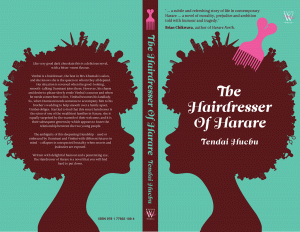
The Hairdresser of Harare

del.icio.us TRACK TOP
Thursday, August 12th, 2010 by Bev Clark

“Like a very good dark chocolate this is a delicious novel with a bitter sweet flavour.”

Available from Weaver Press at $12 each.

Visit their web site to order your copy Today, and support Zimbabwean publishing!

A woman’s place is in politics

del.icio.us TRACK TOP
Thursday, August 12th, 2010 by Delta Ndou

I used to be one of those women who would turn her nose up whenever politics was brought up thinking, “what a waste of time, I’ll focus on gender issues and advancing the interests of women.”

I have had occasion to change my mind about politics and the discourses of governance and decision-making in the highest echelons of power.

In fact, I would go so far as to say I have set my mind firmly on pursuing politics as an overarching goal in my activism career.

Once I realized the influence that politics has on my life and its bearing on the choices availed to me as a woman, as a youth and as an African, I became convinced that being a woman must of necessity require one to be a politician.

I figure if politics determines what I can afford to eat, what kind of bed I can sleep on, what kind of shelter I can call home, what kind of lifestyle I can lead (power-cuts, water-rationing and all) – if politics can impact on what kind of clothes I can afford to wear or the kind of educational and career opportunities availed to me – then clearly politics is exactly where my head needs to be and precisely where my heart should set its sights.

If politics determine what kind of future my children will have or the kind of road I must travel on daily and the texture of my journeys (bumpy dusty roads, potholes and all) then I figure politics is exactly where I need to be.

If politics will determine which embassy will shut its door in my face, if politics can deny me the chance to see the world beyond the borders of my nation, if politics has the power to detain me within the confines of my continent – then to change the narrative of my life and to exceed the limitations imposed by my nationality (tainted by bad governance, skewed politics and all); I must delve into politics.

If politics determine what laws will govern my conduct and which laws will legitimize my oppression – then by all means I must become a politician to change the status quo from within and not from without.

If politics can give immense power to a minority and perpetuate the discrimination and marginalization of certain sects of society – then I should be a politician to use the same vehicle to turn the tide of social injustice.

If politics can determine the quality of my life and my fate when I ail (no drugs in hospitals and no health personnel and all) as well as the kind of burial I am likely to get from my well-meaning but financially stunted nearest and dearest – then politics is my business.

If politics determines my diet, keeping the best brands just out of my reach so that I have to be content with the ‘no-name’ average products (with local industry struggling and all) then clearly, politics is where I need to be.

If politics influence the kind of security afforded to me and my property as a citizen (with underpaid cops and corruption being the order of the day) then I have to be a politician or be doomed to a life lived according to the dictates of others.

If politics gives one the voice, to speak on behalf of others then politics is my kind of brew – for no one speaks for me; I will speak for myself and if need be, I will speak for those on the receiving end of life’s endless tragedies and political intrigues.

A woman’s place is in politics. A woman’s business is to shape a tomorrow brighter than our own past and greater than our present circumstance.

So I sold my soul to the ‘dirty’ game of politics for if it is a game then I refuse to be a casualty, a pawn and a bystander caught in the middle and paying the price for decisions made without my consent or footing the bill for events sanctioned without my permission.

So hear me when I say, politics is my business for I would rather pay the price of being one than suffer the penalty of standing on the sidelines while others recklessly play God with my life.

We’re here and we’re not going anywhere

del.icio.us TRACK TOP
Wednesday, August 11th, 2010 by Delta Ndou

I feel patriotic these days. And before the feeling wanes and recedes into the indifference that often informs the limited involvement of young people in anything important in this country- I think I should speak up.

For in keeping silent I perpetuate a grave injustice to those of my kind – the youth of Zimbabwe.

Combined with these patriotic sentiments are the sentiments of Deborah Meier that I happened across the other day. She wrote, “There’s a radical – and wonderful – new idea here… that all children could and should be inventors of their own theories, critics of other people’s ideas, analyzers of evidence, and makers of their own personal marks on the world.  It’s an idea with revolutionary implications.  If we take it seriously.”

I can trace my blossoming patriotic sentiment to the three weeks I spent cooped up at the University of Ghana with two and a half dozen young women from 21 African countries and to the fact that in nearly deliberation Zimbabwe was used as a reference point for one bad thing or another.

It is one thing to daily hear Zimbabweans speak negatively of their own country, to listen to them and join them in denigrating their own country but quite another to listen to outsiders take similar liberties.

Indeed it is the one thing that will make you defend your country without stopping to examine your reaction but simply because it is your country, your home and ultimately it is who you are – Zimbabwean. It is also what will force you to scrutinize the condition of your country and how other people have come to perceive you as a people.

By omission or by commission every Zimbabwean is responsible for the leadership we have and for the mess we’re in.

Whether through indifference, greed or fear – we’re all guilty of allowing this great land to sink to its knees.

I have joined on occasion, when I could muster the breathe, in the mud-slinging, bad-mouthing, finger-pointing and hurling of insults directed at those in power and those aspiring to be in power. I say on occasion because for the greater part, I simply have been too nonchalant to even care.

Perhaps, that is the real problem for me and the youth, we have believed that we are too weak, too young to be of any consequence and in believing this fallacy we have sought refuge in nonchalance.

It doesn’t help too that there is so much romanticising about the past that we always feel that our unavailability to be drafted into the liberation struggle automatically makes us less qualified to have a say in the running of our country.

I mean if there is one thing ZANU PF has perfected it is the art of using its formidable credentials as a revolutionary party to bring the Zimbabwean electorate and youth to heel with a cocktail of nostalgia, sentimentality and the incessant reminder of the insurmountable debt of gratitude owed to them by every citizen who lives in a free Zimbabwe.

The MDC, on the other hand; wisely discerning that they cannot do much to beat the revolutionary party card that ZANU PF loves to draw – have made it a point to totally ignore the liberation struggle and by doing so attempt to rule Zimbabwe and its people outside the contexts of our history rendering them rather superficial.

I will not strain self trying to untangle the relevance (or lack thereof) of the splinter factions that are now a ZAPU pulled out of ZANU and an MDC pulled out of an MDC-T; too much ink has been spilled de-bunking these political specimens.

However, if the youth hope their participation in the nation’s politics to be meaningful; this is the political menu of parties that is availed to them.

One that is stuck in the past and bogged down by its distrust of young people and new ideas then another with a vibrant youth visibility but suffering from the acute deficiency of denial and a tragic refusal to own Zimbabwe’s liberation history (without which they would not enjoy the very autonomy that allows them to aspire for political power).

I have opinions about Zimbabwe, I have thoughts about the conditions of Zimbabwe, I have theories and hypotheses about what is wrong with this country and about why we are where we are today.

I have no idea how long I have held these views but they must have been simmering in me, stewing for a long time because when I was in Ghana I said, for the very first time, in a lecture room full of strangers what I thought.

And I was surprised by the vehemence with which I leapt to defend my beloved country, astonished by the passion with which I narrated the course of events that had brought us to this present miserable condition and even more shocked by the utter convictions with which I spoke.

I was amazed that I cared that much about Zimbabwe; surprised that I cared at all for over the years the pretence of at indifference has become second nature to me such that I began to believe that it was normal.

How dare we sit, fold our hands and watch the demise of our country as if we had another spare Zimbabwe stashed somewhere to live in as soon as this one folds up and inexorably crumbles?

For in the years to come, many who hold the reins of power will succumb to the inevitability of death and we shall inherit nothing but the shell of what once was.

I believe that Zimbabwean youths have been sidelined for too long and that perhaps we must come to a definitive age-range of what it means to be a youth in this country.

It bothers me no end that a person on the wrong side of 30 should strut around as a youth leader or presume to speak on behalf of young people in this country.

Moreover it bugs me terribly that young people have been willing to be used as arse wipes by those who aspire for political office only to be discarded after the elections and flushed into oblivion.

But I want to believe that the tide is turning. That the youth will be reckoned with, that we will be ignored no more, sidelined no longer and never again patronized.

As we enter the UN International Year of Youth running under the theme “Promoting Dialogue and Mutual Understanding” – I fervently hope that the would-be election candidates of 2011 and beyond will get off their high horses and engage young people as equals because we are not going anywhere.

The International Year of Youth is our chance to declare categorically that as Zimbabwean youths, we are here and we are not going anywhere. This is our country of birth and we have as much right to live and prosper in it as anyone else.

Female condoms popular in Zimbabwe

del.icio.us TRACK TOP
Friday, August 6th, 2010 by Bev Clark

Below is a press release from the organisation Support about the need to make female condoms more widely available:

Female Condom Popular in Zimbabwe – Numbers Show True Picture

By Kathryn Bice, Freelance Journalist

The female condom has come in for some criticism in the media in Zimbabwe in recent months, but experienced advocates are convinced that it is a product strongly desired by Zimbabwe citizens and a vital weapon in the fight against HIV/AIDS.

Critics have claimed that women do not want the female condom because it is too big, noisy and difficult to insert.

Not so, says Mrs Patience Kunaka, the communications manager for PSI Zimbabwe, which distributes the FC Female Condom, branded as care, through private sector channels in Zimbabwe. PSI, or Population Services International, is a non-profit organization that works to make health and population control products and services more available in low-income areas of the world.

The number of female condoms distributed by PSI grew from 455,556 in 2001, when they were launched, to more than 3 million in 2008, before declining slightly last year due to Zimbabwe’s economic problems.

As well as care, the FC Female Condom is distributed free of charge as the unbranded Femidom by the Zimbabwe National Family Planning Council, an arm of the Ministry of Health, through government institutions such as clinics, tertiary institutions and government offices.

Such numbers are proof that demand for the female condom is fundamentally strong and rising, Mrs Kunaka said.

The key is “education and outreach”, she said. “PSI has a highly targeted program. We believe that distribution should be backed up with interpersonal communication. People we have reached out to are very happy to use the female condom.”

The perception that the female condom is too big is sometimes due to the fact that “some people have poor understanding of the female anatomy,” she said. “People who have been exposed to it have no such worries because they know the female condom fits well as it lines the contours of the vagina.”

The FC Female Condom is a tube-shaped sheath about as long as a male condom but slightly wider so that it lines a woman’s vagina comfortably.

The FC Female Condom has a small ring at one end that fits inside the vagina and keeps the condom in place and, according to some users, gives enhanced pleasure. It also has a larger ring that stays outside and covers part of the woman’s genitalia and the base of the man’s penis, giving extra protection from sexually transmitted infections.

Mrs Kunaka got some backing from an unexpected source recently when the advice doctor in US Glamour magazine, Dr Kate O’Connell, wrote that when she tried the female condom, inserting it “wasn’t as tricky” as she expected.

Dr O’Connell also commented that although it made “a little squishy sound, it wasn’t distractingly loud,” and that she probably noticed it only because she had her ears open for noise.

PSI socially markets care through hair salons and barber shops, pharmacies, private health care institutions, support groups for people living with HIV/AIDS, and networks of sex workers.

Priced at 20 US cents for a packet of two, it is “attractively packaged and positioned for women who are confident and care about themselves and their partners,” Mrs Kunaka said.

The internationally recognized hair salons initiative has been so successful that Botswana is considering replicating the model.

“We continue to recruit hairdressers and provide structured training and support for them to sell the female condom and to teach women condom negotiation skills and how to use it correctly,” Mrs Kunaka said.

“When the clients go in for a hairdo, they have a chance to talk to the hairdresser about how to use the female condom, and the hairdresser can teach them.”

Mrs Kunaka said the decline in consumption of female condoms in 2009 was due to Zimbabwe’s economic challenges, which include unemployment and effects of the 2008 inflation.

“The hair salons are our major channel, but they have been badly affected by the economic problems,” she said.

“We have water shortages and power outages, which make it difficult for salons to operate. Some are opening for shorter hours and some are closing altogether.

“We are moving to a situation where some hair dressers rent a chair in a salon, and with rents going up they might have to move at any time, so they don’t have anywhere to store their condoms.”

The economy has also been “dollarized”, with the US dollar being used for many transactions.

“We don’t have a 10 cent denomination, which makes it hard for people to buy their condoms because they don’t have these smaller denominations”, Mrs Kunaka said.

“To enable women to access the product, clients are encouraged to buy amounts costing a dollar which is the readily available denomination.

“But we still have a lot of confidence in the hair salon channel. We try to take advantage of the conducive environment, and provide the distributors with branded aprons, towels, floor boards and racks to display the condoms and posters that show the hairdressers posing with different hair styles.”

Ministry of Health and Child Welfare figures put Zimbabwe’s adult HIV prevalence rate at 13.7 percent in 2009, down from 18.1 percent two years previously. The female condom remains an important weapon in the fight against the epidemic.

“The female condom is very important because it gives women a chance to play a role in HIV prevention at the family level,” Mrs Kunaka said.

“Women say they feel safe, because they can buy and put it on themselves, so they are sure the condom is there to protect them.”

But an underlying problem is the gender inequality in Zimbabwean society.

“When you look at our culture, it is the men who make the sexual decisions. It is very hard for married women to negotiate condom use. In fact women who are in less regular relationships actually have more chance to negotiate,” Mrs Kunaka said.

“In the past there has been a stigma attached to being seen buying a female condom. There was a perception that condoms were for people of loose morals. We position it as a family planning product to married women, and that has successfully overcome the stigma.”

PSI has also increased its efforts to sell the female condom to men.

“We have expanded our barbers’ network, because we hope they get to talk to as many men as possible. If men can also buy the condom for their partners, then many more women will be able to protect themselves.”

Harare’s Mayor needs to wake up

del.icio.us TRACK TOP
Thursday, August 5th, 2010 by Bev Clark

How do you feel when you get your bill from the City of Harare each month?

We get charged for refuse removal, but in many suburbs, this seldom happens. We get charged for improvements. Yet pot holes are infrequently fixed, road signs are in disrepair, if there at all, the grass on verges is uncut, litter is strewn everywhere, shopping centres like Kamfinsa look like a war zone and very few street lights work.

Yet, according to a recent Combined Harare Residents Association (CHRA) news alert, Harare’s Mayor, Muchadeyi Masunda, will not review the large salaries that are being paid to some employees within the council. Apparently the salaries top the US$8000/month mark.

CHRA rightly points out that the money that residents pay each month goes straight to the city’s salary bill and not to service delivery. Amusingly, the Mayor suggests that paying council workers less will result in high staff turn-over and therefore compromise service delivery.

What service delivery? Can’t see any where I live, can you?

Support the work of organisations like CHRA and their calls for rates boycotts and litigation if the Mayor doesn’t take residents concerns seriously.