Kubatana.net ~ an online community of Zimbabwean activists

Mustering my protective sprout

del.icio.us TRACK TOP
Posted on December 15th, 2007 by Bev Clark. Filed in Uncategorized.
Comments Off

I’ve just popped out to the Kamfinsa Shops. I’m pleased to say I made it there and back despite the potholes. Sadly this once thriving shopping centre is a shell of its former self. Shop owners have been forced to close their doors – either there’s nothing to sell, or people don’t have cash. The only activity I saw (if you can call queues active) were the milling masses waiting outside CABS building society in the hopeful hunt for cash. Another throng of people were gathered outside TM supermarket looking for a loaf.

I must confess that my Saturday morning shopping stint wasn’t in search of anything heart-stoppingly essential. I was after a bottle of wine for a Christmas party tonight. Of course this might not be a good idea on top of my margarita, voluptuous glass of wine and Irish coffee at last night’s party. Anyway, no big surprise, there wasn’t any wine and when I thought I’d settle for a Castle, a sign on the fridge informed me . . . no empty, no beer.

At the very least I’m trying to have fun which is a bit hard in a country with little to celebrate. Another way of getting a laugh is to read Zimbabwean newspapers and the advertisements therein. Today I was flipping through The Financial Gazette and an advert from a security company caught my eye. They were giving advice on how to stay safe over the “festive season”. Here’s some of what they had to say:

Mystery deaths in hotel rooms, drowning, car jacking and food poisoning are common during festive seasons. We encourage you to muster your protective sprouts from deep within by elevating your instinctive and intuitive minds to be the focal part of your correction.

You, my friend, are a rapist

del.icio.us TRACK TOP
Posted on December 10th, 2007 by Amanda Atwood. Filed in Uncategorized.
3 comments filed

A few months back, I was sent a copy of off our backs – the feminist newsjournal. It’s a raw, angry take on gender, society and women’s issues, and I loved it.

The magazine includes a feature with Kim, the woman who, in 2005 started a blog called The Den of the Biting Beaver, where she published her views on life, feminism, rape and sexual assault. She published pieces such as this one, entitled The Rapist Checklist, which includes points such as:

1. You are a rapist if you get a girl drunk and have sex with her.
2. You are a rapist if you find a drunk girl and have sex with her.
3. You are a rapist if you get yourself drunk and have sex with her. Your drunkeness is no excuse.
13. You are a rapist if you “nag” her for sex. Because you manage to ply an eventual “yes” from a weary victim doesn’t mean it’s not rape. You are a rapist.
26. If you’re a friend of hers, you can still be a rapist.
27. If you had sex with her the night before but she doesn’t want morning sex and you pressure her for it anyway, then you’re a rapist.
28. If you’re her husband, you can still be a rapist.
30. If she’s had sex with you hundreds of times before but doesn’t want to on the 101st time, then you’re a rapist.
40. If she has fucked every man in a 10 square miles radius and she doesn’t want to fuck you and you have sex with her anyway, then you’re a rapist.

Comments to her blog after posts such as these were so angry, violent and threatening, that Kim eventually stopped blogging, terrified into silence.

The Rapist Checklist might be graphic, vivid and even offensive to some. But it makes an important point, and it does so with the rawness and power that fighting sexual abuse needs.

As 16 Days of Activism draws to a close again this year, Ive been thinking about what would really make a difference in the battle against gender violence. According to a recent article in the Mail & Guardian, “the Human Sciences Research Council has found in community-based prevalence studies that one in two South African women will be affected in some way by domestic violence. Does this mean that one in every two South African males is guilty of some form of violence against women? Crime analyst Anthony Altbeker says he would be ‘very surprised if it was less than 40% of men who are perpetrators of violence against women — it is probably a good deal higher’.”

If that’s the case, if 40% or more of men are themselves perpetrating violence, where is the pressure on them to stop? Where are the examples or the social mores that make such behaviour unacceptable? In their absence, maybe a bit of raw anger, free of the niceties of polite conversation and tactful euphemism, can go a long way.

Torture in the tail lights

del.icio.us TRACK TOP
Posted on December 10th, 2007 by Amanda Atwood. Filed in Uncategorized.
Comments Off

As part of the International Human Rights Day commemorations, Eyes on Zimbabwe, a project of the Open Society Institute, will launch a new report – “We have degrees in violence” – today. In collaboration with the Bellvue/NYU Program for Survivors of Torture, the report shares the testimony both of individuals who were subject to torture or political violence this year, and of health professionals and human rights advocates in Zimbabwe and South Africa.

It is systematic. It is not random. It is not the use of torture by police who are overzealous. It is not that there was a demonstration and things got out of hand and this is what happened. This is not the case. As we speak now, there is still a stream of people who are specifically being targeted.
- Dr. Reginald Matchaba-Hove, University of Zimbabwe College of Health Sciences

The report finds both physical and psychological scarring as a result of political violence and torture, consistent with findings from other local and international investigations. A recent investigation by the Sunday Telegraph (UK) for example, claims torture is Robert Mugabe’s election weapon. Zimbabwe’s protracted economic crisis has left an estimated one in three people suffering from mental health problems. Between the political violence and the economic hardships, the long term implications of this mental health deterioration are significant. Even with the most perfect legislation and respect for human rights, are free and fair elections really possible in just three or four months time, given our current state?

The document uses vivid evidence and first hand accounts of 24 interviewees who have experienced torture or political violence in the past year, at the hands of agents of the state.

For example, RP, a 35 year old male who works for the MDC, was beaten at the police station on 11 March 2007. Describing this experience, he says:

They started beating me all over my body. They beat me on the head, on the ribs, on the shoulder – everywhere, all over the body, with sticks and iron bars. Some were jumping on my ribs to the extent that I passed out three times. Then they told me: “You must go and tell the MDC supporters that the only president is Mugabe. Tsvangirai is not the president.”

The intimidation has not been limited to MDC activists or position holders. According to the report, “ER, a 42-year old teacher from Bulawayo, who holds no formal position with the MDC, was harassed in 2006 because of a writing assignment he gave his students:”

I wrote a comprehension passage for the students, where I described how the main lion is eventually kicked out of his pride. The reason is that his muscles will be weak, his teeth worn out, but the voice remains sharp.

Even though the assignment was based in fiction and metaphor, he was called in for questioning by the Central Intelligence Organisation (CIO) and fired from his school for insulting President Robert Mugabe. He relocated to another district where he was abducted and beaten by CIO agents.

The report also describes the experiences of some of the Zimbabweans who have fled to South Africa in the hopes of greater safety. Whilst many of those interviewed say they feel safer in South Africa, the ordeal of sneaking into the country can itself be a traumatic experience, and once there many fear being deported. The volume of Zimbabweans leaving the country for South Africa for economic reasons means that many “legitimate” asylum seekers are treated with suspicion, and their stories are not necessarily believed.

In addition to the physical injuries from torture and political violence, many of those interviewed also demonstrated psychological effects such as depression, Post Traumatic Stress Disorder (PTSD), demoralisation, and fear. These symptoms, in particular fear, impact not only on the immediate victims of violence but their surrounding community and the country as a whole as well. The fear then silences both the victims and the broader society, further entrenching the symptoms and making it more difficult for those who have been traumatised to heal emotionally and psychologically.

Violence isn’t necessarily the most mature response to violence, but it is often what people turn to. A conversation the other day with Nancy Pearson of the New Tactics Project at the Center for Victims of Torture made me wonder – if survivors of abuse often themselves grow up into abusers, are there parallels for survivors of torture? Are those who have been brutalised more likely to brutalise others? We have seen the MDC turning to violence in dealing with the Lucia Matibenga issue. How do we protect the country from violence spreading deeper and further, regardless of who is in government?

Events of the past seven years have damaged Zimbabwe in ways both obvious and more subtle. How we recover from this will be a key determinant in the country’s future. Reports like “We have degrees in violence” are important for illuminating the path we’ve been on. But increasingly I find myself wanting the documents and discussions that also shine a spotlight on the road ahead, suggesting how pull ourselves out of this mess, and helping us to map out the future we want to have.

Toyi-toying for a new constitution

del.icio.us TRACK TOP
Posted on December 7th, 2007 by Amanda Atwood. Filed in Uncategorized.
1 comment filed

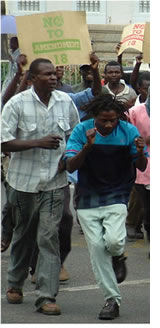
Dancing for freedomHundreds of activists with the National Constitutional Assembly jumped, danced, sang, ran and marched their way to a new constitution this afternoon. The group chanted as they made their way across Harare’s city centre to Parliament, where they were violently dispersed by heavily armed riot police. The demonstrators were protesting the Constitution of Zimbabwe Amendment Number 18 Act as well as the degenerating socio-economic situation of ordinary Zimbabweans. Read the NCA statement about the demonstration, and see more pictures of the event.

Forward planning on Zimbabwe’s black market

del.icio.us TRACK TOP
Posted on December 7th, 2007 by Amanda Atwood. Filed in Uncategorized.
Comments Off

It’s been a long time since I’ve had a successful shopping trip at the TM supermarket over the road from my office. For months I’ve been making periodic forays and coming back empty handed and depressed by the barren shelves. But I need some pets food. Unlike the butchery, TM has the marked advantage of taking my bank card. Which, given that the last time I successfully went to the bank and came away with cash was November 9th, is a bonus. And my work mates had told me confidently that pets food was now readily available in the shops. So over lunch, I ventured bravely forth.

And I was shocked to find the Christmas spirit had taken over at TM. This wasn’t so much in terms of decorations. But the fact that there was actually a thing or two on the shelf gave it a distinctly festive air. I was stunned to see things like floor polish and rolls just sitting on the shelves waiting to be bought – no queue no nothing. I picked up a 2kg bag of rice for $6 million, and a bar of rubbing soap for another $6 million, but the posh imported Thai curry pastes were selling for under a million. Go figure.

The queue was long and slow. Everyone’s feeling the pinch of the cash shortage, and is instead swiping their bank cards. I watched a few people try and scalp cash-paying customers from the queue – offering to take their cash and pay for the other person’s good on the bank card. But the tills using cash were so much shorter, they didn’t have a chance.

Five out of the six people in front of me in the queue were stocking up on ice cream – each was buying the maximum three tubs they were allowed. Stocking up for the holidays, maybe. I haven’t seen those ice cream freezers full in an age.

There’d been a run on fake Mazoe orange cordial, selling for $1 million for 2 litres. The man behind me in the queue had two bottles. A youngster came up to him and asked where in the shop he’d seen the cordial, and was told it was now finished. “But,” the man said as the kid walked away, “I can sell it to you on the black market outside – $5 million.” Maybe he gets points for being proactive. Surely you save a lot of wandering around if you can scout out your black market transaction clients whilst you’re still in the shop buying the good you’re about to mark up and sell on.

The downside – no milk and no biscuits. So it’s going to be another hungry black tea afternoon at the office. And there was no pets food. I’m hoping my cat doesn’t lock me out.

F-wording with us in Zimbabwe

del.icio.us TRACK TOP
Posted on December 3rd, 2007 by Natasha Msonza. Filed in Uncategorized.
2 comments filed

Last Friday I attended a post-budget (someone called it a post-mortem) meeting hosted by AMG Global at the Chapman golf club in Harare. Various stakeholders – largely private businessmen, finance directors and company MDs converged to discuss the economic implications of the budget presented by the Finance Minister, dubbed the ‘People’s Budget‘. Don’t worry about what I was doing there . . but just know I am no expert in Finance jargon and issues. Somehow, most of the budget implications escape me when they are presented first time around, till the Eric Blochs start interpreting the jargon later.

During breakfast a colleague couldn’t help but exclaim that he’d never come across a government that is so against the development of its people until he came to Zimbabwe – and this budget, with the unexplained financing of the $1,76 quadrillion deficit – was just a “way of the tomcats f-wording with us!” Frankly, it was my first time to hear the word quadrillion actually used in a sentence, let alone a national budget. A nun representing a local FBO had earlier stood up to comment on some of the government’s policies especially on import tax. That one cannot get donations of brand new things from abroad anymore, especially vehicles, or even shoes because the tax burden is so heavy you could almost ask the donor to first thoroughly use whatever they want to donate, so that it has a worn appearance when it passes through customs.

Dr Honest Zhou (UZ) who did the post-budget analysis stressed that the budget would be overtaken by inflation even before roll out and would really be lucky to survive the first six months. He also bemoaned the fact that the budget was ‘unfriendly’ as it based its hopes on the ‘rationalized’ anticipation of an unprecedented growth in agriculture and a bumper harvest.

One banker raised concerns that the budget deficit would probably be financed through just printing more money because there is no “shocking limit to what these guys are capable of doing.” With the PDL running at $23 million, the banker moaned the fact that the Finance Ministry are seemingly oblivious of other major drivers of inflation apart from declining industrial output and depreciating local currency. He suggested that “increased output calls for increased capacity utilization, and the country could do with a bit of fiscal discipline and cutting down on unnecessary government expenditure”. Speaking of which, does the president really need that long motorcade?

I was surprised to note that government also intends to place serious tax impositions on informal traders. But how do you identify who is an informal trader (and who isn’t) and tax them? I can see life slowly becoming more brutish for cross-border traders who will be easily identified in the tax net. Find a way of taxing the guys at Road Port and I will call you a genius, better yet, give you a standing ovation. Some people just wont stop ‘f- wording’ with us for sure.