Posted on June 4th, 2012 by Elizabeth Nyamuda. Filed in Uncategorized, Women's issues.
Comments Off
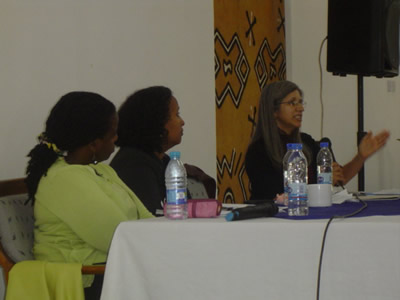
An open gender forum organized by UN Women last week, hosted Shamim Meer’s presentation on her research paper titled, ‘Struggles for Gender Equality: Reflections on the place of men and men’s organisation’. The presentation comes at a time where men are organizing themselves to support gender equality. Notably in Zimbabwe is Padare/Enkundleni and Varume Svinurayi/Vhukani Madoda. From the names these two organisations have chosen to use, it reflects much about their agenda in the women rights equality struggle. Shamim paper’s sought to really bring out the agendas of some of these men’s organisations in the struggle for gender equality and explore where men fit in women rights struggles.
Her major concern is that these formal structures being created by men give men a leading role in the struggle for gender equality of which that should not be the scenario – women should lead themselves. She gives a warning to say, “They are operating in a field where women are seen as subordinates and by making men key actors then you could be reinforcing the subordination.” Thus she argues for the separation of men from the women’s struggle. She also mentioned that the depoliticised understandings of gender as ‘men and women’ went further to strain donor relations with existing women’s organisations. As most women organisations are now being asked, ‘If you are working on gender, where are the men in your organisation?’
In her paper, Meers refers to this new idea of donors funding men as the ‘silver bullet’. In the paper she said, “Working with men from the donor’s point of view, could reduce costs to the health care system, and thus meet efficiency goals prioritized by development organisations. This seemed to be the new silver bullet, which would give ‘more bang for the buck!” To Meer the power that men have over women and the possibility that it may not be in men’s gender interests to transform gender relations or achieve greater equality were ignored. Thus clearly spelling out her debate.
It is from this background that she strongly puts out her belief that women need to take back the lead in the struggle. To support this statement she said, “… the oppressed in any system are best placed to lead their own struggle because they know the issues, their active leading challenges the notions on their lack of status and lack of ability.” Support for men in the struggle for gender equality is greatly appreciated but as Meer insisted it should not interfere with who gets to lead the struggle.
Posted on June 4th, 2012 by Lenard Kamwendo. Filed in Governance, Reflections, Uncategorized.
Comments Off
Africa Day is a celebration of African unity across Africa. On the 25th of May every year Africans celebrate Africa Day knowing that they are free from the bondage of colonization and apartheid. I remember reciting the poem “Founding Fathers of the OAU We Salute You” when I was still in primary school. It was a wonderful poem.
In 1999 African leaders made a Declaration for the formation of the African Union with the view to accelerating the process of integration in the continent, to enable it play its rightful role in the global economy while addressing multifaceted social, economic and political problems compounded as they are by certain negative aspects of globalization. The changing of the organization’s name did not change African problems as right now the African continent is riddled with conflicts, famine, human rights abuses and under-development. Recently North Africa was at the epicenter of conflicts and the masses took to the streets denouncing poor leadership. Lives were lost on the streets and the African Union failed to come up with concrete resolutions. The intervention of the North Atlantic Treaty Organisation (NATO) in Libya and Ivory Coast exposed the AU and left many people asking whether African problems should be solved with African remedies. The hard won independence by South Sudan was short lived as the battle for the vast oil reserves with Sudan rages on. Regional bodies like the Economic Community of West African States (ECOWAS) has proved to be much more effective than the AU in trying to solve political impasses that had erupted in the West Africa region
Southern Africa has not been spared either as evidenced by the continued human rights abuses by the member states. Governments of National Unity are now the order of the day in Africa as the rule of law and the will of the people no longer counts. Most governments continue to rely on donor funding for sustenance and food aid to avert hunger. The African Union’s new headquarters where the African leaders converged on the 25th of May was built using funds from the Chinese government. Africa has become the dumping of foreign products especially from our friends from the East. Sub-standard goods have flooded African markets resulting in the shutting down of local industries. Africa’s participation in the global village is facing challenges due to the fact that the continent continues to export unprocessed goods. Poor remuneration has resulted in massive brain drains across the continent. HIV and Aids has also taken its toll in Africa. Each year passes and more problems continue to affect Africa while the continental body loses its relevance.
Posted on June 4th, 2012 by Marko Phiri. Filed in Activism, Governance, Reflections, Uncategorized.
Comments Off
“Zanu PF Politburo member Professor Jonathan Moyo on Wednesday said Africa was facing a serious deficit of leaders with true African values,” reported the Chronicle of 1 June 2012. Moyo couldn’t have said it better, but then he is the type of fellow who does not listen to what he is saying! In the same story he extolled the (rabid) nationalism of South Africa’s Julius Malema, naming him along your regular pan-Africanists in the mould of Kenyatta, Nyerere, Kaunda and Nkrumah. I wondered what these men would have to say about that, but then dead men tell no tales. But it is agreed that Africa faces a serious leadership deficit and we certainly do not have to only look at the troubles that spurred the toppling of Mubarak who has just being given a life prison term for presiding over the unnecessary slaughter of his compatriots. In fact, we have Moyo’s very own Zanu PF where his party’s leader has said he is not ready to leave his post (despite the Wiki revelations from non other than Moyo, Muzembi and many others that the old man has no place in contemporary power games) because there simply isn’t a suitable candidate within the ranks to succeed him. Not even Moyo apparently! Yet by “slamming” the new crop of African leaders, Moyo betrays Zanu PF’s disregard for the popular vote as these new African leaders came to power not by jambaja but by what would be electoral processes anathema to Zanu PF. After all, one cynical political science don has commented that Moyo’s party is rejecting the draft constitution because it is too democratic for Zanu PF’s liking!
Did you ever notice that when a politician does get an idea he usually gets it all wrong. – Donald Robert Perry Arquis, American poet (1933)
Posted on June 4th, 2012 by Bev Clark. Filed in Inspiration, Media, Reflections, Uncategorized.
Comments Off
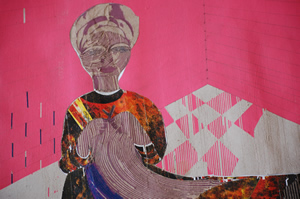
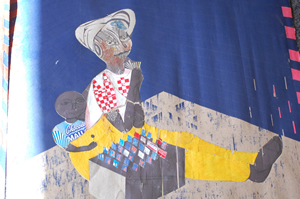
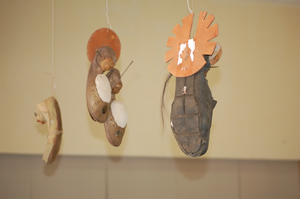
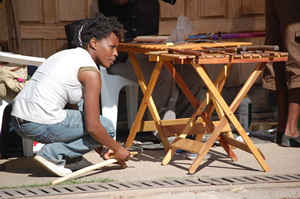
A little while ago we had the real pleasure of dropping in on the Open Studio Art Event in Athlone which featured artists like Misheck Masamvu, Gareth Nyandoro, Aubrey Bango, Masimba Hwati, Tafadzwa Gwetai and others. There was such a good vibe with artists working in situ, as well as great entertainment and of course … The Art was amazing. Let’s hope there will be more of these creative artistic gatherings in Harare.