Kubatana.net ~ an online community of Zimbabwean activists

Access to water is a national crisis in Zimbabwe

del.icio.us TRACK TOP
Posted on October 17th, 2012 by Bev Clark. Filed in Activism, Economy, Governance, Shortages and Inflation, Uncategorized.
Comments Off

Some excellent suggestions from Combined Harare Residents Association (CHRA):

1. The government of Zimbabwe should take the responsibility and acknowledge the incapacitation inspired by the underfunding of local authorities and declare the water issue as a national crisis. This will definitely bring on board international partners who will assist the government of Zimbabwe to mobilize funds for water infrastructure, rehabilitation and provision. The government of Zimbabwe released only 18 million for the rehabilitation of water pipes in Harare but the figures coming in from council shows us that the local authority is in need of more than USD 200 million to deal with water alone.

2. Collaboration with residents Associations in forming community water groups responsible for water conservation initiatives and education will go a long way in saving the water we have in its small quantities.

3. Construction and funding of the Kunzvi Dam water project (the Zambezi river water project for Matabeleland) will go a long way in easing pressure on the current water sources we have.

Poetry highlights injustices in Zimbabwe

del.icio.us TRACK TOP
Posted on October 17th, 2012 by Lenard Kamwendo. Filed in Activism, Economy, Governance, Inspiration, Media, Uncategorized.
Comments Off

An eight-track poetry album entitled All Protocols Observed was unpacked yesterday by Zimbabwe Poetry for Human Rights at a Food for Thought session hosted by US Embassy Public Affairs section.

Though you can dance to it the tracks on the album address some of the serious challenges affecting our country. From the accumulating dirty debt, to ravaging HIV/AIDS as well as politicians abusing their mandate to represent the people. The messages on the album are straight to the point as no one can dispute the fact that every problem in the country so far has been addressed with an “Operation” or a “Commission” of some sort as highlighted in track 5 of the album “Ma Opareshoni nema Komishoni”. Since Independence a lot commissions and operations have been set up to respond to something or other. From Operation Murambatsvina that demolished people’s houses because they were deemed illegal structures to Operation Zuva Rabuda/Sunrise, which resulted in the slashing of many zeroes on our local currency.

The album can be accessed from Zimbabwe Poetry for Human Rights free of charge and the group is encouraging people to share it so that it reaches a wide audience. Poetry is a powerful tool to provoke thought.

Many artists have been silenced in Zimbabwe for speaking out too loudly about the injustices faced by ordinary people. The work of Zimbabwe Poetry for Human Rights has not been easy as their recent performance in Kadoma was met with resistance when youths from ZANU-PF shut down the event and accused the group of spreading regime change messages.

Operation Murambatsvina documentary wins an award

del.icio.us TRACK TOP
Posted on October 17th, 2012 by Lenard Kamwendo. Filed in Economy, Governance, Inspiration, Media, Uncategorized.
Comments Off

Toindepi – Where are we headed? is a short sixteen minutes documentary directed by Tenford Chitanana. The film won the Documentary Short Film Award at the Silicon Valley African Film Festival held in California, USA. The documentary focuses on the day to day hardships faced by young people in Zimbabwe after Operation Murambatsvina left them homeless and jobless. The film is a reflection of the shattered dreams of many young people in Zimbabwe who are struggling to make their presence felt in a society where decision-making is done by the elite and powerful. Operation Murambatsvina took place in 2005 leaving many young people wallowing in poverty as their sources of income were destroyed resulting in many resorting to crime and prostitution for survival.

Consultancy: Agricultural Sector Gender / FAO

del.icio.us TRACK TOP
Posted on October 17th, 2012 by Bev Clark. Filed in Uncategorized.
Comments Off

Agricultural Sector Gender Assessment: Food and Agriculture Organization of the United Nations (FAO)
Deadline: 26 October 2012

Background and Rationale
Gender issues in agriculture are prominent in today’s development agenda where in most cases, the distribution of private and public resources has ignored or disadvantaged female farmers, and redressing this imbalance will improve the welfare of the whole household. Women have always played an important role in agriculture, undertaking a wide range of activities relating to accessing inputs, production of various products, storage, preservation and processing, marketing and distribution. There is currently limited information on the extent of involvement of women in the agriculture sector, more so the challenges they face. Women remain largely excluded from the decision-making machinery within the public and private spheres. In cases where they participate, they are relegated to work that is not valued and they end up confined to the traditional caring role in the family.

In this regard, FAO wishes to contract a consultant or team of consultants to undertake a study to further interrogate the gender dynamics in relation to the agriculture sector.

Purpose and Objectives of the evaluation
The purpose of this study is to analyze gender issues in the agriculture sector.  and to develop recommendations to address these. Specifically the Consultant/s will consider the following:
-Articulate the gender issues faced by women participating in various forms of agriculture
-Develop a resource mobilization strategy for women’s economic empowerment in the agricultural sector
-Suggest recommendations addressing gender disparities in the sector
-Review the institutional set up of the agricultural sector with regards to gender and
-Review relevant policies to address gender in the agricultural sector.

Scope of the evaluation

The Consultant will:
1. Describe in general terms the agricultural system(s) of the main agro-ecological zones or areas in Zimbabwe
2. Determine the major agricultural activities of men and women, with reference to agriculture including but not limited to fisheries, field crops, livestock, farm forestry, processing, marketing, storage and income generating activities
3. Identify constraints and barriers faced by men and women in carrying their activities;
4. Ascertain the extent to which current technology and agricultural research responds to the needs of men and women
5. Assess how current agricultural extension services meet the needs of men and women farmers, including the focus of extension for women as farm managers or partners
6. Identify the nature and extent of training needed by men and women agricultural extension agents (or other rural agents) to improve their support for farmers, especially women farmers
7. Prepare a descriptive and analytical report on the main findings, suggesting appropriate options and recommendations and
8. Review the institutional framework for addressing gender in the agricultural sector.

Approach and Methodology of the evaluation

The consultant/s are expected to come up with detailed methodology of how to carry out the gender assessment.

Deliverables and Schedule of activities

At the end of the evaluation exercise the consultant is expected to:
a) Submit a descriptive and analytic report of findings with appropriate options and recommendations
b) Present preliminary and final conclusions to the government, FAO and the UN Gender Theme Group, ACWG and other fora deemed relevant

Structure of the proposal and Submission guidelines
Interested consultants are supposed to show expression of interest through submission of proposal to FAO by 26th October 2012. The proposal should stipulate how the consultant is going to achieve the objectives of the evaluation consultancy, taking into consideration the scope of work to be done. The proposal should also stipulate the approach and methods of data collection and data analysis. A detailed budget and Curriculum Vitae stipulating the experiences and technical competences of the consultant.

Final Budget of the Evaluation
The final budget and timeline for carrying out the assessment is going to be disclosed to the successful consultant.

Applications clearly marked “Agriculture Sector Gender Assessment “ should be submitted to:

The HIV and Nutrition Unit
Food and Agriculture Organization of the United Nations
Block 1, Tendeseka Office Park
Cnr Henry Chapman / Samora Machel Avenue, Eastlea
P O Box 3730
Harare
Zimbabwe

Or send by email to: ZW-vacancy [at] fao [dot] org

No-one else to blame

del.icio.us TRACK TOP
Posted on October 16th, 2012 by Bev Clark. Filed in Reflections.
Comments Off

Character — the willingness to accept responsibility for one’s own life — is the source from which self-respect springs.
- Joan Didion

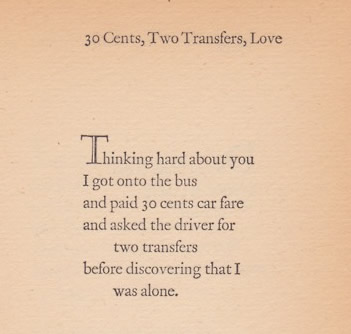
30 Cents, Two Transfers, Love

del.icio.us TRACK TOP
Posted on October 16th, 2012 by Bev Clark. Filed in Reflections, Uncategorized.
Comments Off

via browsery