All the devils



Kubatana.net ~ an online community of Zimbabwean activists
From razor wire to dummies for decoys, check out this amazing photo essay on how to pirate proof a tanker. Photographer Amnon Gutman shines.
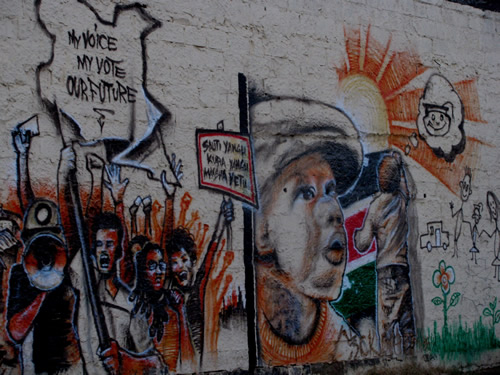
In our last Kubatana newsletter (subscribe by writing to info [at] kubatana [dot] net) we mentioned some very cool street art being done by activists in Nairobi. You can check out the article here. And then we got an email from Margret who shared some photographs of the Nairobi graffiti with us. So thanks to Margret for joining and contributing to the conversation. As she said in one of her emails to us, there are such endless examples of how consciousness is created through info activism.
Go on, make your mark.


Here is the latest paper published by the Research and Advocacy Unit, and prepared by Rumbidzai Dube:
Many a people have started questioning the practice of bride-price known as lobola or roora in Zimbabwe. Wide debates on whether the practice should be abolished or regulated are constantly taking place. Of course, the wider sentiment is that lobola is a part of Zimbabwean culture and doing away with it is tantamount to rejecting our cultural heritage. However, it is also clear that the custom which was meant to establish ties between two families through the marriage of their children has been commercialised, women’s value has been commodified, and the practice has become a source of discord within marriages.
Between January and February 2012, the Research and Advocacy Unit (RAU) had a series of focus group discussions with women from different parts of the country and amongst the variety of issues raised in those discussions was the question of lobola.
Many sentiments were raised, but the overarching idea coming out of the discussions was that the commercialisation of lobola is the problem with the practice, not the practice itself. The women asserted that amassing wealth has become more important than the traditional purpose of the practice, which was to establish ties between the two families (kusunga ukama).
The groups also cited that women (mothers) are part of the problem. Women were said to be pushing their husbands to charge more lobola as part of an ongoing competition by women on whose daughter had more money paid for her than the other. Lobola has become about prestige and not about the joining of two families together. Families are competing to show each other that their children are more valuable than their neighbours’ or relatives’ children.
Culturally, it was known that a son in law is there to assist the family, as expressed in the Shona proverb mukwasha muonde haaperi kudyiwa (literally translated to say, a son-in law is like a fig tree, you never run out of figs to harvest from it). ‘Modern’ generations have lost that appreciation. The women in the discussions pointed to the fact that today’s marriages are short-lived, hence the benefit that parents have from having a son-in law is brief. They tend to charge exorbitant amounts at once so that, if anything goes wrong with the child’s marriage in the future, they would not have lost out on anything.
Parents have turned their daughters into businesses. Whereas previously a woman who gave birth to daughters only and no sons was considered useless, these days, there seems to be a shift. Girls are now considered to be a source of wealth. This not only creates the problem of placing monetary value on human beings, but reinforces the discrimination against girls and women as these women are not valued for themselves but for the potential benefits that can be derived from their existence.
The prevalence of HIV/ AIDS has also become problematic to the whole lobola debate. The contributions from some of the women in the discussions explained that because the in-laws know that should their daughter fall ill, she will be returned to them for home-based care, they therefore charge enough lobola to take care of such cases. Indeed this is not only unfortunate, but borders on a depravity linked to societal degradation, and an erosion of positive cultural and moral values.As a result, sons-in-law have lost respect for their in-laws. They also have developed an attitude of disrespect for their wives, stemming from the expectation that since they paid so much money, then they ought to get value for their money. Women have no right to negotiate for sex, including safe sex. She is the husband’s cook, cleaner, launder, and keeper by virtue of the fact that he paid for those services. At the end of the day the wife suffers. The wife has no right to demand fidelity from her husband, and, should she be unfaithful, she is sent back to her family.
In a nutshell, gathering from the views of the women who participated in the focus groups, the practice of paying lobola seems to stifle women’s voices and bargaining power within marriage. It renders them subservient to their husbands and they cannot complain should they be treated because society expects them to endure in silence.
The question remains, how then should we mediate the lobola payments? The following are some of the suggestions that emanated from the focus group discussions:
- The cultural aspect of approaching one’s aunt tete or ambuya should be resuscitated so that she enquires how much the prospective son-in-law can afford to pay. This avenue has become ineffective because of greed and jealousy.
- Parents should ask their prospective sons-in-law how much they can afford to pay and charge them only for what they can afford.
- People should not put a price tag on marriage as this makes women some form of property or commodity.
- Parents should value their children’s lives and not the money they can make out of lobola.The debate goes on. But it remains relevant that we evaluate the role of lobola in women’s lives. Has it not become more of a harmful cultural practice than a constructive one? The Committee on the Elimination of All Forms of Discrimination Against Women (CEDAW Committee) in its concluding observations on Zimbabwe’s Review at the 51st session said it has. What do we as Zimbabwean women want to do about this issue?
On the 18th of April each year Zimbabwe celebrates its hard won independence from Britain. The liberation struggle which gave birth to a new nation in southern Africa was fought so that every Zimbabwean regardless of tribe, color and creed will enjoy all the freedoms enshrined in constitution. Independence Day in Zimbabwe is no ordinary day like what other people may see it. It is not a one party celebration as it maybe perceived by those from the opposition. We may differ on political opinions and support different political parties but lets put all that behind us and show unity when we celebrate our 32 years of independence. Even in America they have the Democrats and the Republicans but they have reserved 4th of July as day to celebrate their independence. The liberation struggle was fought so that every person can enjoy the freedom to support any political party of choice and to have the freedom to associate and express themselves. So on Independence Day be proud to fly the colors of our national flag high because those colors don’t belong to any party and sing the national anthem loud enough because its not a campaign jingle. Celebrate your independence Zimbabwe!


| Blog: |
| Kubatana.net |
Topics: |
| Zimbabwe, community, activists |
Kubatana Zimbabwe Blog is powered by WordPress 3.5 and Mesozoic theme by Lasse Havelund.
"http://afrigator.com/track/kubatana-none.gif" width="0" height="0"
alt="Afrigator" />