Kubatana.net ~ an online community of Zimbabwean activists

Archive for the 'Uncategorized' Category

Survey reveals cynicism about Zimbabwe’s political leaders

del.icio.us TRACK TOP
Thursday, August 23rd, 2012 by Bev Clark

Read research from Freedom House on the popularity of the MDC / Zanu PF and the electoral environment in Zimbabwe:

Susan Booysen, author of the interim report Change and ‘New’ Politics in Zimbabwe for Freedom House, said she encountered complaints that the MDC had lost touch with grassroots constituencies, whereas Zanu-PF was still visible and fighting party political battles there.

“I’ve heard people saying MDC is just not doing work in the constituencies and is spending too much time in the palace,” Booysen added. “They’re taking for granted they’re the crown princes. They are not capturing the desire for change. And there is still a desire for change among people.”

The whole report is here

Emerging HIV prevention strategies helping to reduce to new infections in Zimbabwe

del.icio.us TRACK TOP
Thursday, August 23rd, 2012 by Lenard Kamwendo

According to the Zimbabwe Demographic and Health Survey (ZDHS) 2010-11 conducted by the Zimbabwe National Statistics Agency in June 2011 knowledge of HIV prevention methods has increased. Knowledge on condom use and limiting sexual partners in women has increased from 65% in 2005 to 77 % in 2011. The same sample also shows an increase from 71% in 2005 to 79% for men in the 2010-11 ZDHS. In order to curtail the spread of HIV infection the government has been working with civil society and international partners in the implementation of HIV prevention interventions.

The Ministry of Health and Child Welfare recorded a significant decline in both prevalence and incidences of HIV from a high of over 29% in 1999 to 14.2% in 2010. This decline has been attributed to a number of factors such as increased promotion and uptake of HIV prevention, treatment and management services. Some of these services have been provided to the people through funds from international donors and the government’s AIDS levy. Recently the United States government, through the President’s Plan for AIDS Relief (PEPFAR) has approved an additional $39 million to fund HIV/AIDS programs in Zimbabwe.

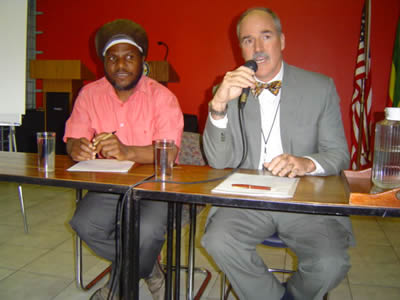
In order to share scientific and community perspectives on HIV prevention interventions, the US Embassy Public Affairs Section hosted Dr Peter Kilmarx, Director of the U.S. Centers for Disease Control and Prevention (CDC- Zim) and Chamunorwa Mashoko an HIV/AIDS activist.  The meeting was meant to share knowledge on the new and emerging HIV prevention strategies in Zimbabwe and how the community is responding to these interventions. Some of the emerging HIV prevention strategies discussed included male circumcision; PEP (post-exposure prophylaxis); PREP (pre-exposure prophylaxis) and provision of ante-retroviral therapy. However Dr Kilmarx noted that post-exposure prophylaxis is currently being used mainly for occupational incidents. Interesting figures in the use of female condom in Zimbabwe have put the country on the pole position in the world and an increase in the number of women who now access HIV testing through antenatal care has helped reduce new infections. Recently a study on a new intervention of over the counter/self testing was conducted in Malawi and the results proved to be successful though it is still subject to debate. Zimbabwe hopes to achieve coverage of 80% in male circumcision by 2015 despite the negative media reports the campaign has received so far.

During the discussion Chamunorwa reiterated that no intervention works in isolation and scaling up HIV testing is vital since it is an entry to accessing treatment. The community was also urged to share these new interventions through advocacy. Drawing experiences from his work in HIV prevention interventions, he also commended female participation in taking up the emerging HIV prevention strategies.

On the death of public figure

del.icio.us TRACK TOP
Thursday, August 23rd, 2012 by Bev Clark

Source Abiye Teklemariam:

“This happened because of an unhealthy conflation of appropriate post-death etiquette for private persons and the etiquette governing deaths of public figures. THEY ARE NOT AND SHOULD NOT BE THE SAME. We are all taught that it is impolite to speak ill of the dead, particularly in the immediate aftermath of someone’s death. For a private person, in a private setting, that makes perfect sense. Most human beings are complex and shaped by conflicting drives, defined by both good and bad acts. That’s more or less what it means to be human. And — when it comes to private individuals — it’s entirely appropriate to emphasize the positives of someone’s life and avoid criticisms upon their death: it comforts their grieving loved ones and honors their memory. In that context, there’s just no reason, no benefit, to highlight their flaws.

But that is completely inapplicable to the death of a public person, especially one who is political. When someone dies who is a public figure by virtue of their political acts discussions of them upon death will be inherently politicized. How they are remembered is not strictly a matter of the sensitivities of their loved ones, but has substantial impact on the culture which discusses their lives. To allow significant political figures to be heralded with purely one-sided requiems — enforced by misguided (even if well-intentioned) notions of private etiquette that bar discussions of their bad acts — is not a matter of politeness; it’s deceitful and propagandistic. To exploit the sentiments of sympathy produced by death to enshrine a political figure as Great and Noble is to sanction, or at best minimize, their sins. Misapplying private death etiquette to public figures creates false history and glorifies the ignoble.”

- Glenn Greenwald

The blame game

del.icio.us TRACK TOP
Thursday, August 23rd, 2012 by Bev Clark

Consultancy for gender equality program in Zimbabwe

del.icio.us TRACK TOP
Wednesday, August 22nd, 2012 by Bev Clark

Terms Of Reference For The Development Of A Program Framework, Women’s Rights & Gender Equality Program: Oxfam in Zimbabwe
Deadline: 31 August 2012 (Close of business)

Oxfam Canada invites Consultant/s to undertake the work detailed in the TOR below.

The proposal should outline:
1. The consultant/s experience on this theme and demonstrate their capacity to undertake this assignment
2. A very clear methodology that the consultant will use
3. The consultancy fees

Introduction
Oxfam in Zimbabwe has recently drafted a Joint Country Strategy (JCS), an Operating model, as well a Joint Country Analysis, (JCA). All of these documents are based on Oxfam’s analysis of the context, lessons from work carried out to date, and shifts to ways of working that will take place as part of the transition to a Single Management Structure (SMS).

Oxfam in Zimbabwe has identified the following vision and mission to guide all programs in the country:

Vision: Zimbabwean women, men and children are exercising their rights and accessing dignified sustainable livelihood opportunities within the context of a just, accountable and democratic political, legal and socio-economic environment.

Mission: To work with, and build the capacity of, Zimbabwean individuals, communities and Civil Society Organizations (CSOs) to claim their rights, increase their resilience, secure their livelihoods, and hold state and non-state actors accountable at all levels.

In order to fulfil this vision and mission, Oxfam in Zimbabwe has identified six country programs for the three-year period of January 2013 to December 2015. Among these is the Women’s Rights & Gender Equality Program, which aims to support women and their organizations to claim and exercise their rights, access leadership and decision-making positions at all levels, and work to eliminate all forms of gender-based violence.

The country programs are drawn from the JCA and the JCS and are based on a clear understanding of the opportunities presented by the social, economic and political context in the country.

Oxfam Canada as the lead affiliate on this program, seeks to engage a consultant to work with a broad range of stakeholders in designing a new program framework for Women’s Rights.

The purpose of the program framework
The framework will serve as the overall guide for Oxfam’s stand alone as well as the mainstreamed Women’s Rights program. The framework is the next step down from the broad Joint Country Strategy (JCS), and above a Program Operational Plan. In other words, the framework aims to spell out in more detail what is articulated in the JCS, while not being so too detailed as to be a day-to-day program operational plan. The framework will define the parameters of Oxfam’s Women’s Rights program in Zimbabwe, choice of partners/partnerships, areas of focus, and it will be used to mobilize resources.

Key components of the program framework
The following are the key components of the framework that the consultant must ensure are clearly spelt out:
a. The context analysis (adding to/amplifying what is already in the JCA)
b. The overall objective of the Women’s Rights Program
c. Specific objectives (building on what is in the JCS and Operating model)
d. A theory of change for the program
e. The strategies (ditto) – with some guidance on how strategic choices are/can be made; these should not be so straight jacketed as to preclude creativity, innovation and or changes to be made in the course of three years.
f. Some indications of the kinds of activities to be implemented (with and by partners,
but without getting into minute details). Since this is Oxfam’s framework it should be
broad enough to allow partners to choose their own activities.
g. The expected outcomes/results of the program
h. The geographic areas of focus (based on existing evidence of what the trends are in
Zimbabwe).
i. Typology of partners for the program
j. Ball park figures on the kinds of financial resources required for the program.
k. A risk analysis

Expected output
A program framework, not more than 15 pages long! Written in simple clear, non-jargon language with all the components listed above, and other areas deemed critical.

Time frame
The assignment will be for a maximum of 15 working days between September 4th 2012 and November 1st, 2012.

Methodology
Consultant to propose a participatory methodology and budget

The proposal should be submitted to: hildam.oxcanzim [at] gmail [dot] com

Specialised HIV pharmacies

del.icio.us TRACK TOP
Tuesday, August 21st, 2012 by Elizabeth Nyamuda

Walgreen a pharmacy in the US specialises in the provision of pharmaceutical services to people living with HIV. This has led to debate on the use of specialised HIV community pharmacies. A study conducted in the US shows that users of HIV-specialised Walgreen pharmacies proved significantly greater adherence to (the degree to which patients follow their prescribed drug regimen) and persistence with their therapeutic drug regimens (the time to treatment discontinuation). In these pharmacies the staff were specially trained to provide HIV services helping HIV infected individuals to be more compliant with their ARV drug.

Now taking this back to my country, statistics reveal that an estimated 1.3 million people are living with HIV in Zimbabwe making it one in every ten is HIV positive of the over 12 million estimated population. Zimbabwe whose prevalence rate is high in Africa, still has what I will call a ‘black corridor syndrome’ in regards to HIV and AIDS. In this black corridor syndrome I mean many people living with HIV keep their HIV status a secret and some even go to the extent of hiding it from their partners. In this black corridor people try to get their ART treatment in the darkest places possible without anyone finding out. They visit private doctors and some import their ART drugs not only because they can afford to, but also because they want to keep their HIV status unknown. People who suffer from this black corridor syndrome take their drugs behind a closed door or change containers that carry their drugs. All this is done to keep it as a secret as much as possible.

In such a society where people living with HIV shun disclosing their status, it means walking into a specialised HIV pharmacy will therefore not be an easy thing. Not that I am pre-judging already but if one is seen walking into such a pharmacy anyone who sees him or her will assume they are HIV positive. In the end it will mean that using services provided by HIV specialised pharmacies will be equivalent to disclosing your status. I believe in these pharmacies because through specialization they are able to meet the needs of people living with HIV hence increasing their patient outcomes. But at the same time I am concerned of certain factors. Won’t it be segregation towards HIV positive people and what of HIV negative users? It’s a battlefield of the mind already and would Zimbabweans embrace specialised HIV pharmacies?