Kubatana.net ~ an online community of Zimbabwean activists

Archive for the 'Governance' Category

Freebies for all

del.icio.us TRACK TOP
Tuesday, October 11th, 2011 by Natasha Msonza

Parallels can be drawn between the 1997 cash payouts to the war veterans and the recent disbursement of ‘youth development funds’ to the youth in Zimbabwe. The objectives of both programmes were to ‘economically empower’ ordinary citizens. While the war veteran payouts were just that, the YDF loans to the ‘youth’ are actually expected to be returned at some point. Under pressure from war veterans demanding payment for their role in the liberation struggle, President Robert Mugabe ordered unbudgeted payouts of 50,000 to each. The local dollar subsequently fell 71.5 percent against the greenback while the stock market crashed by 46 percent as investors rushed for the US dollar.

These unplanned payouts to war veterans went down the annals of history as the event that marked the beginning of the collapse of the country’s economy.

The ‘loans’ recently awarded to selected ‘youth’ in Zimbabwe may not accomplish glory of a similar magnitude, but what may follow can be anyone’s guess.

In the spirit of economically empowering the youth in Zimbabwe, the government – through the Ministry of Indigenisation and Empowerment – availed funds to be used in bettering the lives of youth through income generating projects. The funds are being managed through CBZ Bank, and insurance giant Old Mutual is part of a $10 million grant deal to the YDF. It is a big wonder what made the company agree to such an arrangement which stands to undermine its financial position. When companies like Old Mutual start to simply give away their net worth as gifts, we should get worried. But perhaps it is a clever way to escape the 51% remission guillotine.

In the YDF programme, there is no recovery plan, no obligation, and no collateral – just “young people who have benefited from the facility are encouraged to pay back the loans so that the funds can be extended to other eligible youth in revolving mode”. Are you kidding? So the 800+ lucky ‘youth’ whose names were published in recent press releases as beneficiaries are expected to create thriving businesses that will in the short term make profits from which the loans will then be paid back so that others can benefit.

There is no stipulated timeline by which the loans should be returned, so technically these are indefinite loans. There are just too many holes in this programme. As economist Erich Bloch would say it; the indigenization issue is being handled with a “total disregard for all economic fundamentals or principles.”

This could well be a grand scheme by some well placed individuals to throw away populist money and obtain a few kick-backs in the process. Can imagine obscure groups like Upfumi Kuvadiki getting such loans and actually being expected to pay them back, laugh out loud. We are assured that there are no ‘ghosts’ on the beneficiary list. Probably. I personally know someone whose name appeared on that list. To the best of my knowledge and without being judgmental, this person has plans to purchase a residential stand, possesses no entrepreneurial skills and actually got a consultant to develop his business plan that got him the loan. He wouldn’t say exactly how much he is going to get, but he invited me to ‘also apply and stop being jealous and missing out’.

The requirements are that you just fill in a form, submit a business plan, company registration document, identification documents and Bob’s your uncle, literally. You also need to prove that you are ‘legally constituted’ in a partnership; and if you are not, you are expected to ensure this happens within three months after receiving the loan (why bother then?).

Am I missing something here? Or perhaps I am just being jealous? Well, if you can’t beat em join em hey?

This is Zimbabwe.
UNESCO won’t honour Africa’s longest-serving dictator with namesake prize

del.icio.us TRACK TOP
Monday, October 10th, 2011 by Bev Clark

From IFEX:

UNESCO won’t honour Africa’s longest-serving dictator with namesake prize

UNESCO has once again announced it will not reinstate a life sciences prize funded by and named after Africa’s longest-serving dictator, President Teodoro Obiang Nguema Mbasogo of Equatorial Guinea, report Human Rights Watch and the Committee to Protect Journalists (CPJ).

The decision comes after passionate lobbying by IFEX members and other international and African rights groups. On 27 September, IFEX and 10 members and partners sent a letter to UNESCO director general Irina Bokova, urging her not to reinstate the UNESCO-Obiang prize given the “well-documented record of human rights abuse, repression of press freedom, and official corruption that have marked his rule.”

On 3 October, prominent authors, scientists and other public figures, including Archbishop Emeritus Desmond Tutu and renowned Nigerian author Chinua Achebe, also sent UNESCO a letter decrying the prize and pointing out that it is likely funded by corruption, given criminal investigations in France and Spain into the source of the Obiang family’s mass wealth, including luxury cars.

Due to international outcry, the prize has never been awarded since its launch three years ago, despite yearly efforts by Obiang and other African diplomats to have it reinstated. UNESCO has not yet taken the step rights groups would like to see, however, which is the final cancellation of the award.

As Tutu Alicante, executive director of the non-governmental group EG Justice, argues, “The UNESCO Board needs to end this debate once and for all by rejecting this prize outright. UNESCO delegates should not let themselves be bullied into backing a public relations campaign by President Obiang.”

Human rights in Zimbabwe

del.icio.us TRACK TOP
Friday, October 7th, 2011 by Elizabeth Nyamuda

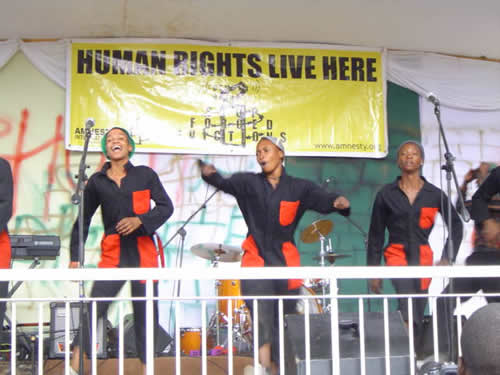
Every year, the first Monday of October is set aside to commemorate Habitat Day. On this day reflections are made on the state of our towns and cities, basic rights for all, and access to adequate shelter. For Amnesty International, World Habitat Day is a global day to take action to end forced evictions and other human rights violations suffered daily by people living in slums and informal settlements. In commemoration of this years’ World Habitat Day, Amnesty International Zimbabwe remembered the survivors of Operation Murambatsvina with the theme “End Forced Evictions’. Many families were displaced and left homeless when the government of Zimbabwe initiated its unpopular and inhuman Operation Murambatsvina. Operation Garikai/Hlalani Kuhle then followed to resettle these families but, however, today years later no proper essential facilities and services have been provided for these families such as sanitation, education, housing and health.

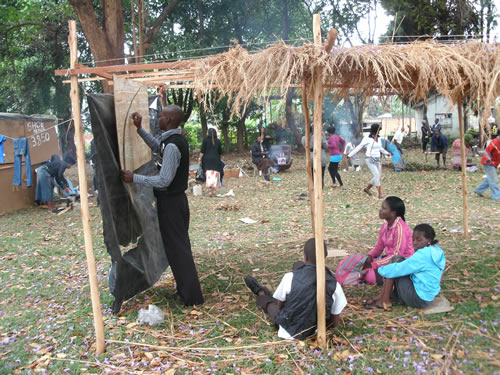
A drama group from Hopley and Hatclife settlements where many of the families affected by Operation Murambatsvina are settled took time to remind Zimbabwe of how they are living. They had their own exhibition of their plastics shacks at the Harare Gardens. Some operate hair saloons, or bars and some sell firewood, or vegetables. The shacks take various shapes and forms but they all exhibit the plight of how our government has failed its people in so many ways. In these informal settlements education is a privilege whereas it should be a right for all children. In these settlements safe drinking water does not exist, as their water sources are unprotected wells. ‘The walls have ears’, is a saying you wont be caught saying in these settlements because their housing is little more than thin plastic.

Therefore Amnesty International of Zimbabwe in remembering the survivors of Operation Murambatsvina is calling on the government of Zimbabwe to:
End all forced evictions
Adopt guidelines based on the UN Basic Principles and Guidelines on Development Based Evictions and Displacement
Provide free primary education for children living under Operation Garikai/Hlalani Kuhle

The impact of Zimbabwe’s mass evictions on the right to education

del.icio.us TRACK TOP
Wednesday, October 5th, 2011 by Upenyu Makoni-Muchemwa

Amnesty International Zimbabwe today held a press conference launching a report titled Left Behind: The impact of Zimbabwe’s mass forced evictions on the right to education. The report is based on research assessing the level of access to education at Hatcliffe Extension and Hopely, two settlements created by the government under Operation Garikai, which Amnesty International Zimbabwe has been monitoring since 2005.

Under Operation Garikai, the government provided a small proportion of the 700 000 victims of forced evictions either with houses that were not fully constructed or with un-serviced plots of land, on which those who were resettled were permitted to build houses without receiving any further government assistance. Both Hopely and Hatcliffe extension did not have access to government amenities such as health, education, water or electricity. The majority of households were allocated plots by the government were unable to build decent shelter, and were living in plastic shacks or other poorly constructed structures.

The data presented, was collected between December 2010 and August 2011. Interviews were conducted with 83 individuals, including children, young people, parents and guardians of children affected by Operation Murambatsvina and living in the settlements. Teachers and volunteers at community schools, NGO workers, members of teacher’s trade unions and representatives of UN agencies were also interviewed. The report estimates that at Hopely there are about 2000 children attending makeshift schools constructed and staffed by community members.  While UN Special Envoy on Human Settlement Issues Anna Tibaijuka’s report estimates that Operation Murambatsvina estimates that Operation Murabatsvina disrupted the primary and secondary education of 222 000 children, Mwanza noted that a comprehensive study of how many children had lost access to education in Zimbabwe was yet to be done.

Speaking at the launch, Amnesty International Zimbabwe, researcher Simeon Mwanza said that Operation Garikai had been retrogressive to the right to Education. He added that the biggest issue faced by communities at Hatcliffe Extension and Hopely was that government had not made any deliberate investments into restoring livelihoods. The resultant food and financial insecurity made accessing education less of a priority. The long-term impact of this was that a significant proportion of Zimbabwean children, in particular those at Hopely and Hatcliffe, were condemned to a makeshift education. Mwanza stated that the people living in Operation Garikai settlements were excluded from government programmes and services, and Non-governmental organisations were struggling to provide for them. Communities in both settlements had made attempts to meet the need to educate their children by building makeshift schools. However, these had gone unregistered and were thus excluded from government support schemes such as the education transition fund and the per capita tuition grant. In instances where communities had attempted to register schools, they were met with resistance from government officials.

The report concludes:

Violations of economic, social and cultural rights for people living in Operation Garikai settlements, including violation so the right to education, have gone largely unnoticed mainly due to lack of a government mechanism to monitor the situation in these settlements and devise strategies to address human rights violations resulting from Operation Murambatsvina. The government has done little to genuinely consult with the affected communities in order to formulate interventions that address problems experienced by the victims. There is a huge gap between the reality as lived by the affected communities and the stated government policies to address the situation.

The people need meetings, not rallies

del.icio.us TRACK TOP
Wednesday, October 5th, 2011 by Mgcini Nyoni

I attended a National Youth Development Trust (NYDT) organized Youth Peace Convention on the 29th and 30th of September at the Zimbabwe Academy of Music, Bulawayo at which the only visible minister of the very toothless and useless organ on ‘National Healing’ spoke. But that’s not what I want to talk about.

On the second day we had representatives from ZAPU, MDC, MDC Tsvangirai and ZANU PF. The ZAPU and MDC guys were eloquent, but I have forgotten what they talked about; which means it was useless. The MDC Tsvangirai guy made a total fool of himself: He kept saying ‘the smaller MDC’ and referred to ZANU PF as the opposition party; implying that his party was the ruling party. Really? We must be the only country in the world where the ‘ruling party’ does not actually rule. I sat there getting very confused; if MDC Tsvangirai is the ruling party, why don’t they control the army and the police and everything else actually. He rudely dismissed the MDC and ZAPU and said their agenda as a party was ZANU PF, not the insignificant small parties. And I thought their agenda like all of us was Zimbabwe!

When it was the turn of the ZANU PF guy, Fundisani Dewa (youth secretary for economic affairs) to speak, he spoke eloquently about how he had spend the last two weeks in a ZANU PF prison. I happen to have remembered this guy’s name because I have known him for years and I didn’t know he was ZANU PF: But I should have suspected that his success was not hard-earned. I guess by mentioning that he was in prison, he was angling for our sympathy. He conveniently forgot that his arrest was totally different to the arrest we always cry about. Him and other youths have been taking over buildings in Bulawayo and that’s surely illegal and he deserved to be arrested. I guess he is bitter because ZANU PF does not arrest its own over something as ‘commendable’ as taking over white men’s property: Fundisani and others must be victims of the infighting that has rocked ZANU PF of late.

The question that we were left asking was that if ZANU PF can do that to its own, what’s in store for those who belong to the opposition parties. When the question of Gukurahundi was raised, he said we should let bygones be bygones. He hastened to add that he had been born in Khami prison during Gukurahundi and that he didn’t know his father. I guess his reasoning for being part of ZANU PF is that it can make him rich. Does it make sense? I am a victim of Gukurahundi myself and what I would want is Affirmative Action; we need to catch up to our Shona brothers who have had an undisturbed path to success. Fundisani is taking his Affirmative Action now and who are we to judge him.

I left the convention wondering if the people knew what their parties were all about and felt it was of urgent necessity to organize meetings between parties and the people. Not rallies, but meetings were people can engage their ‘leaders’ and bring them to account.

Jenni Williams and Magodonga Mahlangu of WOZA granted bail at last

del.icio.us TRACK TOP
Tuesday, October 4th, 2011 by Amanda Atwood

This morning, in a long-awaited bail hearing Justice Maphios Cheda of the Bulawayo High Court granted Jenni Williams and Magondonga Mahlangu of Women of Zimbabwe Arise (WOZA) bail on a surety of $200 each, after 13 nights in custody.  The only condition is that they not interfere with any state witnesses.  They have not been asked to surrender travel documents or even to report to the police.  They will appear for remand on Thursday, October 6.

It is clear from this ruling that the judge did not take the case against them very seriously, and we wonder why it took so long for a bail hearing date to be set down.  Was the state attempting simply to punish the two by arresting and holding them on flimsy charges, knowing that in fact they have committed no crime?  If so, it would not be the first time this has happened.  WOZA is dismayed that under the Government of National Unity such a perversion of justice continues, with elements of the Zimbabwe Republic Police and the justice system allowed to operate untrammelled without the slightest concern for the basic principles of law and human rights.  We hope that there will be no further delays and they will be released promptly, as is their right.

WOZA would like to thank all those supporters who showed solidarity with Williams and Mahlangu through the past two weeks. Together we can promote a more democratic society in which rights are respected and social justice prevails.