End Impunity


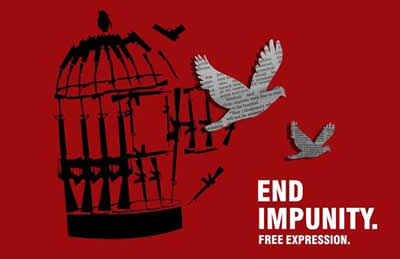
The first-prize winner of this year’s International Day to End Impunity poster contest, Jamie Javier from the Philippines.
Kubatana.net ~ an online community of Zimbabwean activists
The first-prize winner of this year’s International Day to End Impunity poster contest, Jamie Javier from the Philippines.
All manner of artists gathered in commemorating International Day of Tolerance (16th of November) at the Zimbabwe-United States of America Alumni Association facilitated discussion, under the theme: Promoting Tolerance through the arts, chaired by human rights activist and poet, Michael Mabwe. The aim of the talk was to interrogate the role that the arts can play in the promotion of tolerance, at whatever level and discuss how artists can better engage with the current reality in Zimbabwe as they try to promote tolerance.
Speakers included Mbizvo Chirasha – performing poet, writer and founder of Girl Child Creativity, Blessing Hungwe – author, producer, co-director, actor in the production Burn Mukwerekwere, Burn; a play based on the 2008 xenophobic violence in South Africa; and Tafadzwa Muzondo – theatre director, actor, taking arts to the grassroots through the Edzainesu Community Project.
Chirasha traced the history of intolerance in Zimbabwe, giving a few examples of tribalism, colonialism, independence struggle, the various women’s rights struggles, various student rebellions, the emergence of multiparty political system and consequent violence of 2007 elections and the 2008 xenophobic attacks in S.A. Hungwe said that the arts can be an invaluable tool in addressing intolerance by provoking thought, tackling divisive issues, breaking down barriers, bridging gaps, opening people’s minds and encouraging people to take a step back and investigate the prejudices and intolerance they hold at an individual level.
Since late October this year, 211 cases of typhoid have been reported in Harare. Reported cases of typhoid within Harare have opened a Pandora’s Box.
Though no deaths have been recorded so far, questions have been asked as to how a primitive disease such as typhoid can cause havoc in a country that has proper infrastructure in place for the supply of clean water.
Bigger questions are centred on how a country that has attained so much progress in health continues to experience typhoid cases.
Last year, Harare’s Mabvuku suburb was hit by a typhoid outbreak and hundreds of residents feared for their lives as the disease spread like a veld fire across the suburbs.
Then Harare City Council authorities claimed that they had contained the outbreak. Now a year later, the disease has resurfaced in Dzivarasekwa suburbs, making it clear that that only a temporary solution had been found.
More than 200 cases of the disease have so far been reported.
The underlying factor behind the outbreak of typhoid is the shortage of water.
Mabvuku is one place where residents struggle to get access to clean water. The residents have dug wells while boreholes have been sunk as alternative sources of clean water.
While for years Harare residents had thought that water problems are for those living in Eastern suburbs, which are furthest from Motorn Jeffrey Waterworks, the problems have come close next door. Suburbs such as Dzivarasekwa, Budiriro, Highfield, Glen Norah and Glen View also have serious water problems. Pessimists say the situation will become even worse while prophets of doom say the whole capital will end up being supplied by boreholes and wells.
But the million-dollar question is, has Harare really come to such a stage whereby residents have to accept that the city fathers cannot provide water?
Harare Residents’ Trust Coordinator, Mr Precious Shumba sees the typhoid outbreak as a sign of a gloomy future unless drastic measures are urgently taken.
For local government expert, Mr Percy Toriro, the typhoid outbreak in Harare is a clear sign of a failed system.
For years, the Harare City Council has been talking about alternative water sources but no action has really taken place on the ground. The peg that was planted at the proposed site of Kunzvi Dam ages ago has now gathered rust and has probably disappeared by now. Kunzvi Dam is a long-term solution.
Yet, the painful fact about Harare is that the council is simply failing to harness water from dams, purify it and supply residents who pay exorbitant charges every month.
While we huff and puff trying to find solutions, it is sad to realise that the capital’s authorities are clueless. The authorities have no solution to the capital’s water woes and are not treating the matter with the urgency it deserves.
For the ordinary person in Mabvuku, who has not accessed tap water for years, the question is: Can such a council continue to be entrusted with such a vital service delivery? Does the council still have a right to collect water rates? Or is it a matter of wrong people being given such an important mandate?
I remember the days when water in the taps sometimes used to come out cloudy and with a strong smell of the purification chemicals the City Council would use on the water. When this would happen some of us would complain that they were using too many of these purification chemicals and that they made the water taste ‘funny’. Indeed, others amongst us even wondered if these chemicals might be poisonous or harmful to our health. Ah, the good old days!
The water that comes out of our taps today is now harmful, and with its signature tinge of yellow-brown, is now a far cry from the cloudy, overly clean waters of old.
Many of Harare’s resident’s don’t even get to see this dirty water gushing out of their taps, as they no longer get City Council water. As a result, many are using and reusing dirty water from anywhere and everywhere. The water in Harare is no longer safe. In its latest assault on the City of Harare, the deadly water has hospitalised 211 (and counting) people. With the memory of the cholera outbreak of 2008 still fresh in our minds, I am perplexed that the council is doing absolutely nothing, when they know only too well how bad the situation can become.
From Pambazuka, an article on one of my favourite artists, Kudzanai Chiurai:
State of the nation, according to Kudzania Chiurai
Born in 1981 in Zimbabwe, Kudzanai Chiurai is an internationally acclaimed artist now living and working in Johannesburg, South Africa. He was the first black student to graduate with a BA in Fine Art from the University of Pretoria. Highly regarded as a leading voice of his generation, Kudzi has made a name for himself as a thought provoking artist who uses his art to highlight the many fallacies of our continent with specific focus on African leaders and culture. Chiurai’s early work focused on the political, economic and social strife in his homeland and has since evolved to reflect a continental dialogue that puts the state and its people at the centre of progress or the lack thereof. Seminal works like ‘Presidential Wallpaper’ depicted Zimbabwean president Robert Mugabe as a sell-out and this led to Chiurai’s exile from Zimbabwe.
Armed with a paint brush and a strong desire for change Kudzi has become somewhat of a legend in the niche world of pan-African urban culture. For someone who has achieved so much in a short space of time with bodies of artwork that speak loudly, his humility, sensitivity and introverted personality are humbling, making for an interesting harmonious contrast between the artist and his work.
His latest presentation titled ‘State of the Nation’ is intended to explore aspects of a constructed African state that bears scars of political and cultural discourses. On a continent that has experienced more violent conflicts than any other, this exhibition follows an individual’s narration of events that lead up to the inaugural speech by the first democratically elected president. The conflict that exists between cultural vistas and postmodern political narratives is evident in Chiurai’s work. Themes range from rituals, genocide memories of Rwanda and the all too familiar propaganda machine of the state to win hearts and minds of the nation. The vivid and curated portrayal of political scenes and the fear it imposes on the general populace is both profound and sad. The political truth of our continent is captured in every line and colour and together the state of all our nations is laid bare.
Melissa Mboweni curated the exhibition in partnership with the Goethe Institute and collaborations with photographer Jurie Potgieter, singers Thandiswa Mazwai and Zaki Ibrahim as well as clever use of technology brought this body of work to life. Chiurai references child and woman soldiers, African liberation movements and civil wars. He tracks the similarities between societal, political and ideological doctrines of nations in tumultuous times of transition with the often-ignored impact these cacophonous changes have on citizens. The juxtaposing of public and private were highlighted in performances that took place in the streets of Newtown and in the exhibition space that fostered private conversations about the state of our own nation as well as the artist’s work. A sound and technology installation scores the gallery experience. The influence of hip-hop in Kudzi’s own life is evident in his installations.
In a style similar to previous bodies of work such as ‘Dying to be Men’ series and ‘Black President’, Chiurai’s constructed environments are enticing, seductive and explore real casualties of African independence and critically examine the role of state public servants in advancing democracy. This ‘State of the Nation’ exhibition is a timely theme that comes at a time when the continent is grappling with its democratic identity and the role of the state in bringing real freedom and justice to its people.
As an art lover and a follower of Kudzi’s work, I’m hoping his social themes will evolve to depict some of the goodness on our continent and the power of the individual in bringing about change in their own community regardless of the state. Kudzi has the ability, passion and drive to start painting imageries of Africa that shows progress and a people with an undying spirit for survival and entrepreneurship.
- Charles Nhamo Rupare
* Charles Nhamo Rupare is of Shona origin and lives life through the creative eye and dreams of Afrika regaining her dignity and her sons and daughters developing the necessary mental freedom to love peace and communal co-existence. He is an award-winning Afrikan-centred brand specialist, percussionist, writer and a Pan-Afrikan thinker. He is chief editor of www.kush.co.za, a co-founder of Kush Kollective and a Partner of TEDx Soweto.
Youth leader found guilty of sowing divisions and bringing the party into disrepute by disciplinary committee.
So says the headlines. But, why did they do it?
He certainly was divisive, and disreputable.
But, the ANC are a political party, so there are no principles involved. Only power issues.
Are they, the party, scared? They seem to be having trouble at the polls. Toilets, and inability to deliver reform and development. Promises not fulfilled.
Are they scared of a new DA, with a black (it has had a woman before) as it’s head? It takes all the coloured vote (which is significant, as opposed to the white vote), and keeps taking the Cape Provinces.
Do they feel race (and he is a racist) is something they need to keep swept under the carpet? Is the race card something they cannot afford to play anymore? Do they feel they have to actually put together a policy that is logical, and practical, and real? Do they feel they have to keep the radicals to the fringe, as a thing of influence, a tendency, but not mainline policy? They have been a party for 99 years, so they are far more mature than most ‘revolutionary’ parties, and now they take into account the historical fact that revolutionaries do not make good administrators. Are they showing themselves to be a ‘party’ in the classical sense – the role of a political party is interest articulation and aggregation, and they acknowledge that Malema does not aggregate enough interest for the party to articulate?
And why is he, a ‘youth’ leader at the age of 30? Surely he is mature enough (even if he is still writing university exams).
The African National Congress under the leadership of President Zuma today stamped its authority by suspending the ANC Youth League executive.
Julius Malema the most controversial African National Congress Youth League leader has been suspended from the party for five years for provoking divisions within the ruling party and bringing the organisation into disrepute.
Malema popularly know for his reckless statements especially with the one he made in the media advocating for regime change in Botswana had his other executive members also receiving suspensions. Julius and his team recently led marches in Johannesburg, South Africa under the disguise of economic freedom for the poor yet he is living a lavish lifestyle. Just after leading the economic freedom marches Malema flew to Mauritius to attend a friend’s wedding leaving his supporters wondering whether the marches were for a real cause or just a way of diverting attention from hearings which were on going during that time.
Malema’s political career has been marred with allegations of corruption involving the awarding of tenders worth millions of rands.
The suspension of the ANC Youth League executive should be an example to other political parties in the region on how to discipline unruly party members.


| Blog: |
| Kubatana.net |
Topics: |
| Zimbabwe, community, activists |
Kubatana Zimbabwe Blog is powered by WordPress 3.5 and Mesozoic theme by Lasse Havelund.
"http://afrigator.com/track/kubatana-none.gif" width="0" height="0"
alt="Afrigator" />